






UK banks have nearly tripled investors’ money since 2022 but, with another hike expected next month and the Budget on the horizon, the strong run could encounter obstacles, according to investment trust managers speaking at the 2026 AIC Investment Showcase.
Interest rates have been the main engine behind banks’ strong run. When interest rates were near zero, banks struggled to profit because they couldn’t charge customers for holding deposits, which meant all their earnings had to come from lending.
The structural re-rating of UK banks kicked in when the Bank of England started hiking interest rates in early 2022, dramatically improving net interest margins and profitability.
Anthony Lynch, co-manager of JPMorgan Claverhouse Investment Trust, said: “As interest rates have increased, UK banks have been able to make much more of a spread between what they pay on deposits and what they earn on the loans they are making.
“That has meant we have seen earnings growth come through very rapidly in this part of the market.”
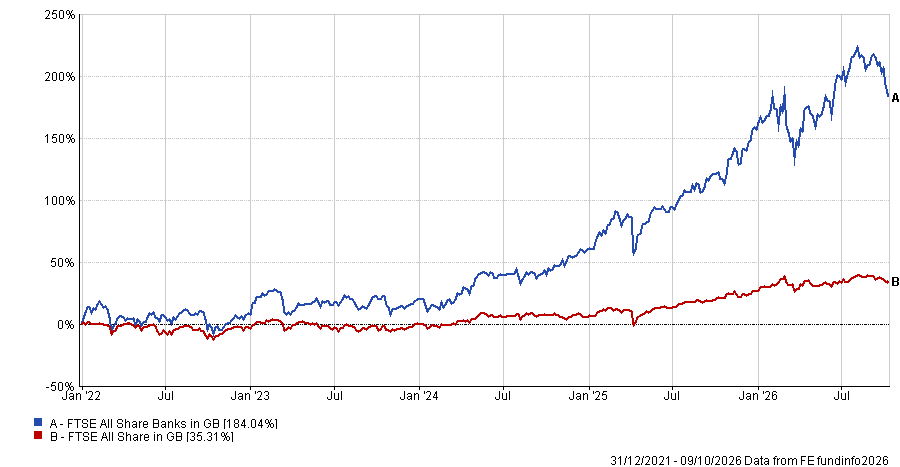
As shown in the graph below, the FTSE All Share Banks index has returned 184% versus 35.3% for the FTSE All Share since 2022.
Performance of FTSE All Share Banks vs FTSE All Share since 2022
Source: FE Analytics
Job Curtis, lead manager of the City of London Investment Trust, said his portfolio was underweight banks ever since the financial crisis in 2008 but that this position changed three years ago when the team identified that UK banks were set to benefit significantly as their fixed low-rate hedges matured and rolled over at much higher rates.
“That has been a very successful move over the past three years, as banks have improved their profits and share prices,” he said.
“In the aftermath of the financial crisis, it was all about making the banks safe again – but now politicians are more concerned about economic growth – and you don’t get that without banks lending, so the environment has improved for them.”
Currently, financials are the biggest sector weighting in the portfolio at 36% – an around six percentage-point overweight to the FTSE All Share.
There are three banks in the top 10 holdings of the City of London Investment Trust: HSBC, Lloyds and NatWest. While the former derives most of its profits in Asia, Curtis noted that Lloyds and NatWest remain very UK-focused.
One distinctive feature of UK banks that Lynch said could extend this earnings growth is their ability to hedge the interest rates they are earning.
“That means they only get the full benefit of rates going up as time progresses, so we can see how the net interest income of UK banks can continue growing for a number of years into the future,” he said.
For portfolio holding NatWest specifically, Lynch said this means its 5% dividend yield is “probably going to grow at double digits for the next three years or so”.
However, the strong performance of UK banks could start to turn should interest rates move too high, Lynch warned, as the risks start to outweigh the benefits.
This is because borrowers are more likely to default as the cost of servicing their debts rises. So while moderate rate rises boost bank profits through wider margins, rates that are too high for too long can start to generate bad debts that then erode those same profits, Lynch explained.
Despite the expected upward trajectory of inflation, the Bank of England maintained interest rates at 3.75% in September. However, it is widely believed the central bank is primed to begin raising rates at its next meeting in November.
“We tend to think the sweet spot for interest rates for banks is somewhere between 2% and four-and-a-bit per cent,” Lynch said.
“We are pushing the top end at the moment, so we are starting to get into the territory where we need to worry a little more about banks with slightly more aggressive books, which are more dependent on wholesale finance and where there is more risk of bad debts.”
Lynch said he views NatWest as more resilient due to its very large mortgage book.
“When considering the other forms of debt a person might take out – credit cards, an auto loan or a mortgage – then the one someone will stop paying last is the mortgage,” he said.
“Bad debts, even in a much trickier economic environment, tend to be better in the mortgage book than in other books.”
Lynch also believes that the “danger zone” around rates has passed, with much of the population having now re-mortgaged from their lower rates of below 2% to over 4%.
“A further jump from around 4% to over 5% is probably not going to be as dangerous a period for bad debts as it otherwise could have been,” he said.
Despite his conviction in continued UK bank earnings growth, Lynch has made changes to his portfolio, exiting positions in banks he believes are more at risk of faltering in a higher rate environment – this includes those in the small- to mid-cap space, such as OSB and Paragon.
“They offer very nice yields, but because they are slightly more reliant on wholesale funding we think they might have to pay up more for deposits and therefore have less net interest income,” he said.
The sustained outperformance of the UK banking sector presents an attractive capital source for the UK government as chancellor of the exchequer John Healey searches for ways to plug the fiscal gap without raising income tax, VAT or employee National Insurance in the Budget on 28 October.
There is widespread speculation that Healey could attempt to raise taxes on UK banks, either by increasing the existing 3% banking surcharge on profits above £100m, or by introducing a windfall tax on the sector’s bumper earnings.
However, Curtis noted that “UK banks already pay a very high rate of tax”.
“And the difficulty the chancellor has is that it is very difficult to distinguish between UK banks and UK branches of overseas banks like JPMorgan and Goldman Sachs – and they have made it clear that they will move their assets and people out of the UK if they get taxed too much,” he said, warning that Healey “has got to be careful”.