


Alternatives could stage a comeback as experts worry about the correlation of equities and bonds. But while commodities, cash and private markets have all been in the headlines in recent years, one area that could be overlooked is activism.
In the investment trust world, there are companies that buy into other investment trusts whose shares trade below the value of their assets, pushing the boards to sell assets or hand cash back to shareholders.
These trusts can earn a place in portfolios, according to Benjamin Newton, investment manager at Credo, as a way to “harvest the discount anomaly” in the investment trust sector.
“Returns come mainly from discounts narrowing and from events such as asset sales, mergers, tender offers or wind-downs, rather than from market direction,” Newton said. “That gives them diversifying, partly idiosyncratic, return drivers”.
The case to invest is strongest when discounts are wide and boards are under pressure to act, which he described as broadly today’s environment. Alternatives – particularly property, infrastructure and renewables – “continue to trade well below the value at which their assets could be sold”, he continued.
The pool of wide discounts has shrunk, though. Across the whole Association of Investment Companies (AIC) universe, the average discount has roughly halved from almost 20% in late 2023 to around 10% at the end of August, according to analysis by Kepler, with the discount of equity-focused trusts back in single-digit territory.
Josef Licsauer, research analyst at Kepler, said boards played their part: “Boards have become far more active: buying back shares, offering tenders, merging for scale, cutting fees and rethinking dividend policies, often with no activist on the register at all.”
Some of that action, however, was prompted, at least in part, by activist pressure, Licsauer said, and much of the recent activist attention has had to move to the segments of private equity and alternatives trade where discounts are still at 20% or more.
But for Thomas McMahon, head of investment companies research at Kepler, the return of activist trusts still depends on the market more than one might think. High interest rates, for example, dampened demand across many trust sectors from 2022, particularly alternatives, and share prices were weak as a result.
So should investors bother with the asset class?
What an end investor gets from an activist approach depends on which one they pick and the method employed to extract gains. AVI, where Tom Treanor is head of research, works through private dialogue and practical proposals first and uses public pressure only where needed, Licsauer said.
Meanwhile, Saba Capital, the New York hedge fund, has a more aggressive, requisition-based approach that aims to expel old management and gain control of the assets: this year, it secured control of Edinburgh Worldwide Investment Trust and Impax Environmental Markets.
Other strategies include MIGO Opportunities (MIGO), co-managed by Treanor, and Achilles Trust, run by Robert Naylor and his team at Harwood. The former engages with boards quietly across the whole investment trust sector, while Achilles concentrates on trusts that own alternative assets and takes a harder line.
MIGO is a diversified ‘discount opportunities’ fund, Newton explained, that could sit as a core holding for an investor who does not already run this kind of strategy; Achilles is a special-situations satellite; it has a handful of positions where the outcome depends on campaigns succeeding and on a cash exit being delivered.
For investors considering how much and which to hold, Newton said Achilles “suits a small, complementary allocation alongside a broader portfolio”. Credo itself holds a small position in Achilles, preferring it over MIGO because Credo already buys trusts on discounts where it sees a catalyst, a specific event that could close the gap, so MIGO is likely to overlap with its existing portfolio.
MIGO’s record under its current approach is also short. Co-managers Charlotte Cuthbertson and Treanor began concentrating the portfolio on alternatives in June 2025. Its net asset value (NAV) rose 19.4% in the 12 months to 5 May 2026, which McMahon said reflected a buoyant equity market.
“Wide discounts mean the real benefits of the strategy have yet to be felt,” he said.
Looking at shorter time frames, MIGO’s NAV total return was 3.9% in the fourth quarter of 2025 against 3.4% for the MSCI AC World index. In the first quarter of 2026 MIGO’s NAV fell 0.2% while the MSCI AC World index lost 1.4%.
Performance of fund against index and sector over 1yr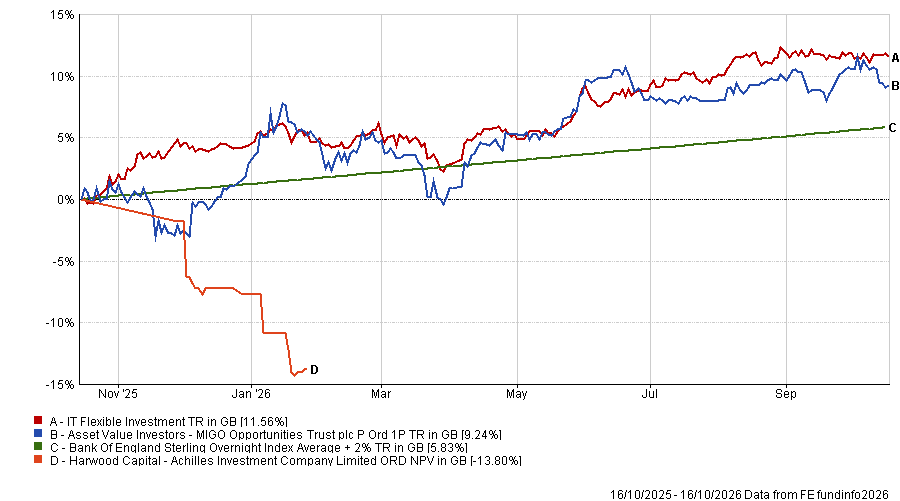
Source: FE Analytics
McMahon added that, since 2022, although equity markets have done well, MIGO has lagged, as high interest rates dampened demand for alternatives. He also flagged concentration as the main risk, noting that “corporate activity is unpredictable and may disappoint in significant individual positions”.
Even so, he said “crunch time is rapidly approaching for the alternative assets sectors”, and that the managers’ approach can deliver good returns “even if markets are weak, as so much of the value is in the underlying discounts”.
Achilles has less history to judge. Newton described it as young, concentrated and harder to trade, and said those traits are why Credo keeps the position small. It is for experienced investors comfortable with campaigns that either succeed or fail.
“Investors are essentially backing the Harwood team’s record in delivering realisations, notably at Hipgnosis Songs, Round Hill Music and Urban Logistics,” he said.
He also pointed to how Achilles is paid: “Achilles charges its base fee on the lower of market value or NAV and earns a performance fee only if it returns cash to shareholders more than 10% above their entry price, so the manager is paid for delivering exits rather than for gathering assets”.
Finally, the Achilles trust trades on a wider discount than MIGO (6.5% versus 0.66%). Its board is buying back its shares and holding a continuation vote in 2027, as manager Robert Naylor said here.
The portfolio will be able to offer to return capital to investors, Newton said, once one of its main deals, Spire Healthcare, potentially closes later this year or early in 2027.