


Staying invested for the long term is one of the most common pieces of investment advice, but the scale of change that can occur makes identifying long-term winners among funds and investment trusts challenging.
The past 10 years, for example, have served up Brexit, a global pandemic, a historic inflation shock, conflict in the Middle East and an AI revolution.
With the next decade likely to bring its own unpredictable twists, Trustnet asked fund selectors which single fund or trust they would buy today and hold until 2036.
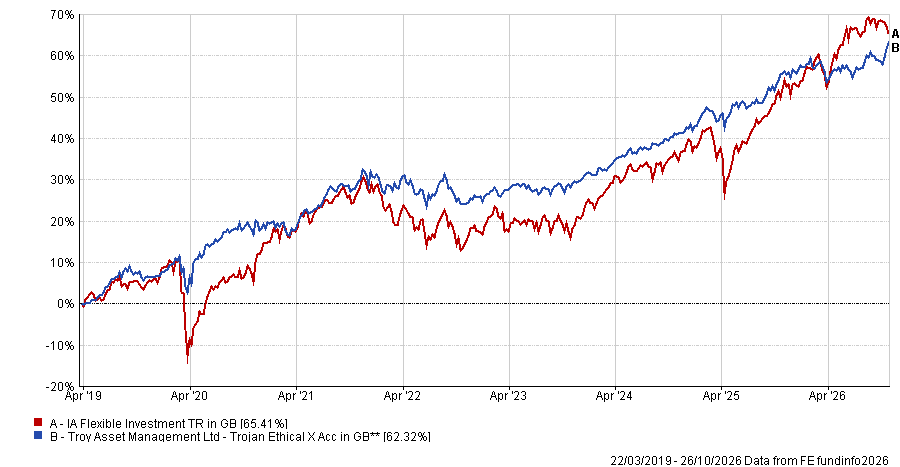
If he had to sell a fund exactly 10 years from today, Michael Heapy, senior investment analyst at iBoss, said he would want a strategy with the flexibility to adapt to changing market conditions rather than relying on a single asset class performing well at the point of redemption. He chose the £996.3m Trojan Ethical fund.
Managed by Charlotte Yonge, the fund utilises the same philosophy that underpins Troy Asset Management’s flagship Trojan strategy, using a diversified mix of high-quality developed market equities, government bonds, gold-related investments and cash but with an added ethical framework which screens out areas such as armaments, fossil fuels, gambling, pornography and high-interest lending.
Heapy said that one of the strategy’s greatest strengths is “its ability to evolve over time”.
“The managers have demonstrated a willingness to adjust portfolio positioning as valuations and opportunities change, helping to balance capital preservation with long-term growth,” he noted.
“Since the strategy’s inception, the equity allocation has ranged from 22% to 72%, for example.”
As of 31 August 2026, the fund’s equity exposure sat at 38%.
Another key attraction for Heapy is the fund’s long-standing allocation to gold, which has “remained a strategic component of the portfolio throughout different market cycles”.
The managers’ focus on preserving capital also makes it a particularly attractive option for a defined 10-year holding period, as “the combination of downside awareness, diversification and long-term growth assets gives me confidence that it can both protect and compound capital over the decade ahead”.
Performance of the fund vs sector over 10yrs
Source: FE Analytics
For Paul Angell, head of investment research at AJ Bell, 10 years is a long enough time horizon to “look through the inevitable volatility in US equities and give a genuine active manager time to add value through individual stock selection”.
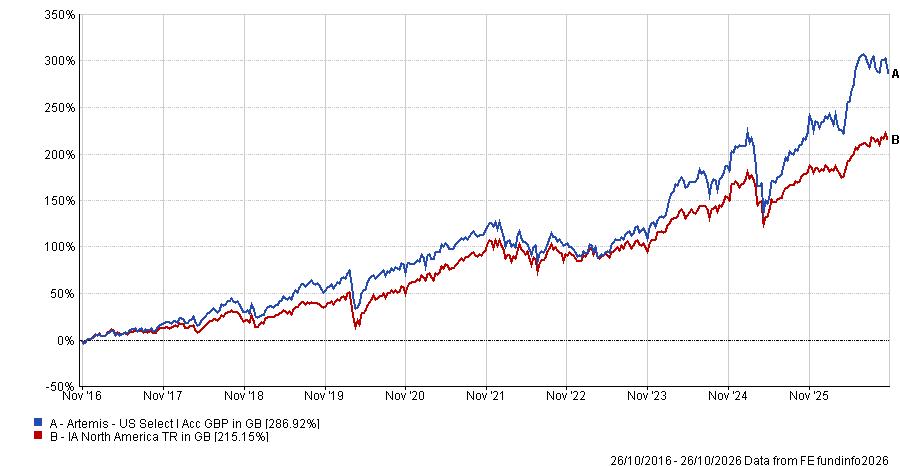
As such, he suggested Artemis US Select, a £1.9bn fund co-managed by Cormac Weldon and Chris Kent. It takes a style-agnostic and macro-aware approach to investing in US equities, with a quality bias.
Central to the philosophy is the belief that investment opportunities arise from market inefficiencies and that disciplined, consistent execution of a proven process is the most reliable way to exploit those inefficiencies over time.
“More recent performance has benefited from areas including semiconductors and AI infrastructure, but the portfolio has continued to evolve as opportunities and valuations have changed,” Angell said.
The fund has logged first-quartile returns over one, three, five and 10 years, gaining 324.4% over the decade, above the IA North America sector average return of 231.6%.
Angell suggested the fund could work well as a portfolio’s principal US equity allocation over the 10 years.
“It could then be paired well with UK and other international equities, alongside fixed income and potentially alternatives, to reduce reliance on the US equity market and its dominant growth companies,” he said.
Performance of the fund vs sector over 10yrs
Source: FE Analytics
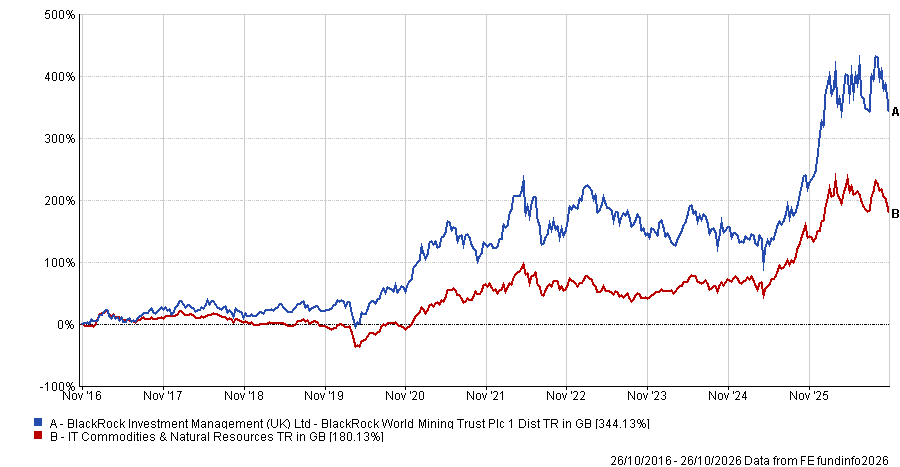
Rob Morgan, chief analyst at Charles Stanley, turned to specialist investment trusts, selecting BlackRock World Mining Trust. It currently manages £1.6bn in assets and is trading at a narrow 1.36% discount to net asset value (NAV).
The portfolio seeks diversified exposure to mining and metal assets globally, with top holdings including Glencore, Rio Tinto and Anglo American.
Co-managed by Evy Hambro and Olivia Markham, the investment process combines a top-down assessment of supply and demand across the economic cycle with bottom-up stock research to determine portfolio composition.
Around a third of assets are invested in gold mining companies, with the trust’s policy also allowing an allocation of up to 10% in physical metals and up to 20% in unquoted investments, as well as exposure to royalties derived from metals and minerals production.
The trust’s meaningful allocation to gold miners “provides a hedge against currency debasement and diversification from the industrial metals”, Morgan said.
“Although it comes with substantial cyclicality and commodity-price risk, the sector is at the confluence of key structural trends that should support earnings growth”.
Specifically, the combination of rising demand and constrained supply to ensure the energy transition and AI infrastructure build out is also potentially very supportive for prices and cash generation, Morgan predicted.
The trust sits in the first quartile of its sector over the 10 years to the end of September 2026, gaining 427.5% over the decade. Drilling down into the year-by-year returns, performance has been notably consistent – the trust has sat in the second quartile in seven of the past 10 calendar years.
Performance of the trust vs sector over 10yrs
Source: FE Analytics
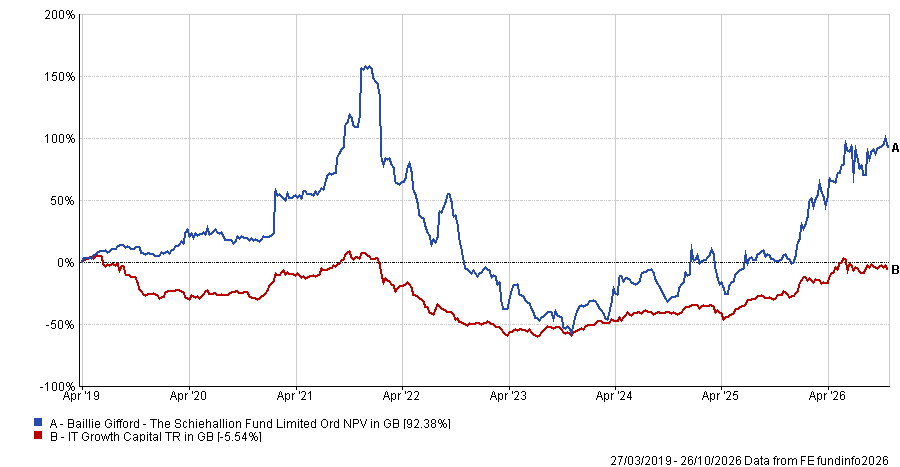
Emma Bird, head of investment trusts research at Winterflood, said 10 years is a “suitable holding period” for holding Baillie Gifford’s $2.2bn Schiehallion Fund.
The managers – Peter Singlehurst, supported by Robert Natzler – seek long-term growth with a patient approach by investing in later-stage private businesses, aiming to generate a NAV total return of approximately three times invested capital over rolling 10-year periods.
“In theory, the managers would be open to holding a private company indefinitely – meaning that the strategy is not simply seeking uplifts on IPO exits – although around 70% of the portfolio is expected to be invested in private assets over the long term,” Bird said.
Technology dominates the portfolio, accounting for 46.5% of assets, with the trust’s largest positions including an 8.7% allocation to Anthropic – one of the most high-profile private companies in the world and among the most anticipated potential listings of the coming years.
“The concentrated portfolio – with 60% of assets in the top 10 holdings as at 30 September – and significant allocation to unlisted companies means that Schiehallion will perform very differently to a global listed equity index or diversified fund, and there may be periods of considerable NAV and share price volatility,” Bird noted.
“As such, we think investment in the fund is appropriate for investors with a long-time horizon and view it as an attractive satellite holding in a portfolio, with the potential for outsized returns but not on a straight-line basis.”
The trust is currently trading at a 15.12% discount to NAV.
Performance of the trust vs sector since launch
Source: FE Analytics
Trustnet has also asked fund selectors which funds and trusts they would hold over one year.