


Defence stocks have fallen hard in the past six months due to a mix of valuation fatigue, shifting political and budget expectations and macroeconomic pressures.
The Finserve Global Defence & Security fund has fallen with them, losing 13.43% over six months and 11.8% over one year.
Yet, manager Joakim Agerback thinks the market has this wrong.
“Many investors, including institutional investors, remain underweight [defence], despite the change in sentiment,” he said.
The pullback, he added, has made forward valuations attractive and he pointed to forecasts of 12% annual sales growth and 16% earnings growth for European defence companies through 2030.
The long-term track record of the fund is strong. Launched in Sweden in 2019, Finserve Global Defence & Security has been distributed in the UK since summer 2026. The $547m SICAV has returned 114.51% over three years, against 42% for the FTSE All World.
Performance of fund against indices over 3yrs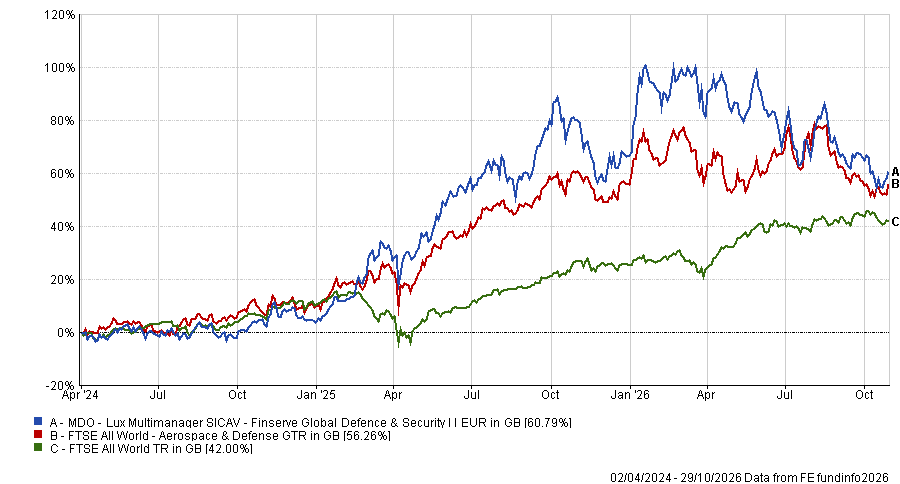
Source: FE Analytics. Returns for the EUR share class (in pound sterling). The fund is not benchmarked against any index: the indices shown above are for comparative purposes.
Below, Agerback discusses why he thinks the sell-off is an entry point, what he got wrong with Czech defence-systems company CSG and what stock selection adds in a sector that investors usually like to access via exchange-traded funds (ETFs).
Please describe your philosophy and process.
We invest globally across defence, security, space and cybersecurity.
Our process starts with understanding government spending priorities, which capabilities are being funded and how these translate into procurement programmes. We assess technologies, competitive positions and the companies best placed to benefit, then focus on execution, profitability, earnings growth, cash flow and valuation.
Our markets offer structural growth above that of the broader economy, providing a strong foundation for long-term value creation through disciplined stock selection.
Why should investors pick Finserve Global Defence & Security?
What differentiates us is our deep domain expertise. Our team and advisory board include specialists who have spent their careers in the military, defence, security and space. This gives us a deeper understanding of government priorities, how defence procurement works in practice and which technologies and companies are genuinely positioned to benefit.
Higher defence budgets do not automatically translate into higher profits. Companies still need to win contracts, deliver and generate cash.
Our strength lies in understanding where the money will be spent and identifying businesses capable of translating that spending into sustainable earnings growth.
What were your best and worst calls over the past 12 months?
One of our best investments was Exail Technologies, contributing 2.72 percentage points to fund performance.
We identified its unique underwater drone and navigation capabilities as particularly relevant given growing hybrid warfare threats and the need to protect critical subsea infrastructure. The announced acquisition by Thales reinforced the strategic importance of this technology.
Our most disappointing investment was [Czech defence systems company] CSG, detracting 1.14 percentage points from fund performance.
We saw a compelling long-term opportunity following its IPO, given Europe's shortage of ammunition production capacity. However, despite strong structural demand, the company has struggled to execute and convince the market.
What signals show that defence companies can convert backlog into earnings and cash flow? What did you miss with CSG?
A defence budget is not a purchase order and a purchase order is not cash flow. Contract structures and customer payments are important in supporting cash flow during expansion.
CSG holds an important strategic position in ammunition production, where Europe's need to rebuild inventories and industrial capacity provides a strong, lasting demand outlook.
However, we overestimated the company's ability to execute on that position. While underlying demand remains attractive, CSG has yet to convince the market it can consistently translate opportunities into sustainable profitability and cash generation.
We have exited most of our position but will continue to follow the company given its long-term strategic importance to European defence.
Are you worried about trend-following investors crowding the defence market?
We believe the market is still underestimating the growth opportunity. Our proprietary research, supported by investment bank forecasts, shows that military equipment procurement, the actual addressable market for defence companies, is growing considerably faster than overall defence budgets.
Furthermore, rising production volumes and operating leverage should drive earnings growth faster than revenue growth. Current European sector forecasts suggest approximately 12% annual sales growth and 16% earnings growth through 2030. Today's deliveries also create tomorrow's aftermarket for maintenance, upgrades and replenishment, extending the growth opportunity well beyond the initial procurement cycle.
Many investors, including institutional investors, remain underweight, despite the change in sentiment. Valuation concerns are understandable, but historical multiples can be misleading when the underlying earnings profile has changed fundamentally.
Following the recent market correction, we believe current forward valuations may offer an attractive entry point. Investors still need to be selective about valuation and competitive positioning, but the opportunity is considerably broader than the companies attracting the most attention.
Why pay an active management fee rather than invest in a defence ETF?
ETFs provide efficient exposure to the sector but we believe specialist knowledge, combined with disciplined stock selection and valuation, can offer investors additional value.
An example is Finnish company Bittium, whose secure tactical communications technology addresses an increasingly important military capability. The company has qualified for the next stage of a major UK defence procurement process alongside BAE Systems and has also secured preferred supplier status with NATO's Communications and Information Agency for secure mobile communications.
What do you do outside of fund management?
I enjoy live music, working out and following geopolitics and macroeconomics. The latter two are perhaps a little too close to my day job, so switching off isn't always easy. Fortunately, at a live concert, the only thing I need to predict is the encore! One of my favourite bands is Manchester Orchestra, although, somewhat disappointingly for your UK audience, they're actually from Atlanta, Georgia. Great band, misleading name!