


The US midterms were a dramatic success for the Democratic party, but markets were less jubilant in the aftermath of the results.
Democrats have won majorities in both the Senate and the House, with some arguing that the “stunning” election result was due to “much anger and dissatisfaction” at the Republican party.
Markets were initially surprised and turned negative, with US futures suggesting a difficult day ahead. However, at the time of writing US equities have stabilised and returned to positive territory. The S&P 500 is up 1.5%, the Nasdaq 2% and the Dow Jones 2.2%.
There have also been gains across Europe, with the FTSE 100 up around 1.8% while the Euro Stoxx 50 index was up 2.2%.
The true impact of these results will be felt over the coming weeks, months and remaining two years of US president Donald Trump’s term in office. Below, experts look at the implications for different asset classes over more than just 24 hours.
Tech and AI
In the initial aftermath of the ‘Blunami’, tech stocks took a meaningful step lower, with the Nasdaq index initially dropping by 2%.
Kit Rees, investment strategist at Quilter, noted that technology stocks in particular “could feel the heat as a Blue sweep raises worries that the sector is in store for greater regulatory scrutiny, especially when it comes to the buildout of data centres”.
Charu Chanana, chief investment strategist at Saxo, said the midterm election results will accelerate investors’ reassessment of AI – a process that has been underway for several months, with tech stocks softening since June.
“The sector entered the midterms with elevated valuations, enormous capital expenditure commitments and growing investor concerns about how quickly AI investments will translate into profits,” she said.
However, a Democratic sweep could add a new layer of concern and complexity in terms of regulatory scrutiny, with investigations into AI companies, competition, consumer protection, data privacy and model safety. This could also combine with restrictions on the data centre buildout.
“A tighter regulatory environment could make investors more demanding about the funding and profitability of AI infrastructure,” Chanana said.
AI remains strategically important for US competitiveness, however, so there will be caution, she said. As a result, the strategist said this is not the end of the AI boom, but a sign of its maturity to the next phase: an AI profitability cycle.
This will continue the current industry separation into three areas: established leaders (such as in chips and memory), capital-intensive infrastructure (data centre developers) and AI adopters.
“The next stage of the AI trade could increasingly reward the third group, while remaining selective on the first. This also means some of the best AI investments may eventually be outside the traditional semiconductor and hyperscaler universe,” she said.
US vs other markets
Andrew Jackson, head of investments at Vontobel, noted that US equities have historically performed well after midterm elections. “However, elevated equity valuations and high bond yields could leave less room for a post-election lift,” he said.
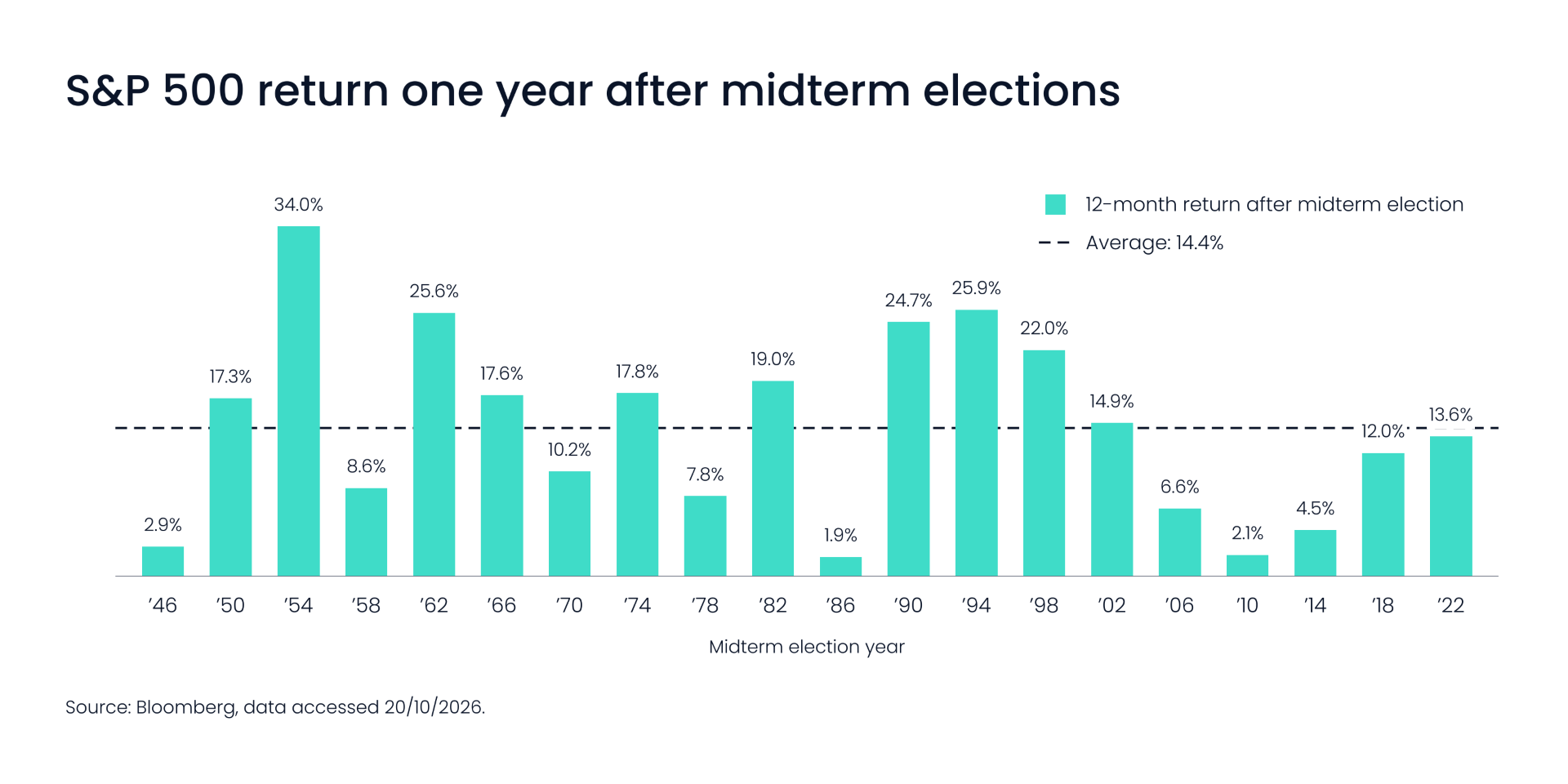
Source: St James’s Place
For Chanana, the midterms result strengthens the diversification argument, but not the case for abandoning US equities. After all, US companies still have significant advantages in technology leadership, profitability, innovation and access to capital, she said.
“Political gridlock does not remove those advantages,” she said.
However, valuations are elevated and other areas are potentially attractive. She highlighted Asia (in particular Chinese tech), non-AI US companies and a move towards bonds and gold.
“The important distinction is that a US technology correction does not automatically mean all international equities will rise. A broad risk-off move can affect both,” she warned.
Energy
Most experts warned of a potential reaction in the ongoing US-Iran war. Jackson said a tougher US response to Iran after the midterms “is a material risk”.
Others saw the opposite: Republicans piling pressure on Trump to end the war. Higher gas prices due to the closure of the Strait of Hormuz were pegged as one of the key reasons for the party’s losses last night.
Holger Schmieding, chief economist at Berenberg, said he expects Trump to strike a deal with Iran that reopens the Strait of Hormuz by early 2027.
“The price for Brent crude will fall to $75 per barrel... by the end of 2027 and an average of $65 in 2028,” he forecast.
Regardless of the war, Carlota Estragues Lopez, equity strategist at St James’s Place, said renewables could benefit as fossil fuels face greater scrutiny from Democrats.
“While high energy prices and concerns about supply security will remain important, the traditional oil and gas energy sector could face greater uncertainty. Democrats will likely seek tighter environmental controls while reducing support for fossil fuels. The renewable energy industry could benefit from a more sympathetic congress.”
US treasuries
Turning to bonds, David Roberts, head of fixed income at Nedgroup Investments, noted that US bond yields fell sharply overnight, especially on short-dated bonds.
“Democrat control at local and national level may put a brake on AI infrastructure buildout. That’s been propelling US economic growth... and heightening inflation. Hence the Fed might not need to hike next year,” he said.
Additionally, any signs of a slowing in the AI buildout should favour fixed income as investors become more nervous and turn to safer havens, as should falling energy prices, which should reduce inflation and prevent the Federal Reserve from raising interest rate (and could even encourage cuts).
Jackson added that a divided government can support treasuries by limiting further fiscal expansion, which should encourage bond investors who have become concerned about the volume of government debt around the world. However, he noted that inflation and Fed policy are likely to matter more for bonds than the election result.
For Chanana, the election strengthens the tactical argument for treasuries. “Our preference would be for intermediate-duration high-quality bonds, rather than making an aggressive bet on the longest end of the curve,” she said.
“The belly of the treasury curve could offer an attractive combination of income and potential price appreciation if growth slows. The main risk is that renewed inflation or an increase in term premiums pushes longer-dated yields higher despite weaker growth.”
Gold
Lastly, Chanana noted that gold has a “reasonably supportive combination of factors” including lower US yields, a weaker dollar and renewed political uncertainty.
“The appeal extends beyond the election itself. Geopolitical tensions, fiscal sustainability concerns and the desire to diversify concentrated equity portfolios continue to support the strategic case for gold,” she said.
However, investors need to distinguish between gold as a portfolio diversifier and gold as a short-term political trade. For instance, if US yields rebound or the dollar recovers, gold could experience another pullback.
Perversely for a safe-haven asset, any geopolitical escalation remains a key downside risk for gold, particularly if the US-Iran conflict intensifies.
As a result, “gold remains useful as a strategic hedge against inflation, geopolitical disruption and policy uncertainty, rather than a vehicle for chasing immediate election-related moves”, she said.