


A small-cap fund manager who sells a portfolio holding because it has grown too big for the smaller companies label risks depriving themselves of the best opportunities, according to Douglas Brodie, co-manager of Baillie Gifford Global Discovery.
The £306.5m fund is benchmarked against the S&P Global SmallCap index. Yet, with an active share of 99% (as of the end of September 2026), the 65-stock portfolio bears little resemblance to the benchmark it tracks.
Brodie described Baillie Gifford Global Discovery as “smaller company investing with a twist”, noting that the focus is to identify companies innovating to shape the future that he believes have the best chance of dominating their field.
“We try and find these companies when they are early on that journey and that gives us the skew towards smaller companies,” Brodie said, adding that it is as much a technology, entrepreneurial and innovation-led fund as it is a global smaller companies’ fund.
He argued that the industry “really shoots itself in the foot” by over-compartmentalising the opportunity set for small-cap investing.
“[The market] takes that big universe globally, breaks it up regionally and then breaks it up into these size brackets – taking a massive universe and making it manageable,” Brodie said.
“I get it, but the minute you keep going down to that ever-more curated and filtered list, you sort of miss the point of doing investment.”
The box of small-cap companies globally is also extremely varied, as every region has a different market capitalisation ceiling.
The S&P Global SmallCap index targets the lowest 15% of the float-adjusted market capitalisation in each covered developed and emerging country. This means that the index includes companies of varying size – for example, fast-growing companies in massive equity markets like the US can swell to tens of billions of dollars before being graduated out of the index.
Brodie maintained that the index “sets the gate point for what can get into the fund”.
“Originally, we began with a $5bn max at the time of purchase and that then morphed to $10bn,” Brodie said.
“At that point, we realised we would be chasing our tail forever because markets generally go up over time, so why would we have a hard and absolute numerical number around it?”
Instead, Baillie Gifford Global Discovery attempts to “keep that purity around what growth investing is: try to find massively transformational businesses, buy them when they are small and own them as they become large”.
There is also no automatic trigger to sell a portfolio company if it gets too big.
“We bought Tesla at around $2bn and sold it just shy of a trillion dollars, but the trigger points to sell vary from company to company,” Brodie said.
“For me, it’s when I get a sense of either the growth rate, the ambition, the closeness to maturity or a steady state – or simply a lack of ability to continue innovating in a way that is going to make a difference.”
Argentina’s MercadoLibre was previously included in the S&P Global SmallCap index but was removed when it grew too big. It currently has a market cap of more than $75bn, placing it in the large-cap category.
However, the company still features in the fund’s top 10 holdings, with a 2.8% position.
Brodie pointed to its continued growth as his main reason for holding onto the company. In the third quarter of this year, MercadoLibre grew its revenue by 45% year-over-year to $10.8bn, marking 31 consecutive quarters of growth above 30%.
Stock share price performance since IPO
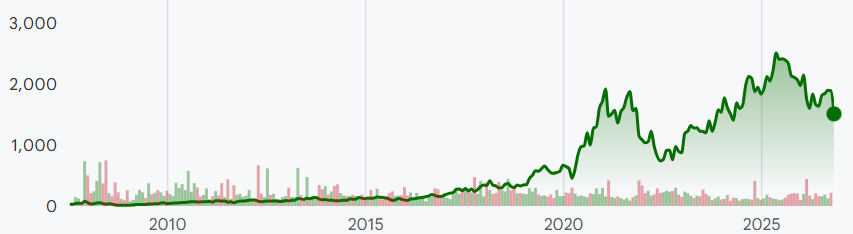
Source: Google Finance
He sees portfolio holding US-based Xometry going down the same path of continued growth as MercadoLibre. It is benefiting from efforts to reshore supply chains in the US, operating an AI-powered marketplace for custom-manufactured parts and industrial sourcing.
It is operating in an industry that is several hundred billion dollars in size and, with Xometry currently representing less than 1% of it, Brodie argued the company has huge growth potential through its ability to innovate via its AI marketplace.
The company has historically been included in the S&P Global SmallCap index, yet it recently surged to mid-cap status following its third-quarter earnings report this month, with its market cap increasing to around $6.6bn.
The index rebalances every March and September.
Brodie said: “For us, it’s more about the principle: we want to find companies that are out there innovating and solving big problems and trying to change the world – we don’t want to cap the opportunity by saying ‘oh, they have now reached this numerical size so we have to sell them’.”