


The weighted average discount between AVI Global Trust’s underlying holdings and their estimated net asset value has reached a level previously seen only during the last three big market crises.
Joe Bauernfreund, chief executive and chief investment officer of Asset Value Investors (AVI), the trust’s investment manager, said in the latest annual financial report: “The portfolio weighted average discount stands at 42% - a level previously only observed at times of severe market stress: the global financial crisis, the eurozone crisis and COVID.”
AVI attributed the widening gap to investor capital and attention concentrating in companies linked to artificial intelligence, which it said has drawn focus away from the asset-backed, out-of-favour companies it targets.
“In terms of relative performance, the markets remain incredibly concentrated by historical standards, and AI has been the key theme in a narrative-driven market,” Bauernfreund said. “Whilst we have benefited from this in small pockets, our significant ‘underweight’ to AI-related names has dented relative performance.”
The discount on AVI Global Trust’s own shares widened. Chairman Graham Kitchen said the discount had been narrowing for most of the first half of the year, until the war in Iran affected the trust’s share price in March.
The discount stood at 8.9% at the year-end, compared with 6.7% a year earlier, with a high of 9.8% and a low of 5.5% during the period. It is currently 7.9%.
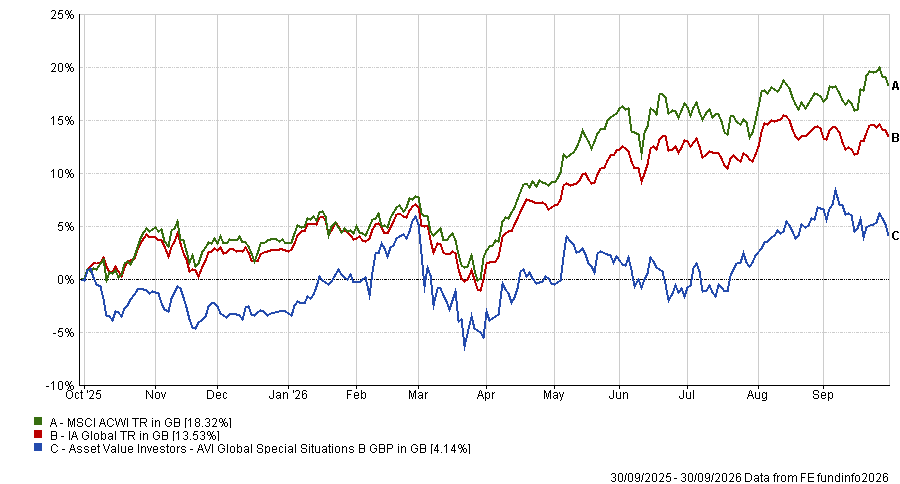
The trust’s net asset value total return was 1.7% for the year to 30 September 2026, against 18.3% for its MSCI All Country World benchmark. This is the third consecutive year in which AVI Global Trust’s return has trailed the benchmark.
Total return performance of AVI Global vs sector and index over year to 30 Sep 2026
Source: FE Analytics
In the eight years after Bauernfreund’s appointment as lead portfolio manager in 2015, the trust beat the benchmark in all but one of those eight years.
Over five years, the trust returned 39.6%, compared with 75.5% for the benchmark.
Bauernfreund said: “Our concentrated and differentiated approach will inevitably suffer bouts of underperformance. This is a feature, not a bug. To mangle the words of Sir John Templeton: to achieve superior returns, one must do something truly different.
“We continue to believe this to be a fundamental truth of active portfolio management, even if it can feel uncomfortable in the moment. Indeed, we would argue this has never been more important than in a market environment dominated by passive and closet tracker strategies. As we look ahead, we believe being truly active will be the key to delivering strong long-term returns.”
Japan and South Korea were the strongest parts of the portfolio over the year. Positions in Japan returned 17% and those in South Korea 44% in sterling terms, while returns elsewhere were generally weaker.
AVI said its response to the wide spread of valuations in the market had included raising the portfolio’s weighting to Japan and South Korea, which together now account for about 49% of the portfolio by country of listing, up from roughly 24% a year earlier. The shift was funded in part by exits from closed-ended fund holdings, including Cordiant Digital Infrastructure and GCP Infrastructure.
Bauernfreund said: “As benchmark-agnostic investors, we will be led by the opportunity set, and recent experience vindicates this, with our positions in South Korea having generated a profit of over £65m, contributing 5.4% to NAV, since we started initiating positions in June 2025, against an average South Korean portfolio weight over the period of 17%.”
AVI said the appeal of both markets rested on a combination of strong fundamentals, cheap asset-backed valuations, governance reform and increased shareholder activism.
In South Korea, it pointed to the government’s ‘value-up’ initiative as a tailwind it believes will create “a multi-year opportunity for activist investors to shift the sentiment of controlling family shareholders”.
Hyosung Corp, a South Korean holding company whose main asset is a stake in the power equipment manufacturer Hyosung Heavy Industries, was cited as an example of the pattern AVI said it looks for in the region: high-quality underlying assets, strong earnings growth and a wide discount tied to a weak governance record. The position added 1.1% to net asset value over the year.
In Japan, AVI pointed to Mitsubishi Logistics, where the company has made measurable changes to capital allocation while AVI has engaged with management. The company sold cross-shareholdings worth about ¥69bn during its financial year to March 2026, continued a ¥20bn share buyback programme and started an asset-recycling strategy. The position added 1% to the trust’s net asset value.
Samsung C&T was the largest single contributor to the trust’s overall performance, adding 2.8% to net asset value and returning 94% in sterling terms. AVI said the holding benefited from a rally in Samsung Electronics shares, driven by a shortage of memory chips used in artificial intelligence data centres.
AVI Global Trust also exited Toyota Industries, then its largest position, in full during the year, following a revised take-private bid for the company. The exit generated proceeds of just over £100m, equivalent to roughly 9% of the trust’s net asset value at the time, and took net gearing to approximately zero.
Not every position performed as well, with Vivendi the largest detractor from returns, reducing the total by 4.1%.
Its shares fell 53% as its net asset value dropped 42% and its discount to net asset value widened from 42% to 53%. The fall in net asset value reflected a 36% decline in shares of Universal Music Group, Vivendi’s main holding, amid investor concern over sales growth, margins and the risk from AI-generated music.
Chrysalis Investments was the second-largest detractor, subtracting 3.6%. Its net asset value fell 25% after write-downs at wefox, a lower carrying value for Starling based on falling peer valuations and further weakness in Klarna’s share price. Its discount also widened, from 29% to 46%.
Other detractors included Partners Group Private Equity (-1.2%), Gerresheimer (-1.1%), which AVI exited during the year, and Jardine Matheson (-0.8%).
AVI said Vivendi and Chrysalis remained “some of our highest potential upside ideas”, trading at wide discounts despite the losses recorded during the year.
AVI Global Trust bought back and cancelled 21.9m shares during the year, equivalent to 5.3% of issued capital, adding an estimated 0.5% to net asset value per share for continuing shareholders.
The trust’s ongoing charges ratio rose to 0.88% from 0.85%. The board said marketing and custody costs had increased, while the asset base had shrunk, mainly because of share buybacks.
AVI itself changed hands recently, as London-based multi-boutique asset manager Pacific Asset Management completed its acquisition of the firm on 2 October 2026. The board said the investment team, investment process, management fees and the trust’s objective would not change.