


Figures on how much AI hyperscalers can continue to spend and the required revenues to pay for this do not “pass the sniff test”, according to Julian Bishop, co-manager of the Brunner investment trust, who warned that the current level of capital expenditure “is unlikely to be sustained”.
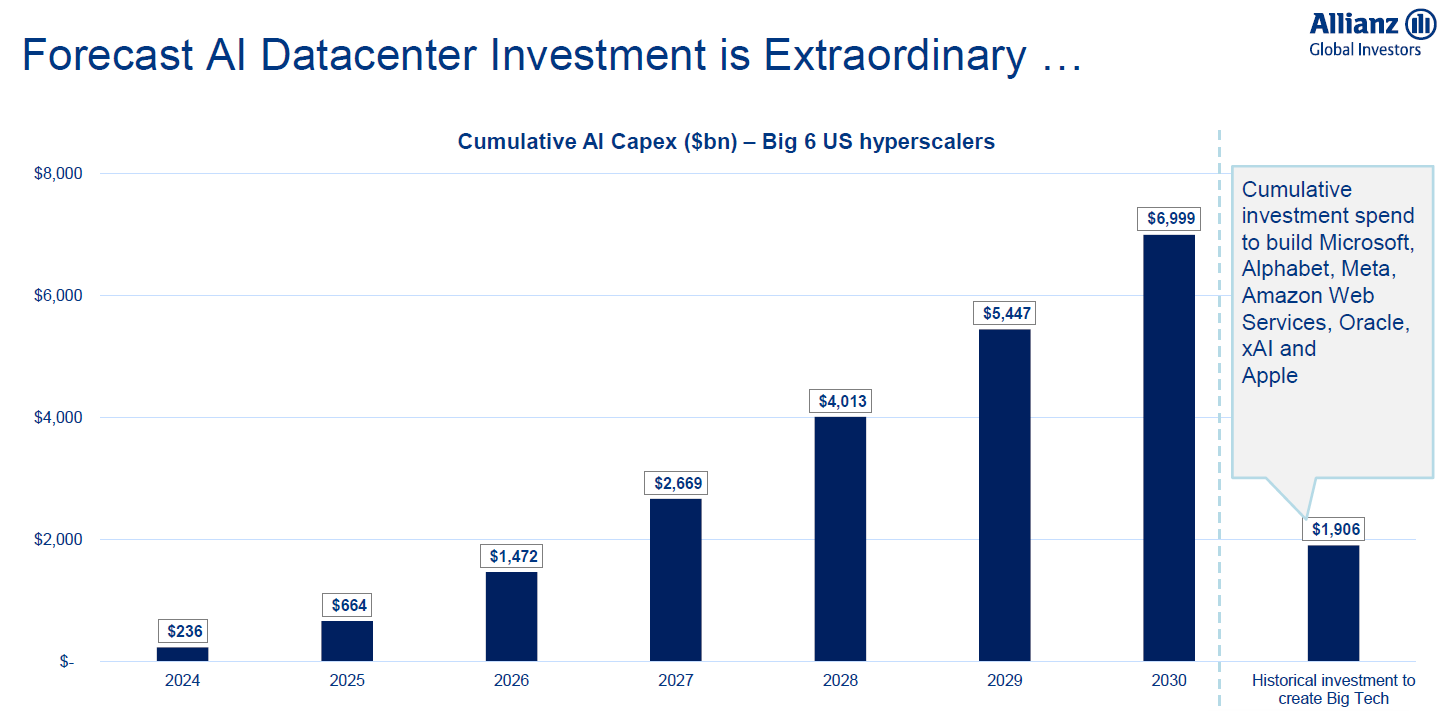
Hyperscalers are forecast to spend some $1.7trn on the AI build-out next year, a “preposterous amount of money”, said Bishop. Yet this is expected to grow further each year. In total, he noted the current capital expenditure (capex) cycle is expected to reach a cumulative spend of almost $7trn by 2030.
Source: Brunner investment trust
This compares with the total spend to build Microsoft, Alphabet, Meta, Amazon Web Services, Oracle, xAI and Apple – which together have spent $1.9trn in their history.
There are reasons for such high numbers, noted fellow co-manager James Ashworth, as prior expectations on capital spending have been revised “upwards and upwards” in recent years.
As experts have been “perennially wrong” with their forecasts, they are now adjusting by putting in “very bullish numbers for what happens in the future”.
Companies such as chip designer Nvidia, chip foundry TSMC and Korean memory giants Samsung Electronics and SK Hynix have been the direct beneficiaries of this enormous expenditure, all of which have been “propelled” by the revised expectations.
However, Bishop said “it's probably hard to sustain” this “pretty extraordinary” level of spending for so long as it requires a huge revenues to justify such spend.
Ashworth agreed, noting the industry may be approaching the limit of capital expenditure, with hyperscalers “now spending basically all of their free cashflow” and issuing equity and bonds to finance the AI build-out.
“There probably is a ceiling to how much they can spend and maybe we're too close to that,” he warned.
Bishop noted that companies need to allow for chip depreciation, as chips last only about five years, and for the cost of building and running data centres.
As a result, he compared AI to the oil and gas sector, which prior to the new spend during the current boom was the most capex-intensive sector in markets.
“The amount spent on capital expenditure on energy, oil and gas, is about $500bn a year. But the oil and gas sector generates about $4trn-$5trn in revenue a year. So the capex-to-sales ratio is 10-15%,” he said.
The AI industry is far from these figures, Bishop noted. The latest filings from Anthropic, the company behind Claude, suggest the firm’s revenues stand at around $70bn. The firm is spending around $40bn on compute, which is tiny compared to the total $1.5trn forecast spend next year.
Anthropic is the largest of the new dedicated AI companies, he said, with ChatGPT owner OpenAI the only other company with “real AI revenues”. Although the former is now “just about profitable if you adjust for various things”, he warned OpenAI’s finances are murkier and the company is still likely to be loss-making.
Moving forward, he argued that companies will need to make around $500bn in revenues for every $1.5trn capital spend “for it to make sense”.
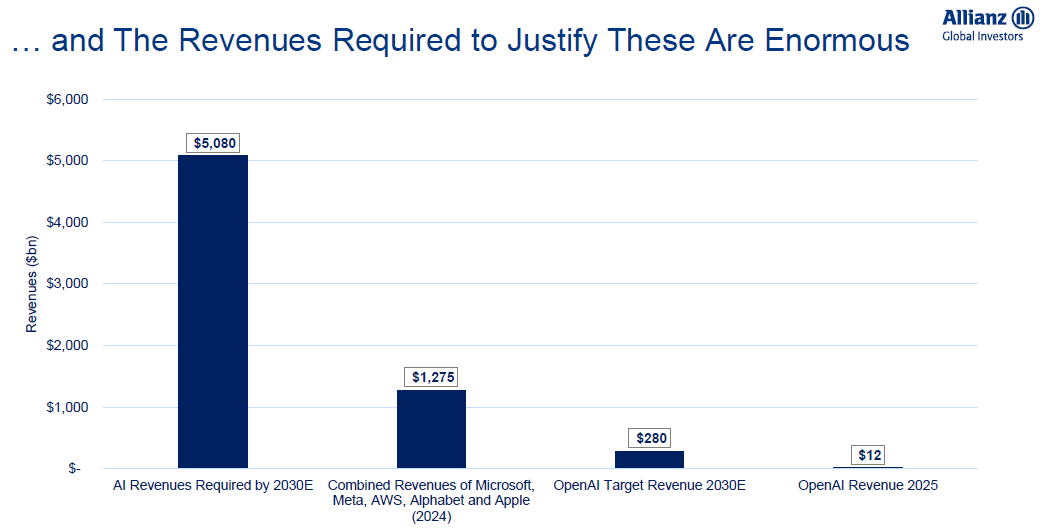
Yet markets will likely be even more discerning. As a result, if $7trn is spent between now and 2030 – an assumption that will likely be strongly tested in the coming years – Bishop estimated this would require revenues of $5trn.
Source: Brunner investment trust
The chart above shows that this is about four times the total revenues of Microsoft, Meta, Alphabet, Amazon Web Services and Apple in 2024.
“OpenAI’s target revenue is $280bn by 2030. Their actual revenues last year were about $12bn. So I just don't think it passes the sniff test,” the Brunner investment trust co-manager said.
The fund still has exposure to AI through its top holdings TSMC and Alphabet but has a much lower allocation than a typical market index.
Ashworth said there is a clear difference between whether a technology is good and valuable versus whether it's an attractive investment, noting there are “many examples of great technologies that were revolutionary for humankind and for civilisation, but that have been terrible investments for people who were involved”.
This goes as far back as the invention of the railways or can be as recent as the dot-com bubble at the start of the century.
Bishop used iron ore as another example, noting that in some ways the current AI spend is “more akin to heavy industry really than the traditional tech sector”.
The iron ore price shot higher in the late 2000s as China began to industrialise and consume vast amounts of the metal.
At the turn of the century iron ore cost about $30 a tonne. By the early 2010s it had spiked to more than $150 a tonne. This led to a rise in investment in iron ore projects, which flooded the market with supply and led to a collapse in the price. The same occurred a few years later with shale oil in the US, he said.
Ashworth concluded: “Even though technology is incredibly useful and incredibly valuable, most of its value is captured by society. Academic work suggests when there's a new invention, about 98% of value is captured by society rather than by the inventor. There's a very clear risk in our mind that AI might be a phenomenal technology, but it might be a very poor investment.”