






More than four in five funds in the Investment Association universe lost money last week after fears about the future of the AI build-out spread to most parts of the market.
The Nasdaq 100 fell 5.1% in US dollar terms, FE Analytics shows, as investors continue to worry about the huge amount of spending and borrowing being sucked up by the AI build-out. This was the tech-heavy index’s worst week since 2020 and leaves it 15.1% down from its peak on 6 October 2026.
Other indices sank as investors dumped tech stocks, with the S&P 500 shedding 8.6%, the Philadelphia Stock Exchange Semiconductor index 7.2% and the MSCI ACWI Information Technology and Communication Services index 12.5%. This left the MSCI AC World index down 8.1%.
Strategists at Edmond de Rothschild Asset Management said the AI sell-off has left “practically no asset class untouched”, noting that the MSCI AC World index has gone through its longest losing streak since 2023 after falling for seven consecutive sessions.
“Investment sentiment was knocked by mounting worries over the sheer size of AI investments and the Fed's hawkish tone. Equity markets were the first casualties,” they said.
“Tech stocks and companies most exposed to AI led declines but the sell-off this time spread to the entire board. Even defensive and low-volatility stocks lost ground.”
They added that Anthropic’s IPO failed to lift sentiment. The AI giant had a “remarkable” trading debut on Thursday but fell on Friday, which the strategists said was “a reflection of how investor views on the AI ecosystem have suddenly changed”.
Nvidia dropped 20.8% last week, Micron Technology 19%, Advanced Micro Devices 16%, Tesla 10.5%, Alphabet 9.5%, Broadcom 8.5%, Microsoft 7.7% and Amazon 5.8%, according to Google Finance.
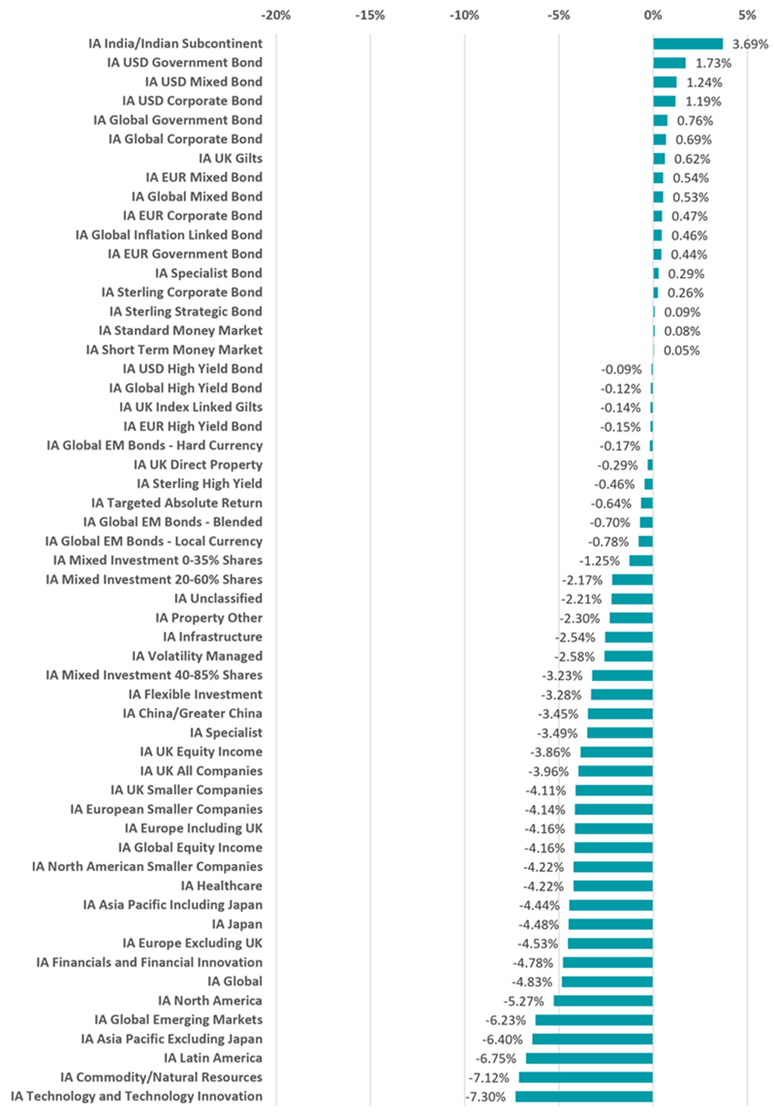
How the sell-off affected fund sectors in the Investment Association universe can be seen in the chart below. Some 4,419 funds – or 81.5% – lost money last week, showing how vast swathes of the market are sensitive to changes in the AI narrative.
Performance of fund sectors between Mon 16 Nov and Fri 20 Nov
Source: FinXL. Total return in sterling
As would be expected, IA Technology & Technology Innovation was the sector hit hardest, with a 7.3% average loss.
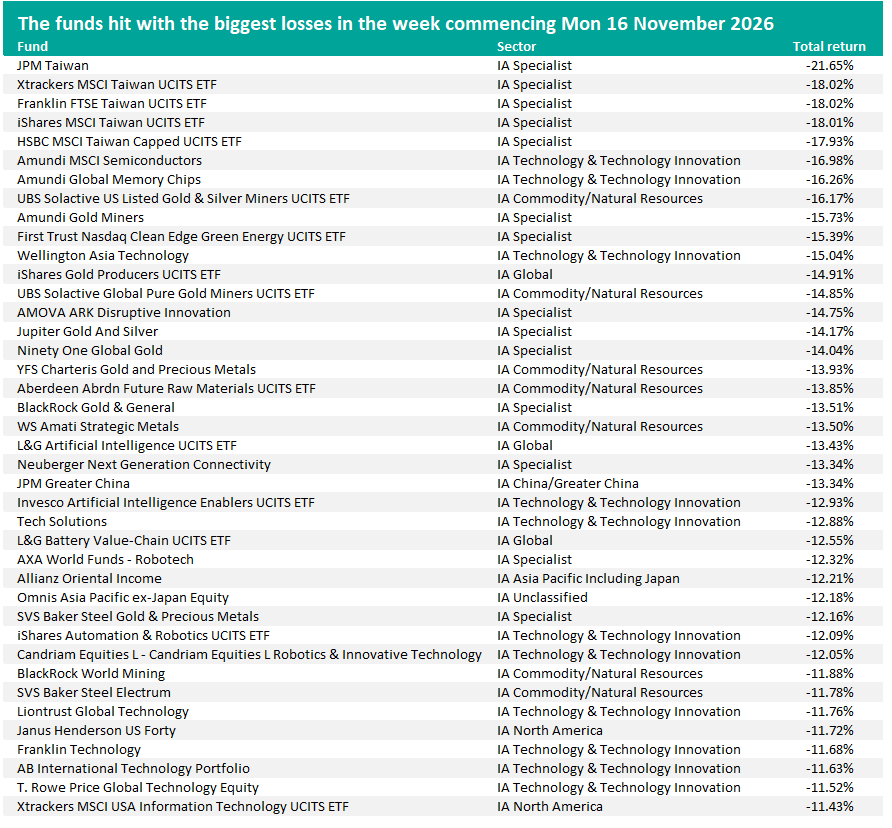
Amundi MSCI Semiconductors fell the most, losing 17%, followed by Amundi Global Memory Chips (down 16.3%) after chip stocks plummeted on worries about a slowing AI build-out and the resignation of Jensen Huang as Nvidia’s chief executive.
Wellington Asia Technology was next with a 15% fall, followed by Invesco Artificial Intelligence Enablers UCITS ETF (down 12.9%), FP Carmignac Tech Solutions (down 12.9%), iShares Automation & Robotics UCITS ETF (down 12.1%), Candriam Equities L Robotics & Innovative Technology (down 12.1%) and Liontrust Global Technology (down 11.8%).
WisdomTree Cybersecurity UCITS ETF was the peer group’s only winner, with a 4.6% total return, while Invesco Cybersecurity UCITS ETF shed just 1.9%. Cybersecurity stocks escaped the wider sell-off thanks to a spike in demand for digital infrastructure protection.
The IA Commodity/Natural Resources sector posted the second-highest average loss, down 7.1%. This was driven by gold funds, as the yellow metal hit a 14-month low last week. This could be down to forced selling, as investors sell gold to cover losses elsewhere, although a hawkish Federal Reserve is also damaging the appeal of an asset that pays no income.
However, funds investing in broader miners and raw materials also fell hard in the sell-off, as this part of market depends on AI-infrastructure demand for metals such as copper and lithium, so can be affected by worries that the build-out might slow.
UBS Solactive US Listed Gold & Silver Miners UCITS ETF, UBS Solactive Global Pure Gold Miners UCITS ETF, YFS Charteris Gold and Precious Metals, abrdn Future Raw Materials UCITS ETF and WS Amati Strategic Metals made the peer group’s biggest losses last week.
Asian and emerging market equity funds also had a bad week, reflecting the fact that chip giants TSMC, SK Hynix and Samsung are based in Asia. The biggest falls here came from Veritas Asian, iShares Pacific ex Japan Equity Index, MI Polen Capital Emerging Markets Growth and Allianz Total Return Asian Equity.
The IA North America sector posted a 5.3% average loss. The US is at the epicentre of the AI revolution and its corporate earnings and economic growth increasingly rely on the build-out.
Janus Henderson US Forty was down 11.7% last week. Its largest holdings are stocks either developing AI, supplying chips or building infrastructure: Nvidia, Alphabet, Amazon, TSMC, Lumentum, Eaton, AMD, Microsoft, Oracle and Lam Research.
The other funds with the week’s biggest falls – such as Xtrackers MSCI USA Information Technology UCITS ETF, iShares Edge MSCI USA Momentum Factor UCITS ETF, Alger Focus Equity, Amundi Russell 1000 Growth UCITS ETF and Alger American Asset Growth – either track an AI-heavy index or have AI trades within their largest holdings.
Peter Spiller, Chris Clothier and Emma Moriarty, managers of Capital Gearing Trust, are cautious around the immense sums being spent on the AI build-out, arguing that investment booms have a habit of ending in “some combination of severe economic slowdown or financial crisis”.
In the trust’s recent half-year results, they touched on the portfolio’s defensive positioning amid the AI investment boom and their worries that any serious road bump to this could spread far beyond the US tech giants.
“The central premise is simple. Firstly, we are in the middle of a major capex boom. Every previous boom of a comparable scale resulted in overbuilding, followed by a period of sharp retrenchment, financial distress and investor losses,” they wrote.
“Secondly, we judge that the revenues that would be necessary to support the investment boom are unlikely to materialise. Third, the US stock market has effectively become a one-trick AI pony.”
Chip companies – among the major beneficiaries of the AI build-out but those hardest hit in the sell-off – account for 10% of this year’s earnings and are forecast to generate 17% of 2027’s. However, Capital Gearing’s managers expect AI capex to “collapse” if data centre revenues fail to generate a reasonable return on the existing investment.
This would hurt the earnings of chip companies. It would also weigh on hyperscalers such as Microsoft and Amazon, which would have to write down some of their investments and recognise liabilities for the credit support they have given through off-balance sheet commitments.
“It is possible to imagine a simultaneous slowdown in corporate spending and private consumption, the latter via a stock-market related wealth effect. This would trigger a recession,” the managers said.
“Given that the US government is already running a deficit of 6% of GDP, it is hard to imagine what fiscal stabilisers it will be able to offer. The resulting economic slowdown would be very pronounced.”
Source: FinXL. Total return in sterling
Turning to individual funds, Taiwan strategies were the weakest – the five biggest fallers last week were JPM Taiwan, Xtrackers MSCI Taiwan UCITS ETF, Franklin FTSE Taiwan UCITS ETF, iShares MSCI Taiwan UCITS ETF and HSBC MSCI Taiwan Capped UCITS ETF. Taiwan's market is dominated by TSMC and other chip suppliers, so these funds are direct plays on the AI hardware trade.
The other funds on the list align with the themes highlighted earlier in the article: those directly tied to the AI trade, commodities essential to the build-out and gold.