






Nvidia's shares opened about 30% higher today after the board reinstated Jensen Huang as chief executive 11 days after he resigned.
They had closed nearly 14% lower on Friday following Reuters reports of an SEC investigation into the company's accounting practices. The earlier sell-off had taken the chipmaker to around 10x forecast earnings, low enough to tempt value-aware investors into buying, including those who had ruled out ever owning it.
Jarrod Cahn, head of equities at Credo and manager of the $186m Credo Global Equity fund, is one of them.
"Until last week, we've never owned Nvidia," he said. "I've been on record before saying that I don't think I'll ever own Nvidia. It just shows you: you just never know."
After the resignation of co-founder Jensen Huang as chief executive of Nvidia on 12 November, the company reported a third-quarter revenue of $115.8bn (up 103% on a year earlier) and raised guidance to $130bn for the fourth quarter. It was at this point Cahn decided to buy a 2% stake in the stock at around $160 a share. He added a further percentage point the next day, making the 3% holding among the biggest bets in the fund.
Cahn said Nvidia's forward price-to-earnings (P/E) ratio, which divides the share price by expected earnings, had dropped from about 30 at its peak to 10.
"We are always weighing up risk-reward and whether there is an opportunity in the short term to own what is an excellent business, quality name, but at a really, really reasonable price," he said.
Credo Global Equity focuses on names between value and quality, buying leading companies with strong management and wide competitive advantages. So far, it has largely avoided semiconductor makers because their earnings swing between boom and bust.
American chip company Micron Technology is an example, the manager noted: demand surges, rivals build capacity, prices fall and margins shrink. But opportunity in Nvidia was too good to pass on.
Performance of stock over the past month
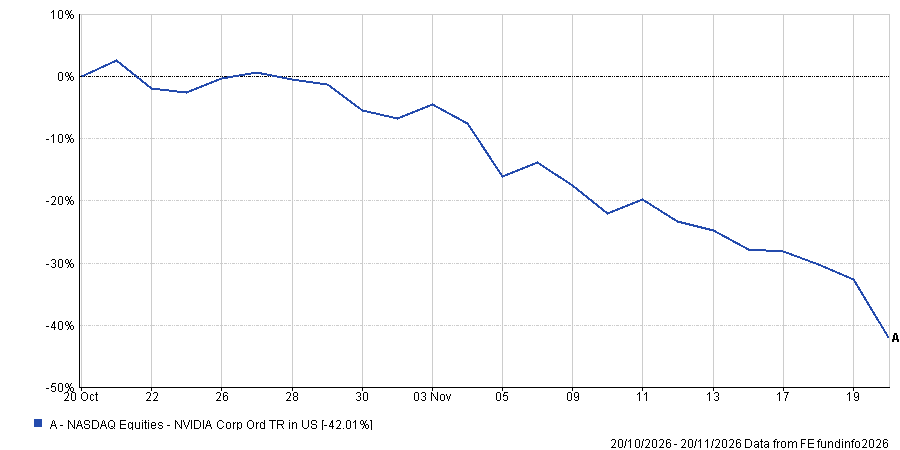
Source: FE Analytics
Among the positive signs he picked up from the annual report were the company increasing its share buyback and lifting capital spending, as well as the explanation of how Nvidia would treat the neoclouds, the smaller cloud providers such as CoreWeave that rent out their chips: Nvidia will keep sponsoring their growth but will not guarantee their borrowing until they reach certain levels.
Cahn said Huang's return was "brilliant for the market" and had helped the holding, although he said the position "wasn't looking so good on Friday", when the shares fell to around $125. He said market participants had wanted Huang back because he was "so strategic in the AI trade" and "the godfather of AI, literally".
He said the concern behind the sell-off was that momentum in the AI trade was fading and that data centres and similar businesses could be starved of financing. Huang's return, he said, had restored confidence, and CoreWeave had also risen about 30%.
“Jensen being instrumental in terms of just taking his big checkbook and saying, 'Right, well, we'll just give CoreWeave another $2bn, and we'll give them another $5bn,' and I just don't think Colette Kress had that capability and kind of nous," he said. He also pointed to Huang's ability to fly to Taiwan and ask TSMC's chief executive for a bigger allocation of chips.
The manager expected to trade the position rather than hold it, with an exit at 13x or 14x earnings for a return of about 30%, which he expected over the next six months.
"I think it's a dead cat bounce. I think we can trade this over the next six months," he said. "That's all I'm looking for. I'm not looking to be a hero."
The fund normally buys on a three to five-year view. For the longer term, Cahn was actually negative on Nvidia, as rivals including AMD, Broadcom and Intel are attacking the company’s lead, as are customers such as Amazon and Microsoft, who now design their own chips.
He also said AI models can now adapt to AMD's software in three to four days, which undermines CUDA, the software platform that has kept developers tied to Nvidia.
"The market may be growing, but market share is going to depreciate. It's the same cycle as we saw with Intel, where people used to pay an Intel tax [on server chips], and then it lost that market share and that went away. We all know about the Nvidia tax and people are tired of paying [it]," he said.
The 3% position is below the 4% Cahn is allowed for his highest-conviction ideas, and he said 3% was enough for him, as two unanswered questions still loom.
The first is how much revenue came from China through intermediaries in Singapore and south-east Asia. Cahn cited a Financial Times report that Singapore accounted for nearly 70% of Nvidia's revenue last year, with no breakdown of where that demand originated. He said clarity on sales to south-east Asia or the geofencing of chips destined for China, and an SEC inquiry that absolved Huang of wrongdoing, would answer "a big, big worry".
The second is the health of the neoclouds. "When you have the likes of a CoreWeave, particularly, and their bonds yielding 15%, that cost of capital is strangling them. The worry is how they will continue to fund their build-out," he said.
Cahn said the rally did not resolve those problems. "I still don't think the core problem with the trade has gone," he said, citing high interest rates and expensive funding. "I'm just still not sure where all the cash is coming from."
He said CoreWeave needed to raise money with its bonds trading at 16%, and that he doubted OpenAI could raise the sums it needed from a listing next year, saying its story on profitability and margins was weaker than that of other recent listings.
For investors holding data-centre stocks, he said he would consider reducing positions over the next couple of weeks if the momentum continued, and favour "picks and shovels" businesses instead.
Cahn was equally unconcerned that his own investors would object to him owning a stock he said he’d never buy. Credo Global Equity did not own Amazon until a few months ago, when the shares traded in line with the market, and it is now one of the fund's three largest holdings. He bought Alphabet at around $160 when, he said, nobody wanted it, and Meta when it was "on its knees".
"Hopefully the investors in my fund understand our methodology and our mindset, and they trust the process. And the process is we won't chase themes, we won't chase valuations, and we'll buy equities that fit our investment profile," he said.