






Saving is not only about making sure you are prepared for emergencies or major life milestones such as buying a home or funding a child’s education. It can also be a way to invest in the experiences that make life memorable – including a bucket-list holiday.
A Stocks & Shares ISA can be an effective vehicle for this kind of goal, as you don’t pay tax on investment growth or income and you can take the money out whenever you need it.
Recent analysis from AJ Bell suggests that a multi-country holiday might cost around £5,000 per person, while a more luxurious itinerary could run to between £10,000 and £20,000 each. For a couple, the total could therefore reach £40,000 – a target AJ Bell noted is achievable by investing £500 a month over five to seven years in a medium-risk portfolio.
With this scenario in mind, Trustnet asked fund selectors which funds might suit these parameters.
Rob Morgan, chief analyst at Charles Stanley, said: “You would expect a balanced 60/40-style portfolio to beat cash roughly 70% to 80% of the time over this sort of period – plus, when investing regularly, the odds improve slightly because the pound-cost average smooths volatility.”
Nonetheless, he noted that five years can be considered a relatively short timeframe, adding that a drawdown in markets towards the end of the period could partially undo diligent saving.
As such, he said it is worth considering a more cautious or balanced approach to “harness the potential for a higher return from investments while smoothing out the bumps and help reduce the risk of a sharp market sell-off curtailing holiday plans”.
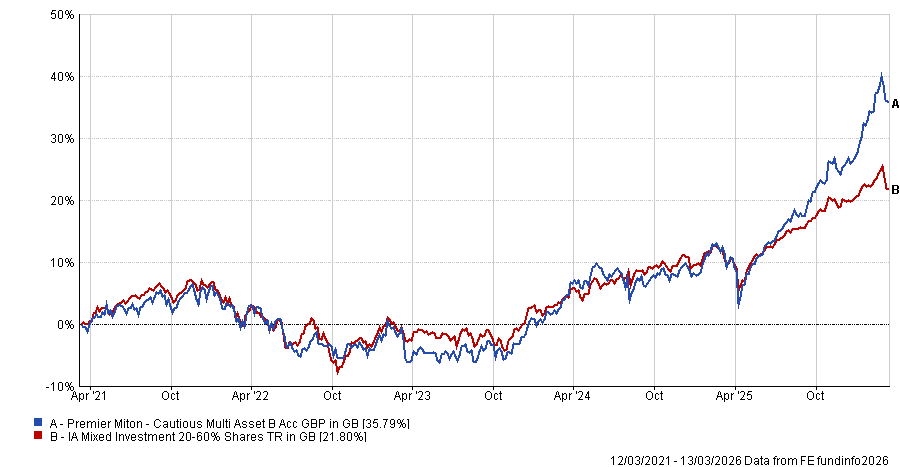
Morgan suggested a well-diversified multi-asset fund with an absolute return mindset: the £279.7m Premier Miton Cautious Multi Asset, which has been co-managed by Anthony Rayner and David Jane since 2014.
Rayner and Jane invest by identifying long-term economic, social, technological and environmental themes and combining them with short-term macroeconomic views, with position sizes driven by risk rather than conviction.
Morgan highlighted the managers’ flexible approach across global equities, fixed income, cash, property and commodities while maintaining a focus on downside risk and asset class correlation.
“There is the potential to add some protection during more difficult times,” Morgan said. “This should give it the ability to perform well in relative terms across a variety of market conditions.”
The biggest position in the portfolio currently is 3.2% in Invesco Physical Gold ETC.
Performance of the fund vs sector over 5yrs
Source: FE Analytics
Meanwhile, Jemma Slingo, pensions and investment specialist at Fidelity International said: “If you have a six-year time horizon and are saving £500 a month you will need an annual growth of roughly 5% – minus fees – to hit your £40,000 holiday goal.”
She noted that a passive fund could be an attractive option, due to their typically much lower cost “meaning your returns will be less weighed down by fees”.
She suggested iShares Core FTSE 100 UCITS ETF or the Legal & General Global Equity Index Fund.
The £14.6bn iShares exchange-traded fund (ETF) tracks the performance of companies in the FTSE 100 and, as such, has enjoyed a strong run in recent months. In 2025, the FTSE 100’s value tilt and exposure to energy and financials drove performance as it gained 25.8% versus a 9.3% return from the Magnificent Seven dominated S&P 500.
However, this does mean the ETF will suffer when the FTSE 100 falls – for example, iShares Core FTSE 100 UCITS ETF lost 11.5% in 2020.
In contrast, the £1.7bn Legal & General ETF tracks the performance of the FTSE World index and therefore has benefited from the AI surge, with the Magnificent Seven all in its top 10 holdings.
Alternatively, Slingo also noted that Fidelity Global Dividend “has achieved a relatively steady gain over the past decade and avoided severe drops” by keeping volatility low, adding it can serve as a useful diversifier for investors with lots of exposure to the US market.
The fund was recently highlighted by Trustnet as a strong defensive anchor option for investors wanting global equity exposure in their portfolios with more protection during periods of volatility.
“As your holiday deadline approaches, it might make sense to shift your portfolio into less risky assets, such as cash or bonds,” Slingo said.
Dan Coatsworth, head of markets at AJ Bell, said five years is indeed not a long time to risk your money in equity markets, meaning investors may choose a less risky actively managed fund that generates predictable or reliable earnings.
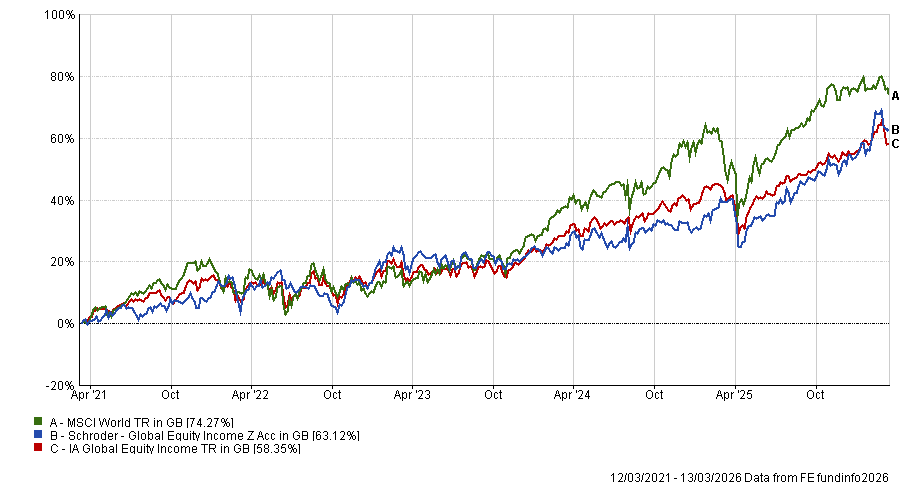
He suggested Schroder Global Equity Income – which was also previously highlighted as a complementary fund to hold alongside Fidelity Global Dividend.
“It could fit the bill as it invests in financially strong companies that pay dividends and which trade on inexpensive valuations,” Coatsworth said, noting that lower valued names “might have less to lose if there are widespread stock de-ratings”.
The fund’s portfolio includes banks, healthcare companies, telecom providers and engineering firms. While these may not generate the same income streams as more growth-tilted stocks, Coatsworth said “slow and steady can win the race”.
“In a down market, investors often gravitate towards income-paying stocks in the hope of being paid to wait for a market recovery, and that should work in the Schroder fund’s favour,” he said.
Coatsworth said that someone who put £500 a month over the past five years into the accumulating version of this Schroder fund would now have a pot worth £42,500 – “the perfect amount for a bucket-list holiday for a couple”.
“By picking the ‘Accumulation’ version, all dividends are reinvested so you enjoy compounding benefits,” Coatsworth said.
Between 2020 and 2025, the fund delivered two top-quartile annual returns compared to its peers in the IA Global Equity Income sector, most notably gaining 4.9% in 2022 – a generally poor year for equity markets – while the sector lost an average of 1.9% and the MSCI World index lost 7.8%.
Coatsworth nonetheless warned that cheap stocks can stay out of favour for a long time unless there is a clear catalyst to drive a re-rating.
“But the benefit of saving for a dream holiday is that you don’t have to hit the target exactly at five years,” Coatsworth said.
“If your investment hasn’t produced the necessary returns in time, stick at it and postpone your holiday until you are in a financially stronger position to go on your travels – after all, good things come to those who wait.”
Performance of the fund vs sector and benchmark over 5yrs
Source: FE Analytics