






Market volatility may leave investors feeling more hesitant this ISA season, with geopolitical tensions, stubborn inflation and shifting interest-rate expectations clouding the outlook.
Against this backdrop, capital preservation and steady returns may become the priority for those taking a more cautious approach.
With this in mind, Trustnet asked fund selectors to identify lower-risk options they believe can offer resilience through uncertainty.
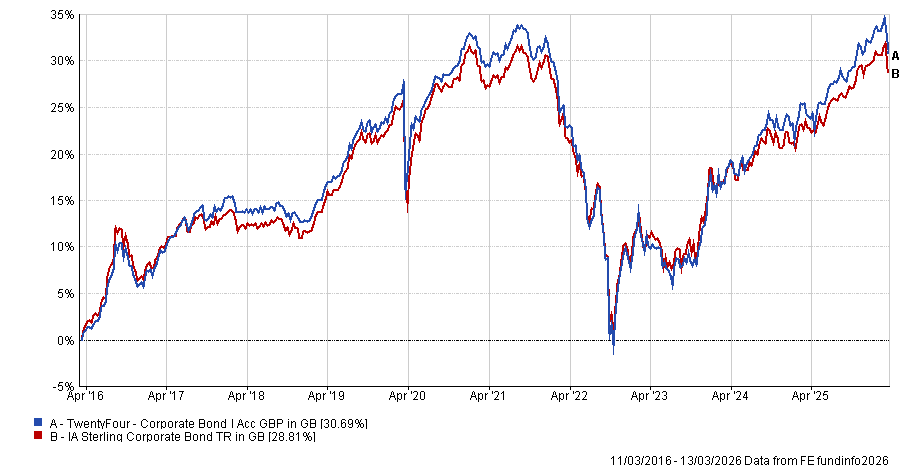
First up, Paul Angell, head of investment research at AJ Bell, suggested the £1.1bn TwentyFour Corporate Bond.
Managed by Chris Bowie, Jack Daley, Gordon Shannon and Johnathan Owen, it predominantly invests in investment-grade corporate bonds, pays income quarterly and has beaten the sector average return in five of the past 10 calendar years.
Angell noted that the management team has “impressive expertise” across multi-sector bonds, investment-grade bonds and asset-backed securities.
“Whilst the shape of the portfolio in recent years has tended to offset an underweight to interest rate risk with an overweight to credit risk, the fund has actually been underweight both interest rate and credit risk more recently, given the managers’ caution around the right level of credit spreads,” he said.
Investment-grade credit spreads remain tight, so the bulk of the fund’s around 5.5% yield continues to come from the “relatively high risk-free rate in the UK”, he added.
“Providing no major pullbacks in credit spreads, the fund should be able to deliver its 5.5% yield over the coming 12 months, with potential for additional capital returns should interest rate expectations in the UK fall.”
Performance of the fund vs sector over 10yrs
Source: FE Analytics
Alex Farlow, associate director of multi-asset research at Titan Square Mile, said both Janus Henderson Absolute Return and Schroder Global Multi-Asset Cautious may appeal to for those seeking lower-risk investment options.
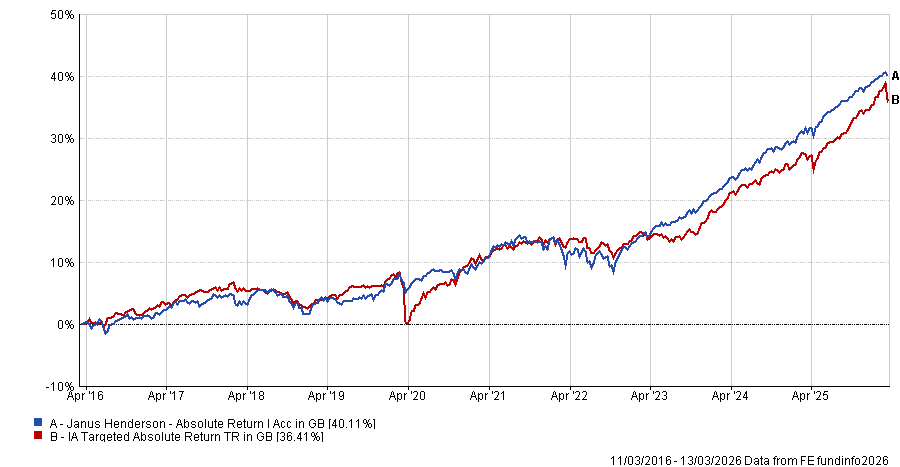
The £1.4bn Janus Henderson Absolute Return fund is co-managed by FE fundinfo Alpha Managers Ben Wallace and Luke Newman, who aim to provide a positive return in all market conditions over any 12-month period.
It is a long/short fund that primarily invests in UK equities, although it can allocate up to 40% in international equities. The end portfolio consists of core and tactical positions, with core constituents being longer-term holdings for the fund – typically 12 months. The tactical positions are more opportunistic investments where the managers seek to take advantage of short-term catalysts.
“There are undoubtedly other funds within its peer group which may produce higher returns but with that comes higher volatility,” Farlow said.
The fund holds a Titan Square Mile ‘A’ rating, with Farlow noting “it sets out to be a ‘sleep-well-at-night’ fund, providing steady returns whilst avoiding significant drawdowns”.
“The fund’s managers have ultimately demonstrated their ability as stock pickers, which has helped generate alpha, but they have also protected investors’ capital to a high degree in periods of market stress,” Farlow said.
Investors should note the fund charges a 20% performance fee based on beating the Bank of England base rate over rolling three-year periods.
Performance of the fund vs sector over 10yrs
Source: FE Analytics
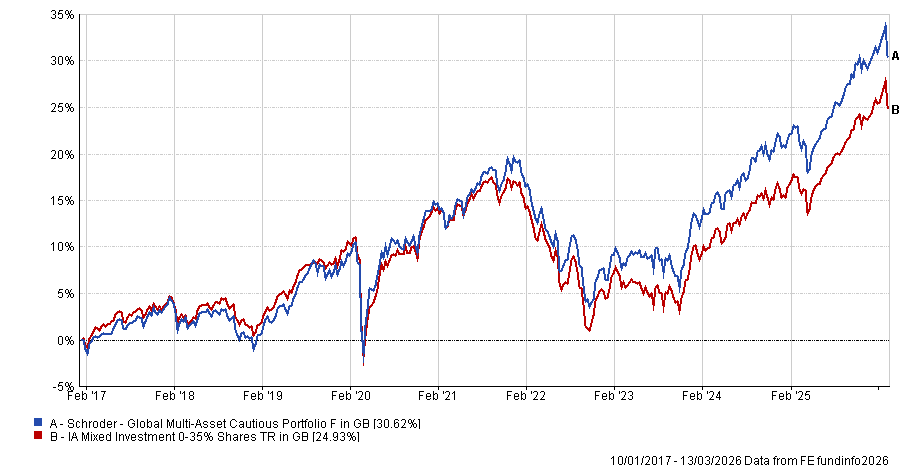
Schroder Global Multi Asset Cautious is another capital accumulation-oriented strategy that targets volatility of 30%-45% of global markets over a rolling five-year period.
The fund sits within Schroders global multi-asset portfolio range of funds, co-managed by Philip Chandler and Tara Fitzpatrick.
It delivered top-quartile returns against its peers in the IA Mixed Investment 0-35% Shares sector in 2024, 2023 and 2021, gaining 6%, 7.3% and 4.6% respectively.
“We believe that the fund’s investment approach, which utilises a combination of asset allocation and active stock selection of those managing the underlying funds, along with the highly competitive fees, make this proposition a very compelling option for investors,” Farlow said.
Performance of the fund vs sector over 10yrs
Source: FE Analytics
Meanwhile, Riccardo Persona, private client investment manager at Whitman Asset Management, turned to funds offering exposure to a traditionally defensive sector – healthcare.
“It has historically been a defensive sector which investors tend to allocate to via equity exposure,” he said. “Cautious investors might instead consider investing in healthcare debt via a vehicle like the $1.1bn BioPharma Credit.”
The trust was established to invest in debt secured by approved life science products and targets a net total return on net asset value (NAV) of 8% to 9% per annum in the medium-term.
At of 31 January 2026, 89% of the portfolio was invested in senior secured loans, including purchased payments, and 11% in senior unsecured notes, convertible notes and other equity.
The investment trust was previously identified by Trustnet as a ‘triple threat’ trust – delivering top-quartile total returns over three years, a steady income stream and diversification away from investors’ equity and bond allocations.
“BioPharma still trades at a small discount [9.9%] to NAV and is ideal for an ISA wrapper due to the high yield,” Persona said.
Also on the investment trust side, several fund selectors suggested the £1.7bn Personal Assets Trust – a capital preservation strategy that aims to protect and increase value over the long-term by investing in a mixture of equities, bonds, gold and liquidity.
It is co-managed by FE fundinfo Alpha Manager Sebastian Lyon and Charlotte Yonge and currently has over 10% invested in gold bullion and around 40% in equities, with its largest positions in Unilever (4.5%), Alphabet (4%) and Visa (3.4%.). The remaining 50% is held in bonds.
Emma Wall, chief investment strategist at Hargreaves Lansdown, said “the trust’s allocation to gold has been welcome in recent years, as has its focus on downside protection”.
Last year, Personal Assets Trust was highlighted as one of only two investment trusts boasting an Alpha Manager and an FE fundinfo Crown Rating of five. It was also previously picked as one of the best investment trusts for first-time investors.
Jason Hollands, managing director at Bestinvest, said: “For investors unsettled by geopolitical events and the debate around a potential AI bubble, [this trust] stands out as a defensive option.”
He noted that the trust has historically dampened volatility and limited drawdowns in turbulent markets.
“It won’t shoot the lights out in a raging bull market but for those prioritising resilience over excitement, it merits consideration,” Hollands said.
For investors who prefer an open-ended fund structure, Angell said the Trojan fund is a good option, noting it is managed by the same team and has the same philosophy and approach as Personal Assets Trust.
Trojan was also the pick of Ben Yearsley, director at Fairview Investing, who noted the fund is “a great all-rounder as the companies it tends to own have strong balance sheets and resilient cashflows”.
“What worries them most is the permanent loss of capital and they do everything they can to avoid that,” Yearsley said.
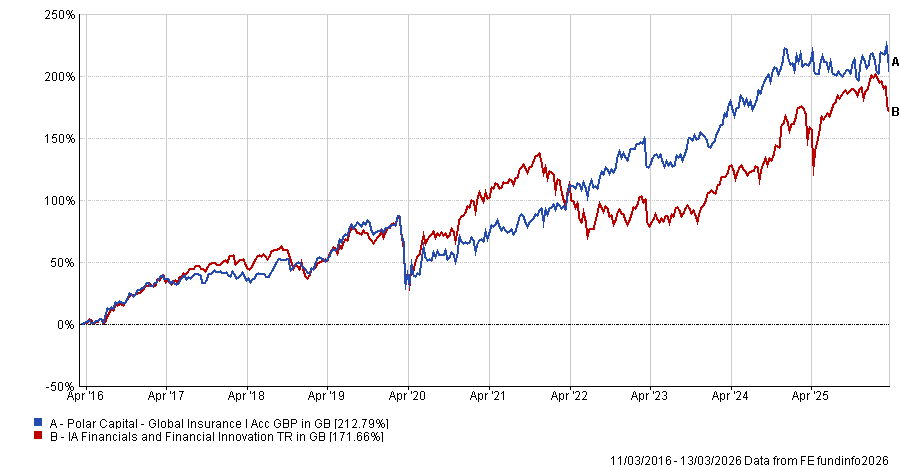
His second ISA pick for more cautious investors is Polar Capital Global Insurance.
The £2.4bn fund is co-managed by Nick Martin and Dominic Evans, and aims to act as a pool of underwriting capital by investing in high-quality insurance businesses with underwriting discipline.
“The companies it invests in make their money from getting their underwriting right,” said Yearsley.
The fund operates a buy-and-hold strategy with minimal turnover, typically limited to one or two changes per year. Its top 10 holdings currently include Chubb, Renaissance Holdings and Beazley.
Performance has been mixed in recent years, with the fund sitting in the first quartile for returns in the IA Financials and Financial Innovation sector in three of the past 10 years and in the fourth quartile for returns in four years over the past decade.
Performance of the fund vs sector over 10yrs
Source: FE Analytics