






The BlackRock Investment Institute has gone overweight US equities just three weeks after dropping its position to neutral, following a ceasefire between the US and Iran last week.
While negotiations between the two sides broke down over the weekend, with US president Donald Trump threatening to place his own toll blockade along the Strait of Hormuz, analysts at the firm said that “the fact that they began in the first place indicates that there are strong economic incentives for all parties to end the conflict”.
The team, headed by Jean Boivin, had been waiting for signs that the war would end, with two key points required: the reopening of the Strait of Hormuz and indications that any lingering macro impact would be contained.
On the first, they said the ceasefire is an “important development”, while the “threshold to return to war is high”.
Following the pause on military action, Brent crude fell below $100 a barrel, the S&P 500 gained about 3.6% on the week and 10-year US treasury yields came off their highs.
On the second, the analyst said they estimate that accrued supply disruptions are “significant” and will take time to dissipate; however, the overall impact is likely to be around “0.2-0.3 percentage points of drag on global growth,” they said.
“Europe is the most impacted, with a 0.5% drag this year, while APAC’s drag is 0.3% and the US drag is just 0.1%. And the two-week ceasefire represents a meaningful step towards re-opening the strait.”
They also highlighted Trump’s planned summit with Chinese president Xi Jinping in mid-May as “another incentive for de-escalation”, as much of the oil transported through the Strait is sent to China.
This comes at a time when expectations for corporate earnings have climbed for both the US and emerging markets this year, as the chart below shows.
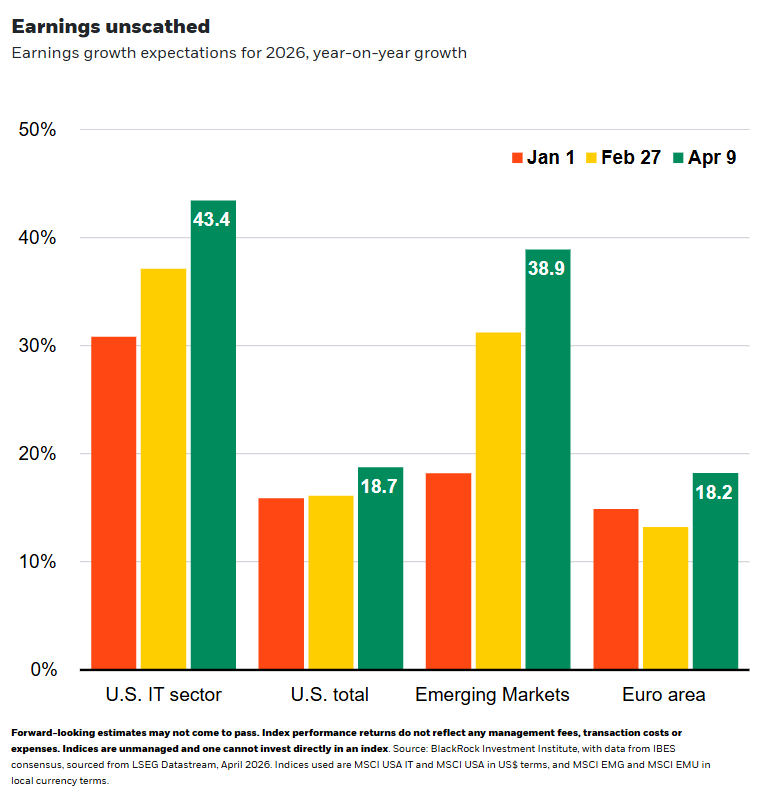
In particular, the outlook for technology stocks has improved, with earnings growth expectations of 43% in 2026, up from 26% last year. This is at the same time as the 12-month forward valuation of the US tech sector relative to other sectors hit its lowest level since mid-2020.
The strength of the AI theme has also informed an overweight to the emerging markets, where companies in South Korea and Taiwan – key producers of the hardware needed for AI – are “driving emerging market earnings upgrades”.
“In the US, the forecast 80% boost to semiconductor stock earnings this year is helping drive upgrades in tech and overall,” they added.
To fund their overweights, the team has reduced its cash-like investments in short-dated European government bonds, which it took out a few weeks ago after markets moved to rapidly price in several rate hikes by the European Central Bank at the start of the conflict.