






Investors remain significantly under-allocated to artificial intelligence despite widespread concerns about overexposure, with the average EMEA portfolio holding 13% less AI exposure than the MSCI AC World benchmark, according to BlackRock.
Strategists at the asset management house argued that recent market moves reflect a rotation within AI rather than an exit from the theme, even as geopolitical shocks and policy uncertainty have driven sharp swings in sentiment.
While investors’ self-reported risk appetite turned sharply bearish in early April, this has since recovered, with equity exchange-traded products (ETP) flows continuing to run ahead of 2025 levels.
Evy Hambro, global head of thematic and sector-based investing at BlackRock, said: “We maintain conviction in AI as a durable investment theme, with opportunities continuing to broaden as energy becomes an even bigger bottleneck.”
Rather than crowding into a narrow group of mega-cap technology stocks, capital has been moving upstream into supply chains and into second- and third-order beneficiaries. These include commodities, energy and infrastructure, reflecting the growing importance of power and physical inputs in scaling AI.
Client polling by BlackRock shows a 50% spread between the year-to-date performance of leading semiconductor stocks and lagging application software within the S&P 500, widening to 70% before the end of February. This dispersion has been accompanied by a sharp upgrade cycle: headline earnings per share expectations for global semiconductors now stand at $686 for 2026, up from $460 at the start of the year.
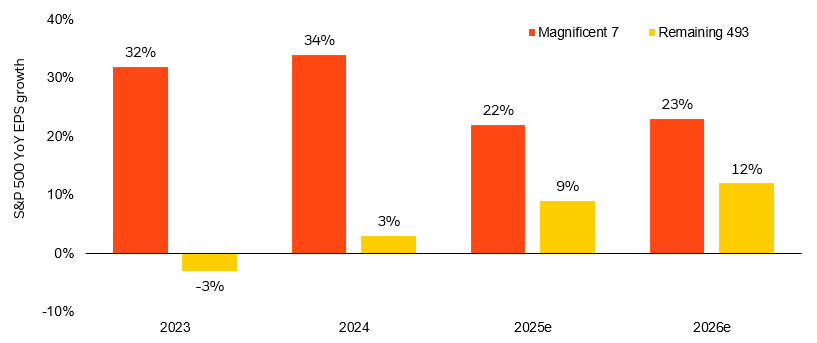
Difference in EPS growth year-on-year for Mag 7 versus other 493 S&P 500 stocks
Source: Bloomberg, as of 16 April 2026.
The firm said this widening opportunity set is reshaping how investors access the AI theme.
As capital intensity rises and leadership shifts across the AI stack, growth is expanding beyond the initial mega-cap beneficiaries. The Magnificent Seven now account for 34% of the S&P 500, prompting some investors to adopt capped or custom index approaches to manage concentration risk while maintaining exposure to long-term AI growth.
Energy has emerged as a central part of the shift. Data centres already account for around 5% of US electricity demand, a figure that could rise to 12% by 2030 as AI adoption accelerates. Despite this, EMEA multi-asset portfolios remain structurally underweight energy relative to global benchmarks.
Flows suggest this under-allocation persists. Global energy ETPs attracted $16.9bn in 2026 following three consecutive years of net outflows, which BlackRock said reflects a gradual reallocation rather than a crowded trade. The firm argued that supply-demand imbalances, combined with rising power needs from AI infrastructure, could support the sector over the long term.
Emerging market equities offer another route into the theme, spanning both upstream hardware supply chains and downstream adoption. EMEA-listed emerging market equity ETPs have attracted $21.7bn of inflows this year, making 2026 already the second-largest year on record. BlackRock said this reflects both tactical positioning and a structural shift as investors seek broader exposure to AI beyond US mega caps.
Despite the continued focus on growth, the backdrop has become more complex. The Middle East conflict has added to uncertainty around inflation and growth, particularly in energy-importing regions such as Europe, while trade tensions and US-China relations remain an overhang. In this environment, BlackRock said investors are not reducing risk outright but are instead seeking ways to remain invested while improving resilience.
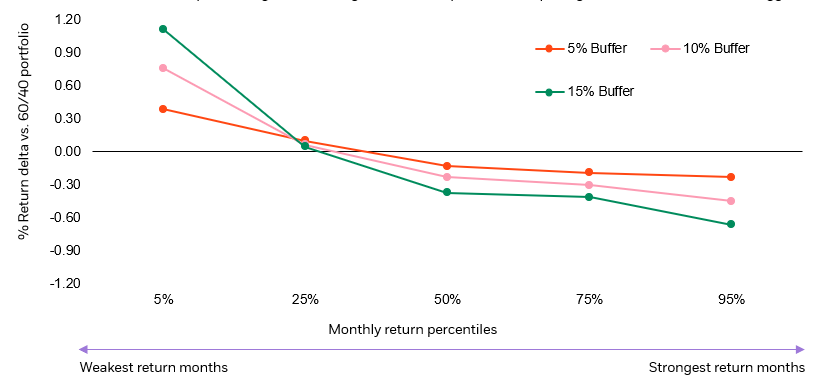
Ahmed Talhaoui, head of BlackRock Systematic Group for EMEA and APAC, highlighted the growing role of equity buffer strategies in achieving this balance. EMEA-listed US equity buffer ETPs attracted $267m last year, more than three times the 2024 total, as investors looked to limit downside without giving up market participation.
"By targeting defined outcomes and dampening negative outliers, buffers can enhance overall return distribution without sacrificing efficiency," Talhaoui said.
Difference in return when implementing buffer strategies in a 60/40 portfolio
Source: BlackRock
The shift reflects a broader reassessment of traditional diversification. Stock-bond correlations have become less reliable, with equities and bonds falling together in late Q1 in the worst month for the 60/40 portfolio since June 2022. In response, investors are expanding their toolkit to include liquid alternatives and more explicit downside protection strategies.
Hedge funds have benefited, with BlackRock noting their ability to generate returns from dispersion rather than market direction. However, allocations remain relatively modest, at around 5% among EMEA portfolios that hold them, compared with a suggested 10% allocation.