






New Capital Global Equity Conviction, Capital Group New Economy and a cluster of ESG-screened index funds have been most closely aligned with the growth investing style over the past three years, Trustnet research shows.
Growth investing involves buying shares in companies expected to increase their revenues and earnings faster than the broader market, often regardless of current valuation. Investors in growth stocks are paying a premium for future potential, typically in sectors such as technology, healthcare and consumer discretionary.
The growth style has broadly rewarded investors over the three-year period to the end of April 2026, supported by enthusiasm around artificial intelligence and the continued dominance of US technology mega-caps.
The MSCI AC World Growth index returned 69.7% in sterling terms between May 2023 and April 2026, 10 percentage points ahead of the broader MSCI AC World. However, the period has not been without turbulence: concerns about stretched valuations among US technology giants and the returns on AI investment have periodically triggered sharp rotations into cheaper, value-oriented stocks.
In this article, Trustnet ranked all funds in the IA Global sector by their three-year correlation to the MSCI AC World Growth index to identify those that have closely tracked the growth style.
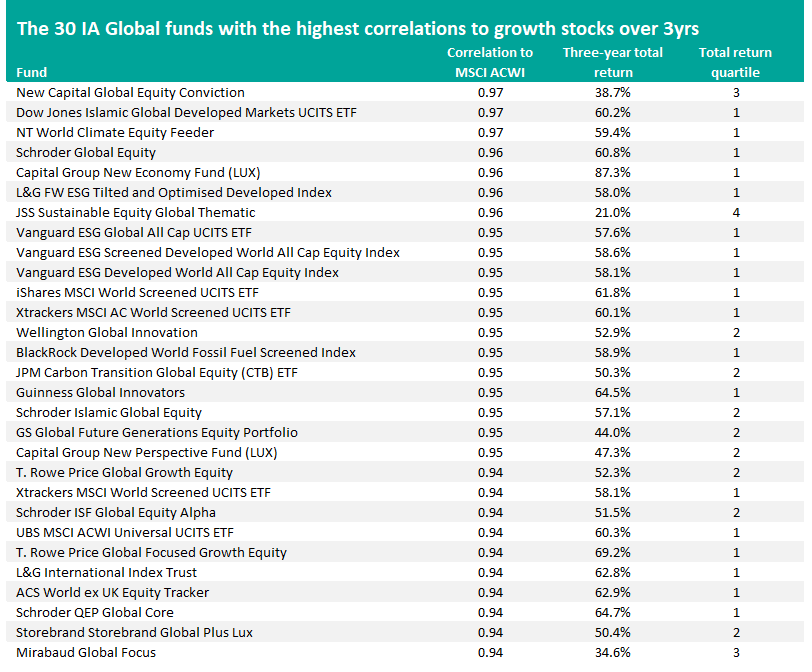
Source: Finxl. Correlation to MSCI ACWI Growth and total return in sterling between 1 May 2023 and 30 April 2026.
New Capital Global Equity Conviction is the fund with the highest correlation to the growth index, being very slightly ahead of Dow Jones Islamic Global Developed Markets UCITS ETF and NT World Climate Equity Feeder.
The fund, which is managed by Haichuan Yu and Jonathan Rawicz, invests in companies that can "sustainably grow their cashflows over time and utilise their profits to increase shareholder value".
Its largest allocations are to the US and information technology stocks, which are natural hunting grounds for growth stocks and a common factor among the funds with the highest correlation to the growth style. Nvidia, Alphabet and Apple are the three biggest individual holdings.
However, while New Capital Global Equity Conviction has the highest correlation to the growth index, it has made one of the lowest three-year total returns of the funds in the above table. Its 38.7% gain for the period under review puts it in the third quartile of the IA Global sector and is significantly below the 59.2% rise in the MSCI AC World.
Performance of Capital Group New Economy vs sector and benchmark over 3yrs to end of Apr 2026
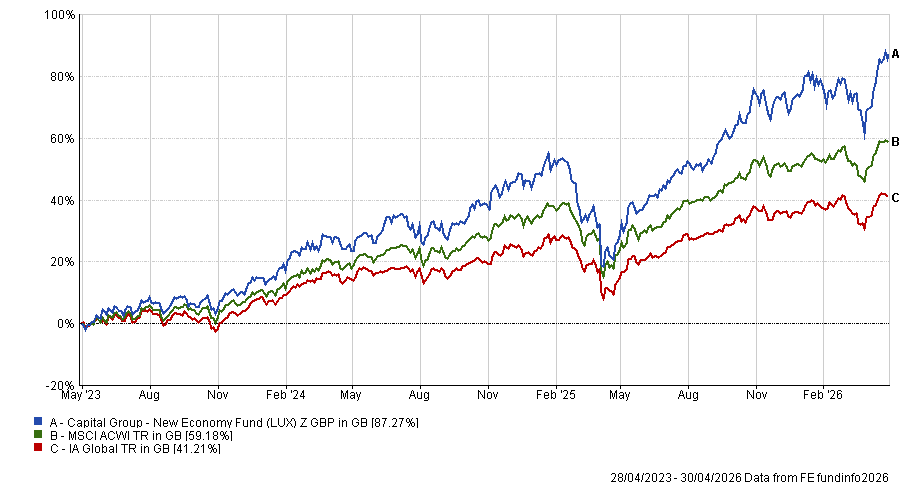
Source: FE Analytics. Total return in sterling between 1 May 2023 and 30 April 2026.
Capital Group New Economy has made the highest return of the funds with strongest correlation to the MSCI AC World Growth index, making 87.3% over the three-year period.
The reason for the strategy's correlation to the growth index is clear from its objective to invest in companies "that can benefit from innovation, exploit new technologies or provide products and services that meet the demands of an evolving global economy".
Alphabet, Broadcom and Taiwan Semiconductor Manufacturing Company are the biggest positions. While the portfolio's allocation to the US is in line with its MSCI AC World benchmark, it has 42.8% in information technology stocks – significantly higher than the index's 28.7%.
This is not the only fund on the list with a focus on investing in forward-looking, technology-oriented themes as Guinness Global Innovators, GS Global Future Generations Equity Portfolio and Wellington Global Innovation have similar mandates. All of these funds naturally fish in parts of the market where growth characteristics dominate.
Guinness Global Innovators has a place in the FE Investments Approved List. Analysts pointed to its strong track record in capturing the returns of growth-led markets thanks to its stock selection and consistent overweight to tech stocks.
"The fund's high-conviction, equally-weighted approach is designed to balance risk while maintaining strong exposure to 'growth' opportunities," they said.
"The team focuses only on financially strong companies, using a clear and consistent framework to assess quality, growth potential, valuation and momentum. It avoids hype-driven or speculative stocks, aiming instead for scalable, profitable companies."
Capital Group New Perspective is another strategy supported by analysts, with Rayner Spencer Mills Research putting the fund on its rated list.
It concentrates on investment opportunities stemming from changes in global trade patterns and economic/political relationships. It is overweight European stocks and underweight information technology, with overweight to industrials, consumer discretionary and healthcare names.
Rayner Spencer Mills Research said: "The strategy has a long track record, with good results across many cycles and investment regimes. Part of the focus is finding future global champions and part of the results achieved have been through the successful identification of these at a relatively early stage and owning them for the long term.
"The fund has invested at a relatively early stage in companies benefitting from secular growth trends driven by the global economy and with the ability and resources to capture these opportunities."
However, the most common theme is environmental, social and governance (ESG) or ethical screening: Vanguard ESG Screened Developed World, iShares MSCI World Screened, Xtrackers MSCI AC World Screened, L&G FW ESG Tilted and Optimised Developed Index and BlackRock Developed World Fossil Fuel Screened apply some form of ethical or environmental screen.
Meanwhile, JPM Carbon Transition Global Equity, NT World Climate Equity and JSS Sustainable Equity Global Thematic tilt towards environmental stocks; Amundi MSCI World Catholic Principles, Dow Jones Islamic Global Developed Markets and Schroder Islamic Global Equity are screened based on their respective religious traditions.
Although funds applying ESG or ethical screens might not be growth strategies by mandate, their screening methodology often systematically removes the cheaper, slower-growing parts of the market.
Standard ESG screens rule out large portions of energy, materials, utilities and traditional financials – which are the sectors that tend to dominate value indices. This points screened portfolios towards the technology, healthcare and consumer discretionary sectors, all of which carry higher valuations and stronger growth expectations.
There are also several vanilla index trackers among the funds that have been most closely correlated with the MSCI ACWI Growth index, such as L&G International Index Trust, ACS World ex UK Equity Tracker and UBS MSCI ACWI Universal.
This reflects the fact that growth stocks now constitute a large share of global market-cap-weighted indices, given the strong performance of US technology mega-caps such as Alphabet, Amazon, Apple, Meta, Microsoft, Nvidia and Tesla.