






AI has become such a powerful force across companies, sectors and regions that the traditional growth-versus-value split is becoming less relevant than the divide between companies impacted by AI either positively or negatively, according to Ankur Crawford, co-manager of Alger American Asset Growth.
“We are at a really interesting time where people still want to segment the market between growth and value,” she said.
Instead, people should really be defining the market as “old economy” – companies and industries that predate the AI era and whose business models are not being materially impacted – or those that are “AI-disrupted”, meaning companies whose business models, valuations or competitive positioning are being materially altered by the technology.
Crawford's strategy is therefore more about identifying and capitalising on change rather than ‘growth’ names, as “change begets growth", with the most change coming from stocks positively disrupted by AI.
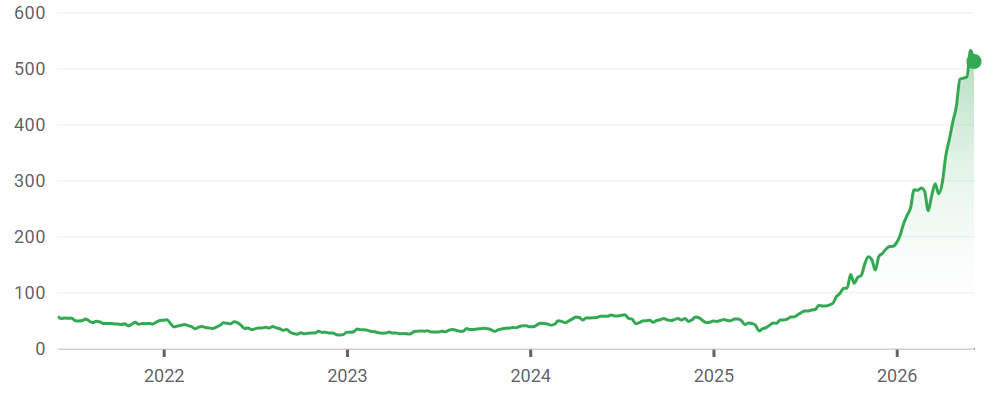
She illustrated this with portfolio holding Western Digital, a manufacturer of hard disk drives that most investors would not traditionally consider a growth stock. Yet the storage company has been a direct beneficiary of surging AI-driven demand for hardware – its share price has risen around tenfold since the start of 2025.
Stock price performance over 5yrs
Source: Google Finance
While it behaves like a growth-tilted AI stock on the upside, Western Digital’s earnings power is such “that it trades almost like a value stock” and behaves accordingly during a growth sell-off.
But the picture looks very different for many software companies, whose industry has long been considered a strong growth sector but it is now grappling with the threat of AI displacing traditional business models.
“A lot of software companies are being somewhat disintermediated by what is happening in AI,” Crawford said.
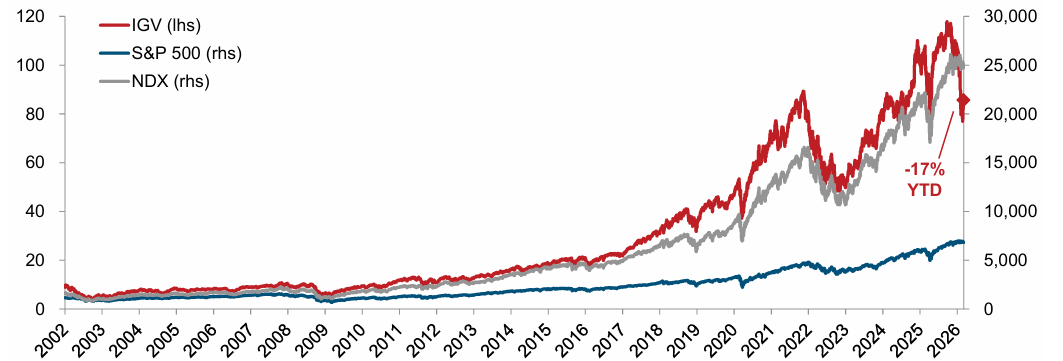
Indeed, recent Goldman Sachs research found that iShares Expanded Tech-Software Sector ETF (IGV) – which tracks the performance of 120 North American stocks in the software industry – lost 17% in the first quarter of 2026 and lost 26% from its 2025 highs.
Performance of iShares Expanded Tech-Software Sector ETF
Source: Goldman Sachs, FactSet
Valuations have also fallen sharply, with companies in the ETF trading at 22x on average, well below their Covid-era peak of 51x.
For Crawford, this is further evidence that the more meaningful question for investors is not whether a company is growth or value, but whether it sits on the right or wrong side of the AI disruption divide.
Looking ahead, the manager is in no doubt that the AI disruption has much further to run.
While Alger American Asset Growth has been focused on AI since 2016, she said the market remains “in the very early innings of a massive change in technology in our economy”. As such, it is "crucial" for investors to have a roadmap for where they think the technology is going, what changes may occur in the market because of it and ultimately who will be the winners and leaders.
“Historically, correlations have been incredibly high within sectors – software stocks would move together, hardware stocks would move together, because the end-market driver was a common factor,” she said.
If these end markets and opportunity sets begin to diverge within the same groups, Crawford expects there to be “massive divergences” in terms of which companies work from an investment standpoint.
She added that further ripples of change will come from developments in things like physical AI, which includes autonomous robots and vehicles – possibly as soon as within three to five years.
As such, Alger American Asset Growth’s management team is beginning to consider which companies will benefit from this shift across the supply chain.
In the nearer term, there are also geopolitical dynamics to consider.
“Access to AI can really change geopolitical positioning on the global stage. During the software surge, India was a big beneficiary of outsourcing of call centres and consulting but that entire market is a former disruptor getting disrupted,” she noted.
“AI is posing real existential questions for both companies and countries, and it will have an impact on future GDP, growth and populations.”