






For some investors, the priority is not growth but protection. In uncertain markets, those who sit at the lowest end of the risk spectrum often look for portfolios designed to smooth out volatility.
The £1bn Vanguard LifeStrategy 20% Equity fund is one such option for the most cautious investors, with 20% of assets allocated to equities and the rest sitting in fixed income, forming a low-volatility anchor for investors who want stability above all else.
In the final article of Trustnet’s series looking at funds to hold alongside Vanguard’s LifeStrategy suite, we asked fund selectors which strategies could complement Vanguard LifeStrategy 20% Equity.
Darius McDermott, managing director at Chelsea Financial Services, said the Vanguard fund is “as defensive as a passive fund gets – but passive means you take whatever the market gives you on the downside too”.
For investors at this end of the risk spectrum, McDermott said “we would want a genuine shock absorber alongside it”, suggesting the £121.3m SVS RM Defensive Capital fund.
“It deliberately invests where others don’t look – unloved, under-researched assets trading well below intrinsic value, from high-yield bonds to discounted investment trusts in biotech and private equity,” he said.
“Buy things cheaply enough and you build in defensiveness through valuation, not just asset class.”
McDermott said the result is a fund with low correlation to both equities and bonds that targets positive returns across market conditions.
“In a world where traditional hedges like gilts and even gold are behaving less predictably, that kind of genuinely uncorrelated return stream is exactly what a conservative investor needs.”
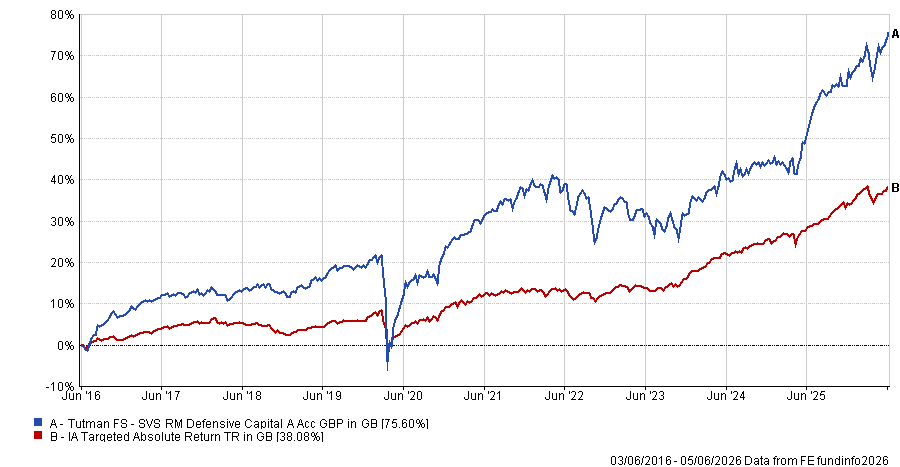
SVS RM Defensive Capital has posted a 75.7% return over the 10 years to the end of May 2026.
Performance of fund vs sector over 10yrs
Source: FE Analytics
Meanwhile, Sheridan Admans, founder and chief investment strategist at Infundly, looked for a valuation-led fixed income strategy to hold alongside the cautious LifeStrategy fund, suggesting TrinityBridge Select Fixed Income.
The £762.2m fund is co-managed by FE fundinfo Alpha Manager Stephen Hayde and Andrew Metcalf and aims to generate income while preserving capital over the medium term, with a flexible mandate that allows the managers to hold cash or sovereign bonds when credit spreads look unattractive.
“Its willingness to do this gives it a defensive discipline, while its credit underwriting can add selective return potential when bond-specific opportunities appear,” Admans said.
The fund also incorporates a strong sustainability framework, targeting a weighted average carbon intensity below the ICE BofA Global Corporate Index and aiming for a 50% reduction by 2030, with net zero emissions by 2050.
Admans noted that TrinityBridge Select Fixed Income’s “edge” comes from “deep internal credit research, especially in mispriced, unrated or underfollowed bonds”.
“I like the clear decision structure supporting accountability, selectivity and valuation discipline,” he added.
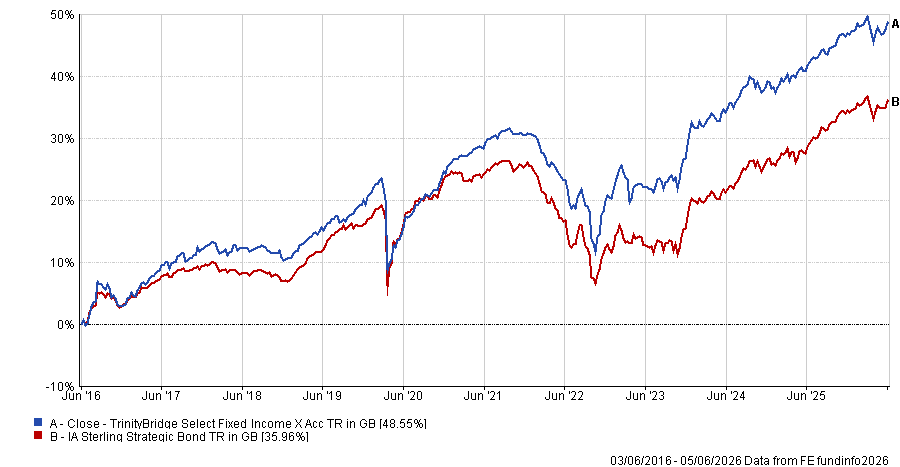
It has delivered a 49.9% return over 10 years.
Performance of fund vs sector over 10yrs
Source: FE Analytics
Admans also pointed to the £11.6bn Royal London Short Term Money Market fund.
He said it would complement the most cautious LifeStrategy fund by adding a cash-like, liquidity-focused holding to the overall portfolio, “reducing portfolio sensitivity to equity and bond market volatility, while offering incremental yield from high-quality short-dated instruments rather than taking meaningful duration or credit risk”.
“The appeal is its disciplined short-term structure,” Admans said. The fund uses diversified instruments such as certificates of deposit, commercial paper, repo and short-dated bonds, with liquid preservation at the centre.
“It gives cautious investors a clearer capital stability role than another active bond fund,” he said.
Given the defensive role of Vanguard LifeStrategy 20% Equity is designed to play its 80% allocation to fixed income markets, Paul Angell, head of investment research at AJ Bell, said investors would do well to diversify their risk away from the fund’s heavy fixed income exposure by pairing with the defensively-managed, multi-asset Trojan fund.
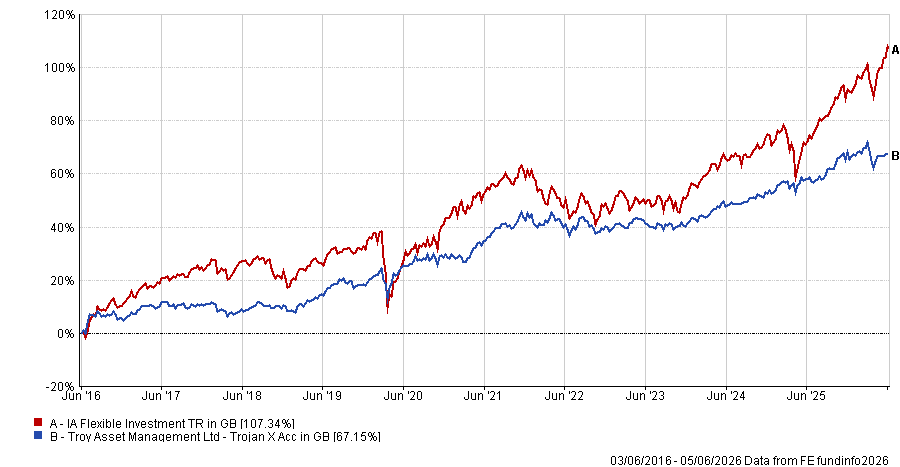
Managed by Alpha Manager Sebastian Lyon and Charlotte Yonge, the £5bn fund invests across quality-growth equities, government bonds, gold and cash. It currently holds 36% in equities, below its long-term 42% average, reflecting the managers’ view that equity markets remain vulnerable and that risks are not fully priced in.
“Despite being invested in major, liquid, asset classes, the fund still takes on market risk, and there is therefore no guarantee the fund will protect capital over any period,” Angell noted.
“That said, the fund’s long-term performance has been good, delivering a solid return profile with significantly less volatility than wider markets.”
Trojan typically plays a defensive role in portfolios, holding up when riskier assets such as equities and credit sell off.
“This has been the case through numerous market pullbacks, including the financial crisis, the outset of the Covid pandemic and the rising interest rate environment of 2022,” Angell added.
Performance of fund vs sector over 10yrs
Source: FE Analytics
Similarly, Dzmitry Lipski, head of funds research at interactive investor, turned to equity income strategies to also shore up the defensive equity layer of investors’ portfolios.
“Vanguard LifeStrategy funds hold equities but they are market cap weighted, not income-focused,” he said.
With income strategies tending to tilt towards value, quality and lower volatility sectors, they can still provide a natural ballast in weaker markets while also ensuring a steady income stream through companies generating consistent cashflows and dividends, Lipski noted.
As such, he suggested Artemis Income and Fidelity Global Dividend to “help improve return potential without fully changing the cautious nature of the portfolio”.
Fidelity Global Dividend was launched in 2012 and is managed by Alpha Manager Daniel Roberts with deputy Tristan Purcell. The 50-stock portfolio is tilted toward industrials and financials, with holdings demonstrating resilient cashflows, strong balance sheets and sensible valuations.
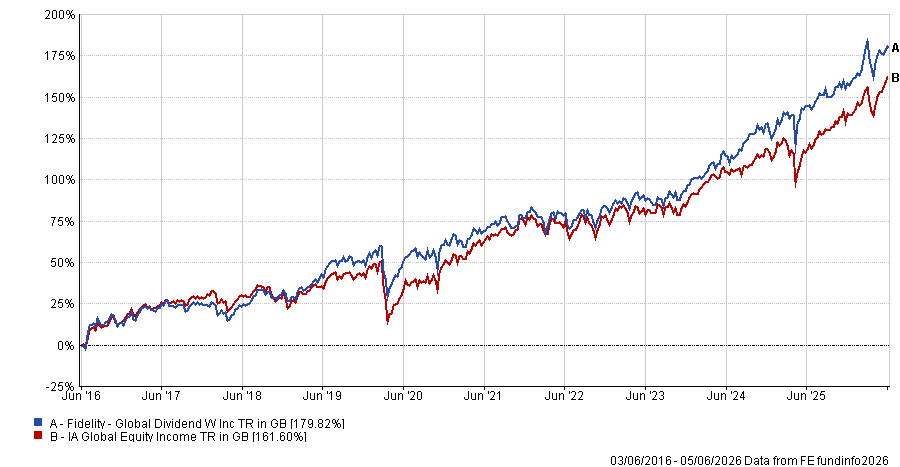
The fund has demonstrated consistency across market cycles, outperforming the IA Global Equity Income sector average in eight of the past 10 years.
Performance of fund vs sector over 10yrs
Source: FE Analytics
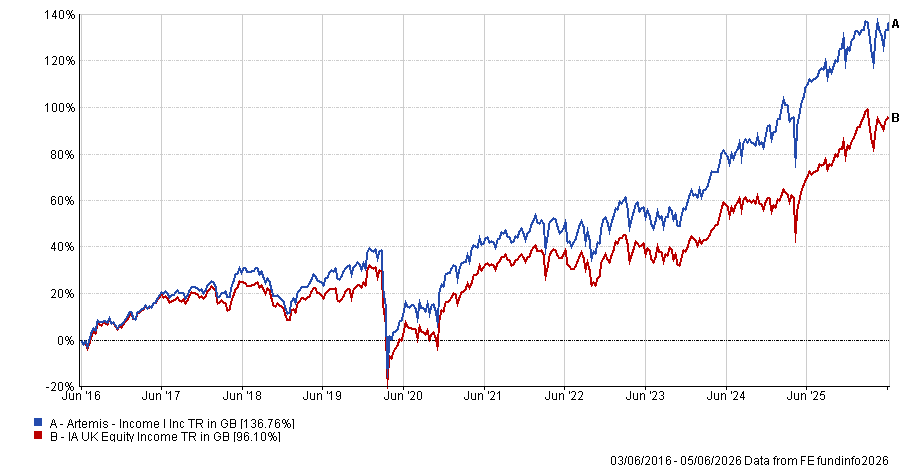
For investors who would rather invest in the UK, Artemis Income, a £5.3bn fund launched in 2000, is co-managed by Adrian Frost, Nick Shenton and Andy Marsh.
The managers take a style-agnostic approach, focusing on free cashflow yield rather than growth or value labels.
The similarly sized portfolio of 45-55 stocks also looks to dependable companies capable of supporting reliable dividends and long-term capital growth, including Tesco, Lloyds Banking Group and BP.
It is in the first quartile of the IA UK Equity Income sector over 10 years, gaining 133.5% in the 10 years to the end of May 2026.
Performance of fund vs sector over 10yrs
Source: FE Analytics