






While many investors are still debating whether AI is a bubble or not – and which big AI players will be left standing – others are investing in companies throughout the rapidly expanding supply chain that stand to benefit regardless.
Alec Cutler, manager of Orbis Global Balanced and Orbis Global Cautious, acknowledged that the demand driven by the biggest AI players – also known as hyperscalers – is real and structural, with these companies funnelling billions into the development of AI tools and infrastructure.
However, who will ultimately survive the AI race is less certain, with investors risking losing out if they bet on the wrong horse.
“After all, there is the relatively recent example about Uber spending half a billion dollars trying to generate a billion dollars of savings, coming up with nothing and curtailing the project after just four months of token use,” Cutler noted.
In addition, how AI will be used – and paid for – by the masses is also uncertain, he warned.
“Is AI a bubble? I don’t know – but what I do know is that keeping the portfolio in the lower-expectation fringes where the AI upside isn’t being credited means we can continue to participate as the AI build-out plays out,” Cutler said.
As such, he has turned to undervalued ‘picks-and-shovels’ among the energy, infrastructure and semiconductor companies that the AI industry depends on.
This line of decision-making included selling appreciated picks and shovel stocks like Siemens, according to Cutler.
“We were buying Siemens at $8 when people thought it was going out of business and that we would never need gas or steam turbines again – now its $150 to $160 and we have been selling since it was priced at $100,” he said.
“That money has been ploughed into lower-risk and higher-reward AI opportunities.”
As an example of where he is finding underappreciated opportunities, Cutler flagged his interest in Pennsylvania’s natural gas producers, arguing there is “absolutely zero AI premium” priced in and that they are “an asymmetric AI play”.
Using AI in real time requires data centres to be close to people to prevent issues such as latency – the time delay between sending a request to an AI system and receiving a response.
For crucial population centres along the East Coast of the US, such as New York, Cutler said Pennsylvania is conveniently placed and has a supply of cheap natural gas. This is not currently reflected in the stock prices of the state’s natural gas producers, he explained, because the Constitution Pipeline – a proposed 135-mile natural gas conduit from the Marcellus Shale to New York – has been blocked.
Cutler argued that hyperscalers could stand to benefit by erecting data centres near the supply (meaning no need for a new pipeline). This, in turn, would benefit Pennsylvania’s natural gas companies.
His AI strategy also draws on lessons from investing in the build-out of the internet. “I did a similar thing back then: buying the fibre optic stocks and the networking gear. I didn’t know who was going to win, whether it would be AOL or whoever else, but I did know they were all going to need a lot of fibre in the ground.”
At the time, he owned stocks like Canadian multinational telecommunications and data networking equipment manufacturer Nortel. While this company doesn’t exist today, he noted that “the key bit” – the fibre optic backbone – is still there and still being used.
Semiconductors over hyperscalers
Unlike the fibre optic cables of the 1990s, Cutler argued that the chip sets powering AI data centres are not built to last. Instead, chips will have short five- to six-year lifecycles before newer models will be developed, which makes them consumables rather than capital items.
This means demand for chips – and their manufacturers – will not peak and fade in the same way, Cutler said. These replacement cycles for chips will instead allow demand to keep resurging, ensuring a future pipeline for semiconductors like TSMC, which he has owned since 1995.
Cutler pointed to TSMC’s significant market share in the semiconductor industry, counting tech giants like Apple and AMD among its customer base.
Stock price performance over 5yrs
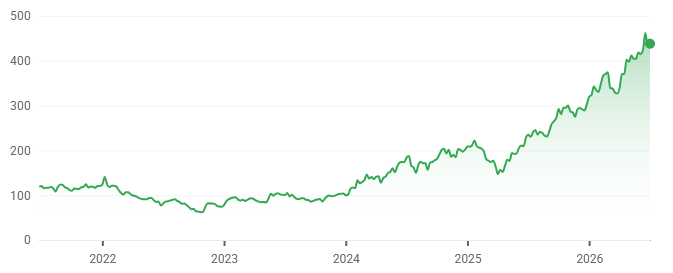
Source: Google Finance
However, some investors have been cautious of owning TSMC due to the risk of invasion from China. Although Cutler acknowledged that China invading Taiwan “would be a big disrupter”, he said this reality is “increasingly unlikely”.
“I think the Chinese have figured out that all they would really get from it is 24 million very unhappy people and smouldering husks of buildings instead of functioning fabs [fabrication plants manufacturing semiconductor chips],” he said.
Cutler then pointed out that the very same ‘China risk’ is not applied to the companies dependent on TSMC. “What about Nvidia?” he posited. “It would be out of business without Taiwan.”
Despite his belief that there is less risk of China invading Taiwan, Cutler is hedging his TSMC exposure by shorting the Taiwan dollar.
“Intel was also a hedge for me until it went up too much and became expensive – I don’t like expensive hedges,” Cutler noted.