






Since 2023, investors have had plenty to navigate – a shifting rate environment, rising geopolitical tension and an equity market increasingly dominated by a handful of AI-driven mega-cap names.
In this first instalment of a new Trustnet series, we have identified funds that delivered first-quartile returns consecutively from 2023 to 2025 and have done so again in the first half of 2026 – a test of consistency rather than a single strong year propelling performance.
We are starting with the multi-asset sectors, where managers arguably have the greatest flexibility, as they can shift allocations across equities, bonds, property, cash and alternatives as conditions shift.
Only 14 funds across IA Flexible Investment, IA Mixed Investment 20-60% Shares and IA Mixed Investment 40-85% Shares met these criteria. Notably, no funds from the most cautious multi-asset sector – IA Mixed Investment 0-35% Shares – are included in the final table below.
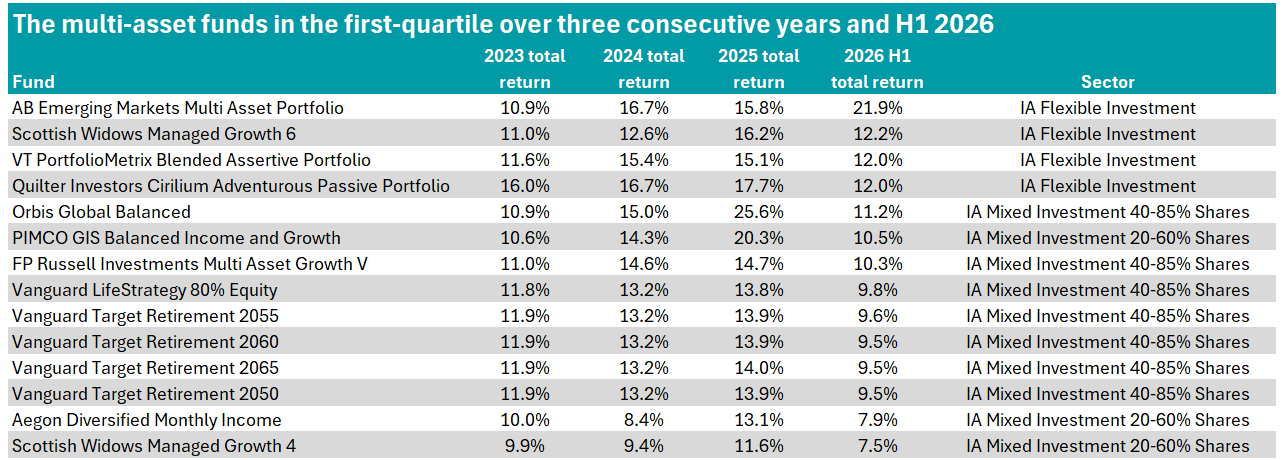
Source: FE Analytics
The standout performer in the first half of 2026 is AB Emerging Markets Multi Asset Portfolio, which gained 21% to the end of June – enough to rank it third across its whole sector over the six-month period.
The $1.1bn strategy, managed by FE fundinfo Alpha Manager Sammy Sazuki alongside Eric Liu, Richard Cao and Christian DiClementi, has leaned into the global AI roll-out, with TSMC holding a significant position in the portfolio at 10.1%, followed by Samsung at 6.8% and SK Hynix at 4.9%.
These growth stocks are, however, counterbalanced with more defensive holdings in the top end of the portfolio, such as ICICI Bank and Petrobas.
The recent run of performance by AB Emerging Markets Multi Asset Portfolio is all the more striking given its struggles just a few years earlier, when it eked out just 0.6% in 2020 before losing 12.7% in 2021.
Moving from emerging markets to a more globally diversified approach, the Orbis Global Balanced fund has also managed three consecutive years in the first quartile for returns in the IA Mixed Investment 40-85% Shares sector and a strong first half of 2026.
Co-managed by Alpha Manager Alec Cutler and Mark Dunley-Owen, the £2.4bn strategy is built around a simple but disciplined idea: find high-conviction investments trading below what the management team believes they are actually worth and hold them until the market catches up.
RSMR analysts said: “The fund’s active hedging and flexible asset allocation make it a compelling option for investors seeking active management beyond a traditional 60/40 portfolio with a three-to-five-year investment horizon.”
The analysts suggested that the fund can be blended with passive and/or growth funds to dampen drawdowns and can be seen as capital protection and a diversifier within portfolios.
Similarly to AB Emerging Markets Multi Asset Portfolio, the Orbis strategy also includes TSMC and Samsung among its top holdings.
Meanwhile, the bond sleeve has an average duration of 4.8 years and a yield maturity of 5.6%.
As well as logging a strong short-term performance, the fund was also recently identified for having held a maximum FE fundinfo Crown Rating for the greater part of the past decade.
At the other end of the active management spectrum, the £18.2bn Vanguard LifeStrategy 80% Equity strategy features in many UK investors’ portfolios as a core holding. It was the most bought multi-asset fund in 2025, attracting £1bn in net new money, while performance added £1.9bn.
True to the suite’s design, the fund keeps things straightforward with roughly 80% of assets housed in equities and 20% in bonds – no bold country or sector calls, although like the rest of the LifeStrategy range it carries a structural tilt toward the UK.
Beyond the past three years, Vanguard LifeStrategy 80% Equity’s longer-term track record has also been consistent: it has been in the first or second quartile every year from 2016 to 2025 in the sector.
Fund selectors have previously suggested holding funds such as JOHCM Global Opportunities, Thornburg Equity Income Builder and Schroder Global Equity Income alongside it.
Several other Vanguard funds from the firm’s Target Retirement range also appear in the table. These use a life-styling approach that automatically adjusts equity and bond exposures depending on proximity to the ‘retirement’ year set.
Meanwhile, one of three funds from the IA Mixed Investment 20-60% Shares sector to post first-quartile returns in 2023 to 2025 and for the first half of the year is the £872.7m Aegon Diversified Monthly Income fund.
It aims to deliver a target yield of around 5% per year, with the potential for capital growth over any five-year period.
The fund, launched in 2014 and managed by Vincent McEntegart and Debbie King, currently invests 41% of its assets in equities and 34.6% in bonds, with the remainder split between specialist income, listed property and cash. Geographically, the fund has a big weighting to the UK at 40.8%.
RSMR analysts said: “The Aegon Diversified Monthly Income fund offers investors access to a cost effective, unconstrained, global, multi asset approach to income generation.”
Scottish Widows Managed Growth 4 and PIMCO GIS Balanced Income and Growth are the other two from the sector. The latter is the best performer of the three so far this year, up 10.5%.