






Artemis Global Income became the most-researched fund among Trustnet users in the opening half of 2026, while investors spent more time looking into emerging market strategies.
Global markets faced a volatile first half of 2026, as a result of geopolitical shocks and booming AI-related investment. The US-Iran conflict disrupted oil markets and investor risk appetite during the second quarter but corporate earnings grew strongly over the period, helped by continued capital spending on AI infrastructure.
The S&P 500 had a decent six months, with technology, semiconductor and AI infrastructure companies accounting for a disproportionate share of gains, but emerging markets surged over the period, driven by AI hardware exposure in Taiwan, South Korea and China.
An insightful view of investor sentiment can be gained by looking for funds or sectors that have seen large increases or falls in their overall research share among Trustnet users. To do this, we take the funds' share of Trustnet factsheet views in the first half of 2026 and compare it with 2025 to identify the relative winners and losers.
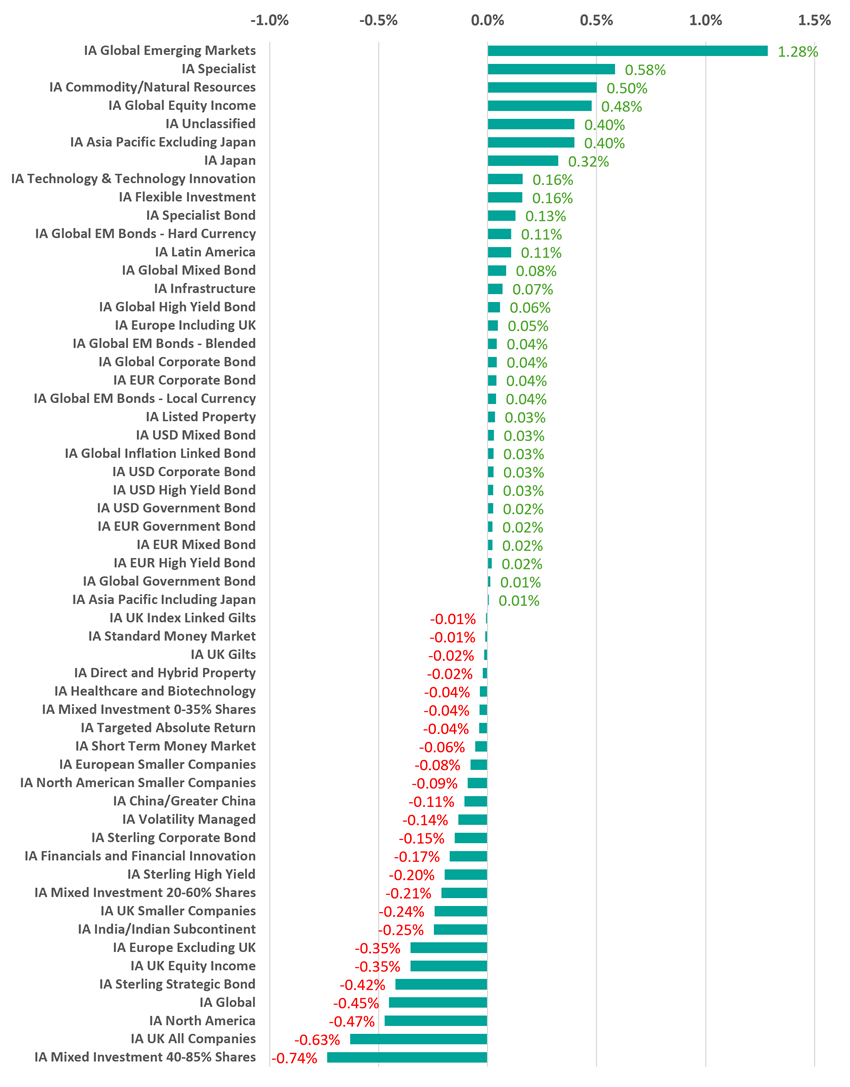
Change in sector research in H1 2026
Source: Trustnet, Google Analytics
One immediate finding is that investors have been spending less time researching the IA Mixed Investment 40-85% Shares, IA UK All Companies, IA North America and IA Global sectors – which are some of the biggest in the Investment Association universe – in favour of emerging markets, specialist and income strategies.
By far the biggest shift on a sector level was towards emerging markets. The IA Global Emerging Markets sector accounted for 2.31% of factsheet views in 2025 but this jumped to 3.59% in 2026's first half.
This coincides with a recent burst of outperformance for the asset class, following an extended period of lagging behind developed markets.
FE Analytics shows the MSCI Emerging Markets index made a 25.5% total return (in sterling terms) over the period, compared with 11.2% from the developed markets-focused MSCI World. Over the 10 years to the end of 2025, emerging markets' 145.9% was around 100 percentage points behind the MSCI World.
As well as attractive valuations following this underperformance, investors see emerging markets as a source of growth. Strategists at BlackRock favour a selective approach to emerging markets, pointing out that it is benefitting from structural investment themes such as artificial intelligence (helped by semiconductor exposure through Korea and Taiwan), infrastructure investment, energy security and rewiring supply chains.
"Consensus now expects headline earnings per share for the MSCI Emerging Markets index to grow by more than 50% this year versus 2025, compared with expectations for an increase of 18% at the start of the year," they added.
"Within our EM equity overweight, we see opportunities in Latin America, where AI-fuelled demand for critical minerals like copper and lithium should benefit the region's commodity and energy exporters."
IA Commodity/Natural Resources were researched more in the first half as commodity prices continued to rise amid the US/Iran conflict and constrained supply chains, while the quality and defensiveness of global equity income funds might have prompted investors to look at them during the period's more volatile times.
Source: Trustnet, Google Analytics
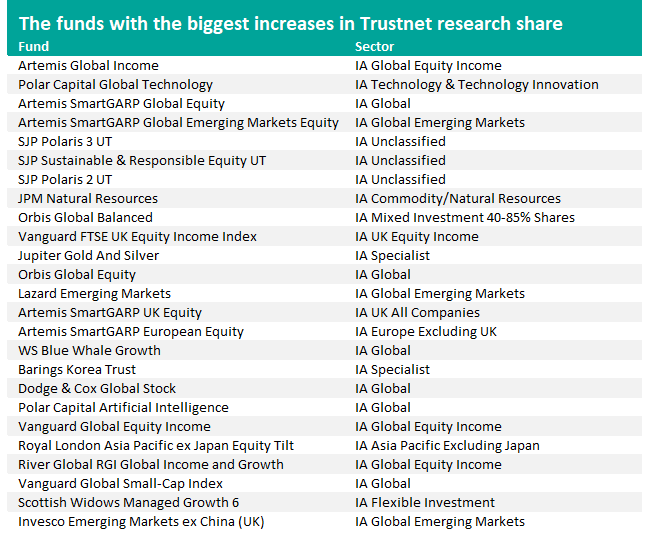
The most popular fund among Trustnet users over 2026's opening half was Artemis Global Income. It was responsible for 1.83% of all factsheet views in the Investment Association universe, up from 1.23% in 2025 – when it was the second most researched fund on Trustnet.
It is followed by Vanguard LifeStrategy 80% Equity (1.19% of factsheet views), Vanguard LifeStrategy 60% Equity (0.96%), Orbis Global Balanced (0.88%), Vanguard LifeStrategy 100% Equity (0.86%), Fundsmith Equity (0.77%) and Polar Capital Global Technology (0.67%).
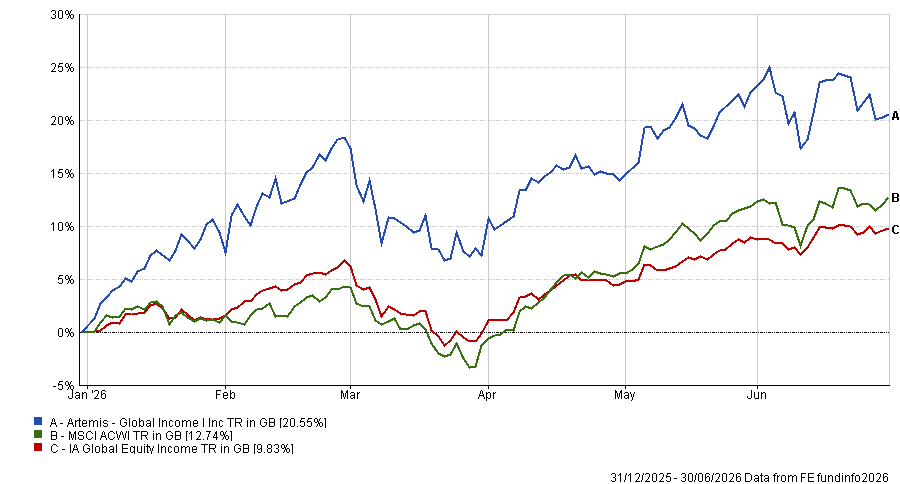
When we look at the funds that have grown their research share the most over the past six months when compared with 2025, Artemis Global Income is again in first place. The fund, which is managed by Jacob de Tusch-Lec and James Davidson, boasts sector-topping returns in recent years: it was the second-best performer in the IA Global Equity Income in the first half of 2026 and its best fund in both 2025 and 2024.
Performance of Artemis Global Income vs sector and index in H1 2026
Source: FE Analytics. Total return in sterling between 1 Jan and 30 Jun 2026.
The fund invests across companies of all sizes, combining bottom-up stock picking with a view on global economic trends to avoid missing key opportunities or taking on unintended risks. Rather than relying mainly on high-yielding mega-cap names for income, the manager favours large and mid-cap stocks, building the portfolio around a core of reliable quality names alongside cyclical and higher-risk special situations for balance.
Analysts at Titan Square Mile, which gave Artemis Global Income an A rating, said: "We believe this fund offers a high conviction strategy which at times, may contain concentrated positions (for example in banking stocks, and more recently defence companies) and so may experience prolonged periods of underperformance if these positions are out of favour, alongside periods of stronger performance.
"As a result, investors should expect a bumpy ride. However, the fund overall will offer a good diversification benefit to more traditional income strategies."
Four funds in Artemis' SmartGARP range – Artemis SmartGARP Global Equity, Artemis SmartGARP Global Emerging Markets Equity, Artemis SmartGARP UK Equity and Artemis SmartGARP European Equity – are also being researched more on Trustnet following a period of strong returns.
The SmartGARP process, which was developed by Philip Wolstencroft in the early 1990s, scores stocks across eight different factors: growth, valuation, estimate revisions, momentum, accruals, ESG, macro and investor sentiment. Three of the four funds above were in the top quartile of their sector in the first half, while the exception (Artemis SmartGARP Global Emerging Markets Equity) made second-quartile returns.
Value is a theme in the list of funds with the biggest increases in their Trustnet research share. Artemis Global Income has a value approach, as do Orbis Global Balanced, Orbis Global Equity and Dodge & Cox Global Stock. The value style had underperformed growth investing for an extended period but has closed the gap in the recent past and was narrowly ahead in 2026's first half.
The jump in research into Barings Korea Trust (from 1,107th place last year to 188th today) tracks the strong returns of the KOSPI this year, driven by AI infrastructure demand, memory chips and governance reform.
The wider AI theme can also be seen in the list of funds catching the eyes of Trustnet users with the presence of Polar Capital Global Technology and Polar Capital Artificial Intelligence.
Flipping things on their head, Fundsmith Equity took the biggest fall in research share, going from 1.07% last year to 0.77% this year amid bottom-quartile returns. It is still the sixth most-viewed fund on Trustnet, but this is down from third in 2025 and first in many previous years.
Royal London Global Equity Select, L&G Global Technology Index Trust, Rathbone Global Opportunities and Baillie Gifford Managed are some of the other funds that have been receiving less research from Trustnet users over the past six months.