






M&G Japan is the only actively managed fund in the IA Japan sector to combine low costs with top-decile returns over the past decade, Trustnet research can reveal.
This latest article is part of an ongoing series that identifies actively managed funds that sit in the cheapest decile among their active peers, while also ranking in the top decile for 10-year total returns across the entire sector.
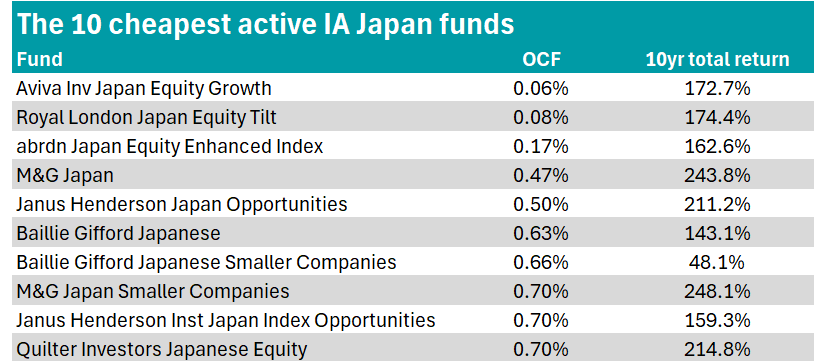
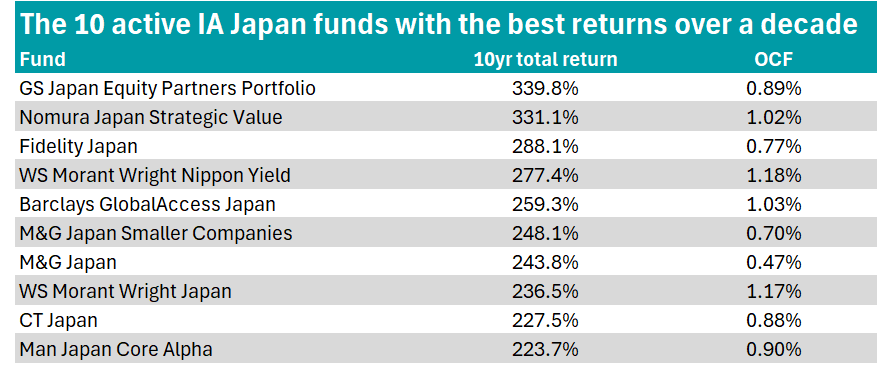
In Japan, only one fund met the criteria: M&G Japan, which has an OCF of 0.47% and 10-year return of 243.8%.
The £5.4bn strategy is managed by Carl Vine, with FE fundinfo Alpha Manager Dave Perrett as deputy, and targets a combination of capital growth and income to deliver a return higher than the MSCI Japan index over any five-year period.
They typically hold up to 60 stocks, with the largest holdings in the portfolio including Mitsubishi, Sony and Toyota. Positions sizes are typically between a 1% and 5% active weight, with smaller-cap names at the bottom of this range due to liquidity.
It is invested across the market capitalisation spectrum but carries an overweight to small- and mid-caps across the region.
The fund is popular among investment platforms and fund selectors. For example, it features among AJ Bell’s Favourite funds, with the platform noting that a £10,000 investment into the fund in 2016 would have swelled to £25,398 by the end of June 2026.
Growth of £10,000 invested in M&G Japan since 2016

Source: AJ Bell
Paul Angell, head of investment research at AJ Bell, said: “Given the relatively core approach, the fund can theoretically perform in any market environments, however, the fund should typically work best when company fundamentals and idiosyncratic stock selection are being rewarded and underperform in narrow thematic rallies or during periods of growth leadership.”
The fund is also on FE fundinfo’s Approved List of funds, with Sophie Turner, a fund analyst at the firm, highlighting manager Carl Vine’s strong track record in investing in Japanese equities.
“A key part of the management team’s process that we like is that they aim to remain sector neutral and have derived their consistent performance through strong stock picking,” Turner said. “This is something they have shown time and time again.”
The fund is also ‘Elite-rated’ by FundCalibre, with the firm’s managing director – Darius McDermott – noting the management team “knows Japanese companies inside and out, focusing on a core universe of around 250 stocks they have followed for many years”.
McDermott also highlighted the team’s constant dialogue with management teams as another key characteristic he likes about the fund.
When breaking the fund’s performance down by calendar year, it becomes clear that its 10-year record has been bolstered by its more recent performance record. It surged from its bottom-decile return of 3.6% in 2020 to the top-decile with a 13.8% return the following year.
Angell said that this recent strong run has been backed by “strong stock selection across robotics, semiconductors and manufacturers which have all been positive for returns”.
M&G Japan is slightly overweight industrials vs the index at 25.8% vs 24.7% and it is also overweight informational technology vs the index at 19.2% vs 18.8%.
McDermott concluded that, with an OCF of 0.47%, the fund is “exceptional value for genuinely active, high-conviction management”.
But M&G Japan is not the cheapest actively managed fund in the sector. That top spot goes to Aviva Inv Japan Equity Growth, which boasts an OCF of 0.06%. It has gained 172.7% over the decade.
Source: FE Analytics
It also isn’t the top performer outright – its 10-year return ranks seventh strongest among actively managed funds in the sector.
Source: FE Analytics
More broadly, investors who opted for the cheapest active funds would have enjoyed a higher average 10-year total return than if they had backed the most expensive, according to the Trustnet research.
The cheapest decile of active funds posted a 192.9% average 10-year gain compared to 163.9% for the most expensive.