






Sterling bond investors navigated a volatile first half of 2025, with gilt yields hitting record highs amid ongoing political uncertainty at home and geopolitical tensions abroad.
Despite the turbulence, investors continued to seek out opportunities in funds across the sterling bond sectors in the first half of the year, with such funds attracting £2.3bn between January and July.
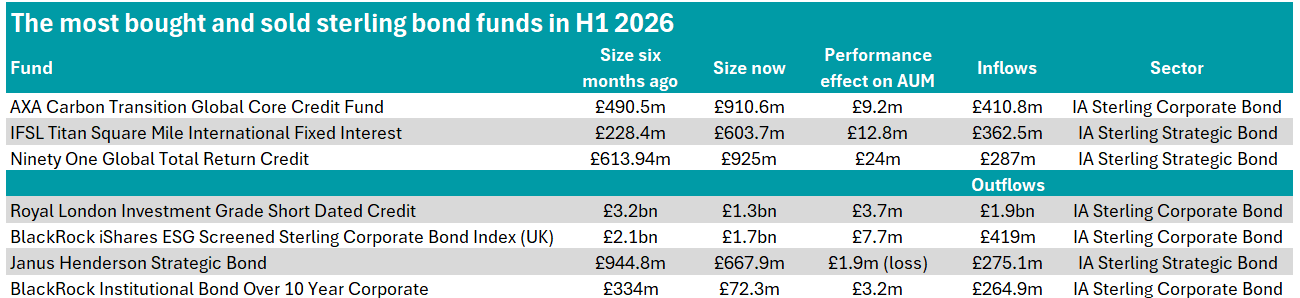
As part of an ongoing series, Trustnet looked at which funds across the sterling bond Investment Association sectors attracted over £200m in net new money and which lost over £200m.
As shown in the table below, no funds in the IA Sterling High Yield sector met these thresholds.
Source: FE Analytics
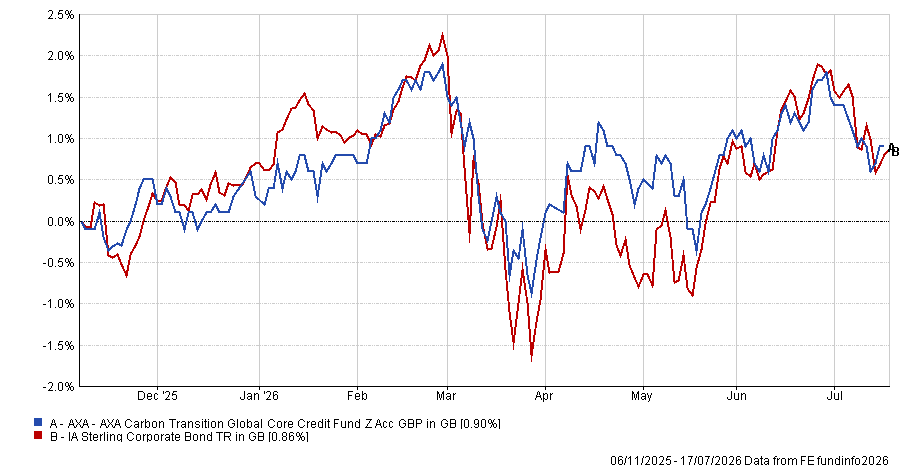
The largest inflows across all sterling bond sectors went to AXA, as the AXA Carbon Transition Global Core Credit Fund attracted almost £411m of net new money. Performance added a further £9.2m, lifting assets from £490.5m at the start of the year to £911m by the end of June 2026.
Managed by Charles Fianko, with Lionel Pernias as deputy, the strategy aims to generate income and capital returns in line with the ICE BofA Global Corporate Index, while contributing to the global transition to net zero.
This secondary climate-related goal means the fund invests in larger, commonly held issuers demonstrating credible commitments to achieving net zero by 2050 or reducing carbon intensity in line with that trajectory.
Otherwise, at least 80% of assets are invested in global investment-grade corporate bonds, denominated in sterling, euros, Australian dollars, Canadian dollars or US dollars and hedged back to sterling.
Performance of the fund vs sector over 5yrs
Source: FE Analytics
The next largest inflows came from IFSL Titan Square Mile International Fixed Interest, which attracted £363m of net new money and gained just shy of £13m from performance, bringing assets to £604m.
The strategy, which was launched at the end of 2024 and has an ongoing charges figure (OCF) of 0.55%, targets increases in value over at least five years through capital growth and income, investing across investment-grade and sub-investment grade bonds without fixed limits, meaning exposure to higher-risk credit can be significant at times. Up to 20% of the portfolio may be invested in equities, alongside warrants and money market instruments.
Over the full year to the end of June 2026, the fund returned 5.3%, placing it in the second quartile of the IA Sterling Strategic Bond sector.
Ninety One Global Total Return Credit also attracted substantial inflows, pulling in £287m. Co-managed by FE fundinfo Alpha Manager Justin Jewell and Darpan Harar, the fund also carries an FE fundinfo Crown Rating of five.
It aims to deliver total returns over a full credit cycle, targeting Overnight SONIA +4% before fees over rolling five-year periods. It invests across global credit markets without constraints on currency, credit rating, issuer type, coupon structure or duration.
Since launching in 2022, Ninety One Global Total Return Credit’s calendar year returns have fluctuated between the second and third quartile but it ranked in the first quartile for the first half of 2026.
The strategy has previously been suggested as a complementary holding alongside Fidelity Global Dividend, due to its ability to provide a yield without the price volatility and pay-out risks when equity markets are down.
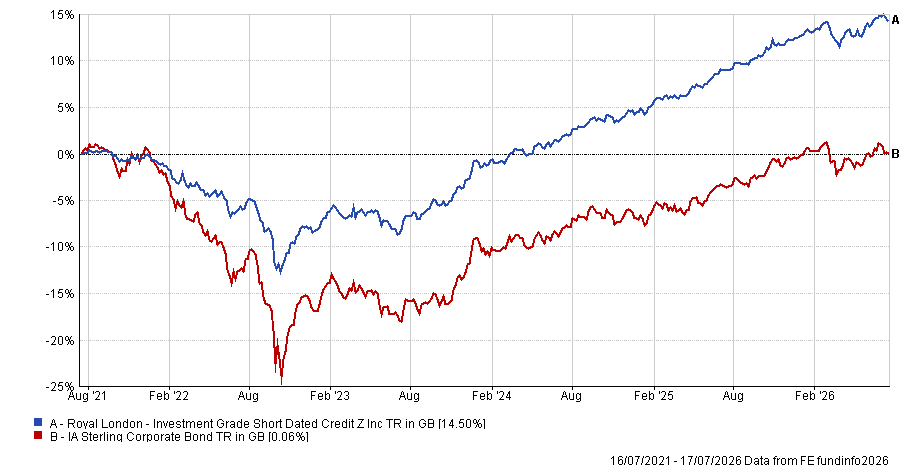
On the outflows side, Royal London Investment Grade Short Dated Credit logged the most significant withdrawals by a wide margin, recording £1.9bn in outflows. Performance added back £3.7m, reducing overall assets from £3.2bn to £1.3bn over the six-month period.
Managed by Alpha Manager Paola Binns, with Matthew Franklin as deputy, the fund aims to outperform the ICE Bank of America Merrill Lynch 1–5 Year Sterling Non‑Gilt Total Return Index by 0.25% over rolling three‑year periods.
At least 80% of assets are invested in sterling‑denominated investment‑grade bonds, with 70% in short‑dated issues maturing within five years.
The strategy also applies an ethical screen excluding certain sectors and seeks to exploit inefficiencies in credit markets by investing outside the benchmark when attractive opportunities arise. Its shorter‑duration profile makes it less sensitive to interest‑rate movements. It was one of the most bought funds in 2025.
RSMR analysts said: “The fund will perform strongly in periods of stable but rising rates relative to longer duration options.
“It has a quality bias, being investment grade, so has more defensive outlook and will do well when rates are high and stable – it will also perform well in periods when inflation is elevated or uncertain because inflation hurts fixed cash flows and SD bonds can reprice sooner.”
They added that the strategy can serve as a core element of a diversified fixed‑interest portfolio or as a standalone defensive holding for investors with lower volatility budgets.
Performance of the fund vs sector over 5yrs
Source: FE Analytics
Meanwhile, Janus Henderson Strategic Bond was the only fund from the IA Sterling Strategic Bond strategy to record outflows above £200m, with investors withdrawing £275m over the first half of the year.
It was also the only fund in the table where performance detracted, as it lost almost £2m, while total assets fell from £945m to £668m over the assessed period.
Co‑managed by Jenna Barnard and Nicholas Ware, the fund aims to outperform the IA Sterling Strategic Bond sector average over any five‑year period, investing globally across government and corporate bonds of all qualities, while currency exposure from non-sterling assets is substantially hedged.
It currently holds 196 positions with an average duration of 5.5 years, with most holdings rated as ‘BAA’ (25.3%) or ‘AA’ (23.2%).
Janus Henderson Strategic Bond is built around long-term thematic investing, currently focusing on structural themes such as demographics, technology and globalisation.
RSMR analysts said the fund’s flexible strategy is designed to perform across a wide range of economic, monetary and fiscal environments and that its global mandate and ability to allocate across investment grade, high yield, loans and derivatives provides a broad opportunity set.
“The fund will still face challenges when interest rates rise, inflation is elevated or corporate profitability weakens,” the analysts added.
“At such times, the managers aim to mitigate downside risk through active duration management and selective credit exposure.”
The other funds in the table that logged outflows higher than £200m over the six months are both from the IA Sterling Corporate Bond sector and run by BlackRock: BlackRock iShares ESG Screened Sterling Corporate Bond Index (UK) and BlackRock Institutional Bond Over 10 Year Corporate.