






The record-breaking SpaceX initial public offering (IPO) last month has ignited a new wave of interest in backing privately owned companies before they list on the stock market.
In a long-running trend, companies are staying private for longer, and as a result, they are creating more of their value before floating on public markets.
SpaceX is the most extreme example, growing from an initial valuation of $27m in 2002 to £2trillion by the time it listed on Nasdaq in June 2026 – an increase of over 7.7million% before its IPO.
Analysis by Aberdeen Investments shows it is not alone. The research says that while companies such as Apple, Microsoft and Amazon created the majority of their value after they listed on private markets, more recent listings, including Airbnb and Meta, created most of their value before they listed on the stock market.
The problem for ordinary retail investors, however, is how to gain early access to privately-owned companies before their shares are traded on a public exchange. Early investors in SpaceX and most other big private firms were wealthy individuals and corporations such as fund managers or private equity specialists.
The investment trust route
But there is another way. Investment trusts, founded over 150 years ago, have been providing access to privately held companies for many decades. But this feature is only recently capturing major headlines – thanks in a large part to the journeys of companies such as SpaceX.
Indeed, early access to private companies is fast becoming one of the most captivating features of the investment trust structure. And there is a wave of potential mega IPOs on the horizon that UK investors can gain access to today to try to maximise any gains in the run-up to their listing.
From Anthropic to ByteDance and Revolut, UK investment trusts offer varying exposure to some of the most exciting companies approaching IPO anywhere in the world.
Scottish Mortgage Investment Trust was the first in the UK to provide investors with exposure to SpaceX. The £17 billion trust invested £200m in SpaceX in 2018, a stake that has subsequently grown to account for 25% of the trust’s value.
But other trusts have also seen extraordinary growth from early investments.
Claire Dwyer, head of investment companies at Fidelity International, said: “As more companies stay private for longer, investment trusts will play an important role in broadening investor access to this highly dynamic phase.
“One example is Fidelity China Special Situations’ investment in Alibaba while it was still private, prior to its 2014 IPO. Alibaba Group was initially acquired as a private investment when the company was valued at approximately $48 billion, representing around 2.5% of the trust's assets. By the time of its IPO in September 2014, Alibaba’s offer price of $68 per share implied a market capitalisation of approximately $168 billion – around 3.5 times the valuation at which the trust first invested.
“Following its first day of trading, Alibaba’s market capitalisation rose to approximately $240 billion, further widening the valuation uplift to around five times the trust's original entry valuation.”
So what other private companies are expected to list in blockbuster IPOs in the near future? And which investment trusts can give you a stake?
AI giant Anthropic is widely expected to IPO later this year, having already filed documents with the US authorities, and there are five investment trusts that have a stake in Anthropic that can give UK investors some exposure. See the table below for details.
Other mega IPOs that look likely include TikTok owner ByteDance, data specialist Databricks, payments giant Stripe and banking disruptor Revolut.
Another advantage of investing in private companies via an investment trust is that you can always buy and sell your investment trust shares on the stock exchange at a moment’s notice. Whereas, if you invest via the new long-term asset fund (LTAF) structure, you have to give notice that you are redeeming your investment and there are restrictions on how much can be redeemed. And when markets are very volatile, LTAF managers may find it challenging to deliver redemptions and the fund could be gated, meaning investors’ holdings can’t be redeemed.
The data in the table below is correct as of 3 July unless stated otherwise, and is intended for indicative purposes only. Valuations are changing rapidly and are very difficult to precisely quantify where companies are not yet listed. Anthropic, for example, is estimated to have risen in value by 550% in the past year, and its weighting in a portfolio will also change constantly as the value of other holdings in the same trust fluctuates.
The key message, however, is that if you are interested in taking a stake in these exciting private companies, history suggests you should do so sooner rather than later. Investment trusts give investors early access to exciting private companies, which could be the mega-IPOs of tomorrow.
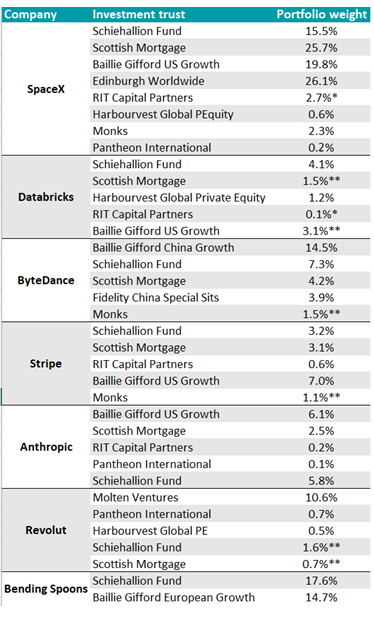
Source: The Association of Investment Companies. Data confirmed as latest available estimates as of 7 July, unless otherwise stated.
*Data correct as at 31 December 2025.
**Correct as at 31 May 2026.
*** Pantheon International’s exposure to Revolut is as at 30 November 2025.