






Andy Burnham walked into Number 10 Downing Street on 20 July 2026, becoming the seventh prime minister of the UK in just 10 years.
During the two-year premiership of his predecessor, Keir Starmer, UK funds endured a testing backdrop of domestic stagnation combined with global volatility.
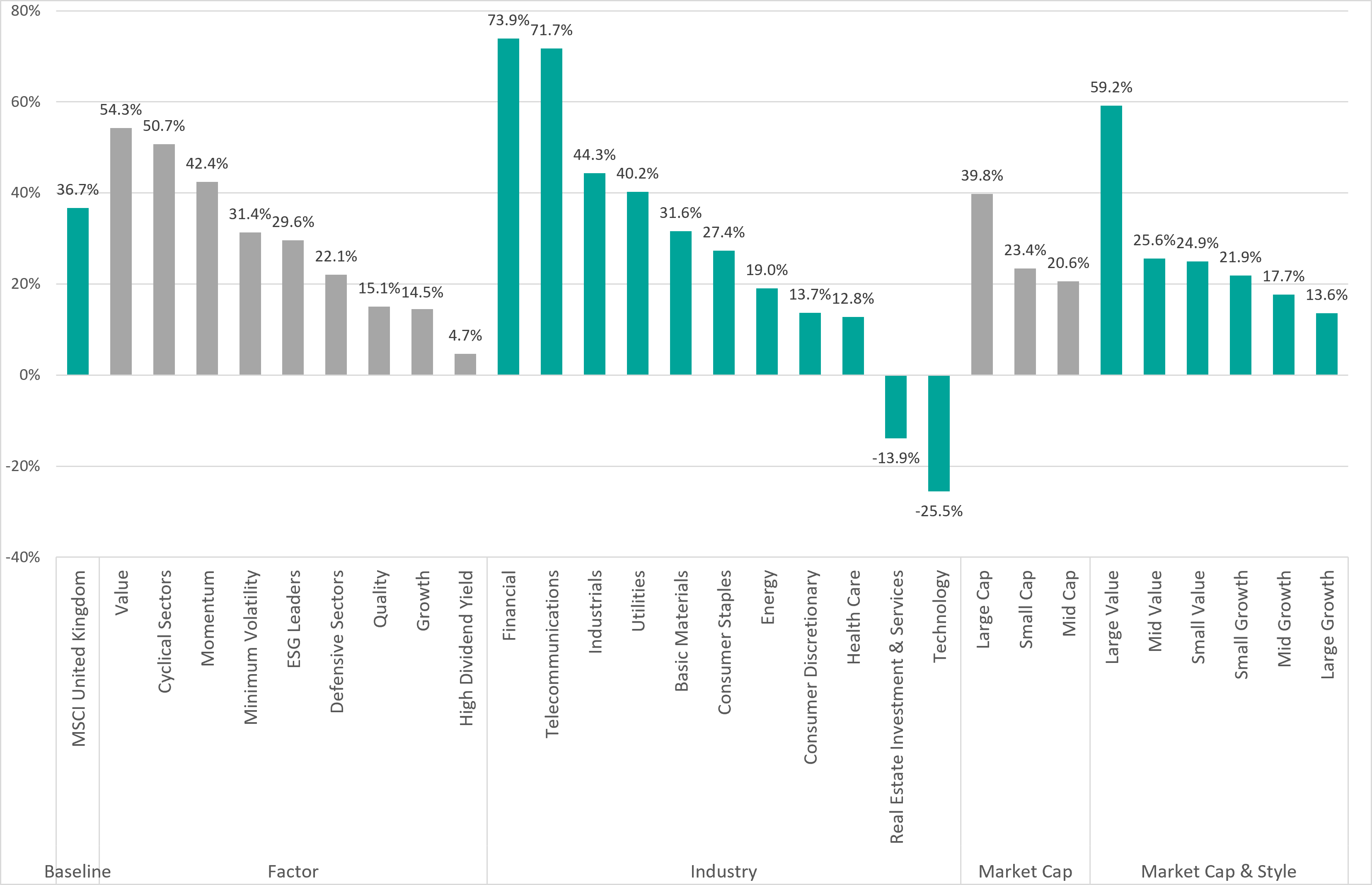
However, amid a persistent cost-of-living crisis, weak economic growth and a fractious geopolitical backdrop, value-oriented industries emerged as the main positive drivers for the MSCI UK index and some strategies found ways to thrive.
Breakdown of UK equities under Prime Minister Keir Starmer, July 2024-July 2026
Source: FE Analytics
This article examines the total return of funds across the IA UK All Companies, IA UK Equity Income and IA UK Smaller Companies sectors from 5 July 2024 to 20 July 2026.
Of the three sectors, IA UK Equity Income posted the highest average return, gaining 27.9%, followed by IA UK All Companies (22.6%) and IA UK Smaller Companies (6.1%).
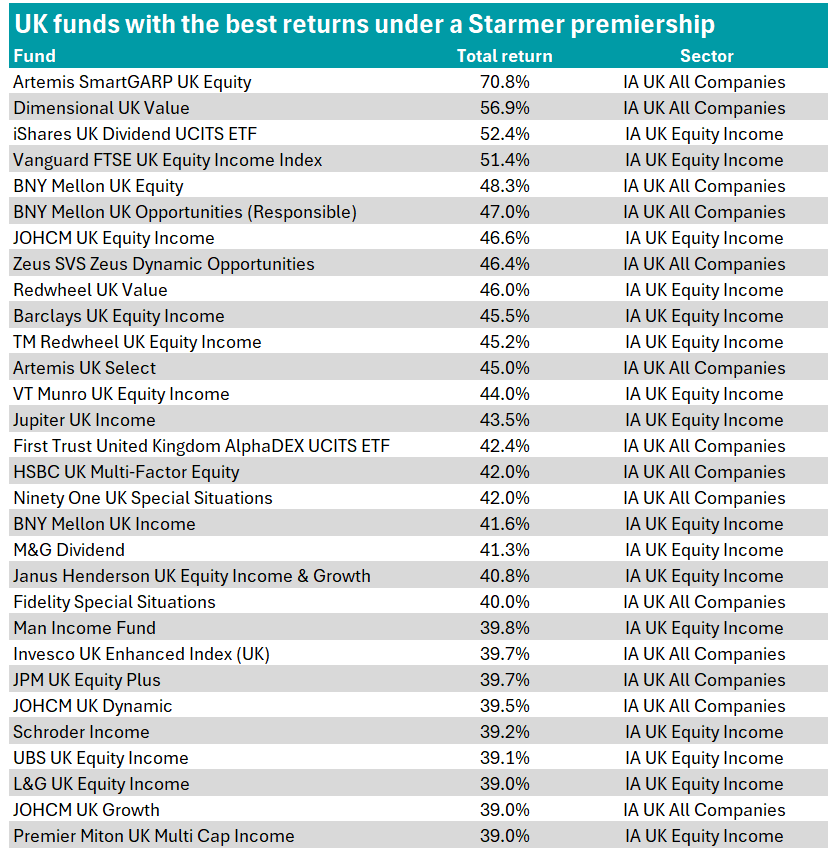
As shown in the table below, the most successful funds during this two-year period prioritised value, with large exposures to large-cap financials, industrials and other defensive sectors.
Source: FE Analytics
At the top of the table is Artemis SmartGARP UK Equity, which gained 70.8% over the assessed period – the highest return of any fund across the three sectors.
The £1.6bn strategy, managed by FE fundinfo Alpha Manager Philip Wolstencroft since 2010, uses the firm’s proprietary SmartGARP process to remove behavioural biases and identify opportunities by systematically comparing thousands across fundamentals and value metrics.
The fund’s positioning aligns closely with the areas of the market that performed best under Starmer. Its top holdings are dominated by UK financials, including Lloyds Banking Group, HSBC and NatWest. It also has a clear large-cap bias at 69.4%, followed by 24.3% in mid-caps and just 0.8% in UK small-caps.
Artemis SmartGARP UK Equity also has a strong long-term record, as it is also one of the best-performing UK funds since the Brexit referendum, gaining 257.2% to 22 June 2026.
RSMR analysts said the strategy is expected to perform well in environments where valuation and earnings upgrades drive returns and where dispersion between companies is elevated.
“Its focus on revisions and momentum supports performance when markets reward improving fundamentals rather than purely valuation or macro trends,” they said.
Second in the table is the £340.9m Dimensional UK Value fund – also in the IA UK All Companies sector and with a focus on value stocks – which gained 56.9% over the period.
It has a maximum FE fundinfo Crown Rating of five and aims to increase the value of investment alongside generating income, without being managed in reference to a benchmark. Instead, the fund’s philosophy is rooted in academic research, as the management team applies systematic rules to capture long-term drivers of return.
Similarly to the Artemis strategy, the fund’s sector exposures lean towards industries that performed strongly throughout Starmer’s premiership, including financials and energy.
Dimensional UK Value is one of the cheapest actively managed funds that has delivered a first-decile 10-year return, with an ongoing charges figure (OCF) of 0.34%.
Over the past five years to the end of 2025, it has paid out £2,270 per unit – the highest dividend distribution in the sector. It was also identified as having one of the highest information ratios in the peer group over that five-year period, outperforming on both the upside and downside.
Looking at its longer-term track record, it has logged a first quartile return in its sector in five of the past 10 years.
Within the IA UK Equity Income sector, two exchange-traded funds (ETFs) – iShares UK Dividend UCITS ETF and Vanguard FTSE UK Equity Income Index – logged the best returns.
The strongest actively managed fund in the sector was the £2bn JOHCM UK Equity Income strategy, co-managed by James Lowen, Clive Beagles and Josh Herson. It gained 46.6% over the assessed period.
The management team follows a strict dividend yield discipline, as they believe dividends signal confidence in the sustainability and future growth of cashflows and are less volatile and less creative than published earnings numbers. This approach leads to an emphasis on higher-yielding stocks.
RSMR analysts said: “The managers have proven that their stock picking skills have worked overtime relative to other income options in the sector.”
Its largest active positions include Standard Life, Barclays and Lloyds Banking Group.
JOHCM UK Equity Income tends to perform well when UK domestic growth is stronger or when value stocks are outperforming, and it struggles when growth or momentum stocks dominate.
Meanwhile, no funds from the IA UK Smaller Companies sector made it into the top 30 for returns between July 2024 to July 2026.
The strongest performer in the sector over this period was Premier Miton UK Smaller Companies, which manages under £100m in assets and posted a 30.9% return over the assessed period.
The fund, which is co-managed by Gervais Williams and Martin Turner, invests across the micro- and small-cap universe, with its highest sectoral weightings in materials (18.2%) and energy (14.5%). Its lowest exposure is to real estate at just 0.2%.
Of course, not all UK funds have fared well over the past two years, with several recording a loss.
IA UK Smaller Companies’ Liontrust UK Smaller Companies was the weakest performer across all three sectors, losing 14.1%.
In the IA UK All Companies sector, Chelverton UK Equity Growth was the worst-performing, down 8.9%, while the worst performer in the IA UK Equity Income sector was Unicorn UK Ethical Income, which lost 7.4%.