






Late in 2023, Cormac Weldon, manager of Artemis US Select, bought data storage company Western Digital. It was loss-making, carrying a weak balance sheet and by his own account considered “not even value, but just a poor business”.
He bought it as a beneficiary of AI spending at a point when weak balance sheets at both Western Digital and rival Seagate meant neither could fund new production capacity. That scarcity collided with the AI industry's demand for hard disk drives.
Today, after its rally (the stock is up about 600% over 12 months, as shown in the chart below), the market has completely reframed Western Digital.
“It's grown a huge amount,” Weldon said. “I don't know if it still appears in value baskets – it's probably in growth, because it's grown so much.”
Performance of stock over one year
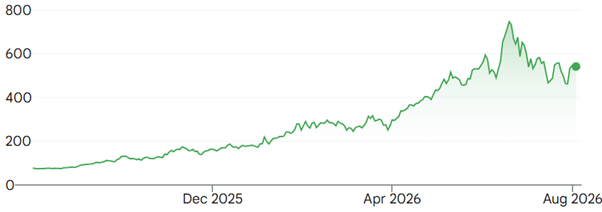
Source: Google Finance
This goes to show how none of these labels are truly binary and no stock stays in one camp forever.
“[I don’t like using] growth or value because they're sort of bogus concepts,” he continued. “A stock doesn't know it has a label and that it's supposed to perform at a certain point in the market. A stock is a business that has fundamentals, and then the market will value those fundamentals based on what it sees.”
As Weldon recently told Trustnet, Artemis US Select is run in a style-agnostic way. Put simply, the manager said he should never have to tell a client the market and his style of investing are at odds with one another.
The process starts at the level of the individual business, asking whether it is getting better or worse, and looking for upside worth at least twice the downside if the call is wrong. Investment style does not enter into that assessment.
“We won't not look at a stock because it's considered value, or it's considered high growth, or whatever,” Weldon said. “We'll just analyse the fundamentals of the business and then decide whether it offers an asymmetric risk [versus] reward.”
Screening out companies based on a certain style of investing before conducting individual analysis means “you're not competing against the market, you're competing against a part of the market... you're sort of doing it with one hand behind your back,” he said.
The same scepticism applies to the opposite label.
“A good company doesn't necessarily mean a good stock,” he said, citing consumer brands Nike and Estée Lauder, as well as payments processor PayPal, as businesses with strong reputations that have not consistently rewarded shareholders.
“If a good company is producing better and better results, sure that'll get rewarded,” he said, “but if it's now producing exactly what we expected and consensus has caught up with reality, it's probably not going to be that strong a performer”.
“Trees don't go to the sky,” he added. “Maybe Nike gets its sneakers wrong and other competition comes along, maybe Estée Lauder doesn't have a clue what it’s doing in China and it was all smoke and mirrors anyway”.
The stocks have trended lower over the past 12 months, as the chart below illustrates.
Performance of stocks over one year
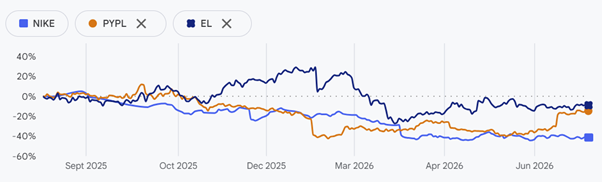
Source: Google Finance
There are however moments when turning to one over the other can make sense, he admitted. For example, value can become “the more obvious trade” when the market prices it too cheaply.
“People have looked at growth and given it high, high, high multiples,” he said. “By definition, if they’re buying growth, they're selling all these value stocks, and value underperforms a lot. There can be occasions when you just want to say, actually, that's the pool I want to fish in.”
He cited early 2009, during his time at Threadneedle, as the clearest recent case. Back then, markets were pricing in economic collapse.
“This economy's over, we're going into depression, the Fed isn't going to be able to help, the government isn't going to be able to help, we're done for,” he said, describing the mood at the time. Value stocks traded at their cheapest relative to the broader market outside the Great Depression.
Right now, he sees no equivalent opportunity in value as a cohort. “Value isn't cheap relative to the market, that's the interesting thing,” he said.
“The framework I'm using is, if you look at the cheapest quarter of the market and compare its valuation to the average stock, value scores average compared to all of its history. 2009 and then early 2020 were massive outliers in terms of valuation,” he concluded.