






UK equities were the best-performing area to invest in last month, but their renaissance has been building for far longer than just those 31 days.
The IA UK Equity Income sector was the best-performing fund peer group in July, with the average portfolio making 4.3%. It was followed by IA UK All Companies, where the average fund was up 4%, while the IA UK Smaller Companies sector average was fourth (3.7%).
The FTSE 100 index hit an all-time high (10,989) during July, although it ended the month slightly off this level, with strong returns from some of the largest stocks including banking groups Standard Chartered, Lloyds and NatWest and oil major Shell.
Performance of indices in July
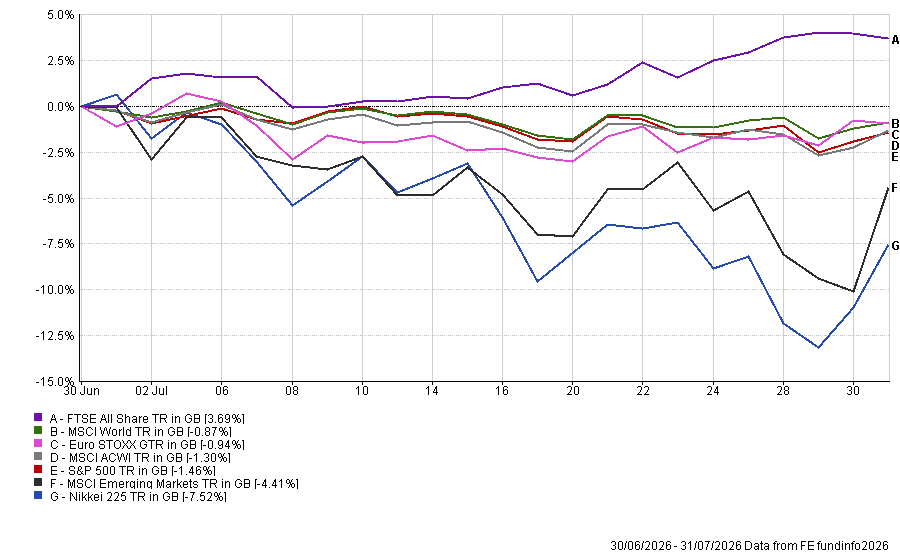
Source: FE Analytics
Laura Foll, portfolio manager on the global equity income team at Janus Henderson Investors, said: “UK equities performed strongly in July, likely boosted by a number of factors, including a lower-than-expected UK inflation number, which potentially curtailed the need for any interest rate increases.”
There was some “relief” at what was seen as a “market-friendly choice” of chancellor, when John Healey was named successor to Rachel Reeves. But few experts suggested the recent rebound is due to the change in government.
Gervais Williams, manager of the Premier Miton UK Smaller Companies fund, said there has been “political stability” brought by new prime minister Andy Burnham, while JM Finn head of investment office Jon Cunliffe said the market is “giving the new Burnham administration’s growth strategy the benefit of the doubt”.
Neither, however, suggested this was the main reason UK equities are thriving at present. Below, experts explain some of the main factors boosting domestic stocks.
A diversification haven
Perhaps the biggest reason is investors’ move away from US market to other areas, most agreed. While the US remains an interesting place to invest, worries that some of the tech giants are becoming overvalued following a turbocharged AI boost are convincing some to allocate part of their portfolios elsewhere.
Cunliffe said the low relative valuation of the UK stock market has made it a key beneficiary of the broadening out of equity market returns in recent months.
“In addition, as investors have sought refuge from volatility within the AI ecosystem, the FTSE 100 came into favour given its high weight to defensive sectors, miners, and energy.”
This was echoed by Sue Noffke, manager of Schroder Income Growth fund, who noted that investors do not need to be anti-AI to be pro-diversification.
While the AI rally has “rewarded concentration”, investors should be wary of assuming that a narrow group of stocks can continue to drive market returns indefinitely.
“Concentration works very well until it doesn't and today's market is arguably less representative of the broader opportunity set than at any point in recent history,” she said.
Like Cunliffe, she noted that the UK offers diversification as valuations remain below many global peers while earnings growth is expected to remain positive this year and next, boosted by ongoing significant share buybacks.
“Importantly, UK equity indices are far more international than many investors appreciate, with only around 22% of FTSE 100 revenues, and 53% of FTSE 250 revenues, generated domestically,” she said, which gives investors some peace of mind that the market is not tied solely to the domestic economy.
“The UK's sector mix also provides exposure to themes beyond the narrow AI trade, including energy and commodities businesses supporting growing power demand and electrification trends, alongside financials, consumer staples, healthcare and industrial companies,” Noffke added.
“Many of these sectors are likely to be beneficiaries of AI adoption through productivity and efficiency gains rather than direct participants in the AI infrastructure spending cycle.”
The shift from globalisation to nationalism
For Williams, part of the UK’s appeal is the move away from globalisation and towards nationalism, a direction that tends to be painful for investors but can be mitigated by looking towards exactly the type of companies listed on the home market.
“Globalised downturns were near-painless whereas nationalist downturns, as in the 1970s, are challenging. In these conditions, cash-generative companies can have an advantage,” he said.
“Acquiring viable assets from insolvent corporates, debt-free, can accelerate their earnings and cashflow growth. The UK is well placed, given its cohort of equity income stocks.”
Mergers and acquisitions (M&A) and the mid-cap bounce
The other part of the equation is takeovers. Foll noted M&A activity continues at pace, highlighting bids for the likes of Rotork as examples of consistent appetite from international peers and private equity for UK businesses.
Noffke said there has been “outsized bid interest” in 2026 so far for a wide range of UK companies drawn to the quality and value available from companies that are intrinsically underpriced relative to their overseas rivals.
AJ Bell data shows there have been 39 bids for UK firms so far in 2026 at an average premium of 39%. This has particularly benefited mid-caps, where there has been a wave of takeover approaches.
Cunliffe said “the dozen FTSE 250 companies that have been subject to formal bid approaches, with the pace accelerating as the year has progressed” is one of the main reasons that mid-caps have outperformed their large-cap cousins in recent months, alongside resilient domestic UK economic activity and market leeway being given to the new government.
Performance of indices over 3 months
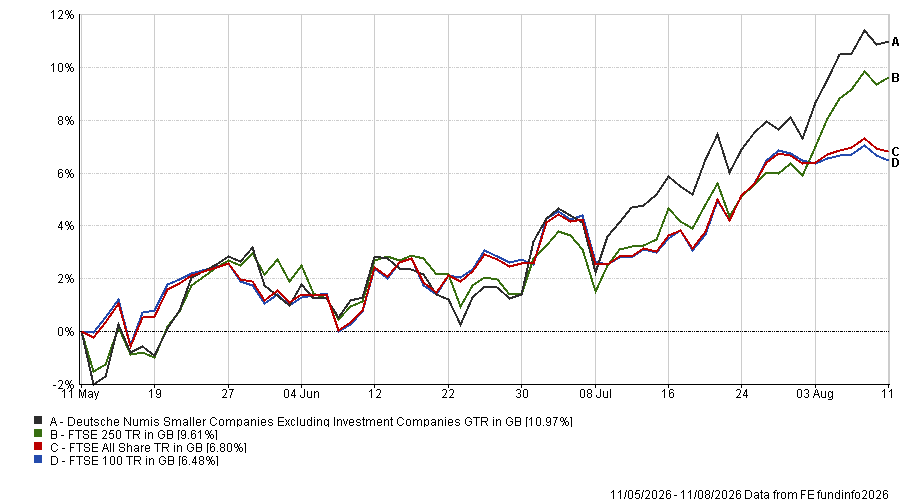
Source: FE Analytics
Noffke added that mid-caps have also benefited from AI concerns, with investors finally turning towards overlooked parts of the market, such as further down the size spectrum.
“Sectors such as recruitment, housebuilding, retail and chemicals are benefiting from a combination of better-than-feared results and a less negative economic backdrop in the UK and Europe,” she said.