






Some funds rise to prominence because they sit neatly at the intersection of strong long‑term performance, clear objectives and recognisable brand strength. Over time, this creates a feedback loop, as high engagement leads to greater visibility, which in turn reinforces its position as a go‑to option for investors seeking reliability.
Artemis Global Income is one such fund. It was the most‑researched strategy on Trustnet in the 12 months to the end of August 2026 as investors looked for funds offering diversified dividend‑focused exposure.
On the question of why Artemis Global Income is so popular, Ben Yearsley, director at Fairview Investing, said: “Performance, performance, performance – it’s been on a phenomenal run and that, combined with the good brand awareness of Artemis, has led to investors flocking to the fund.”
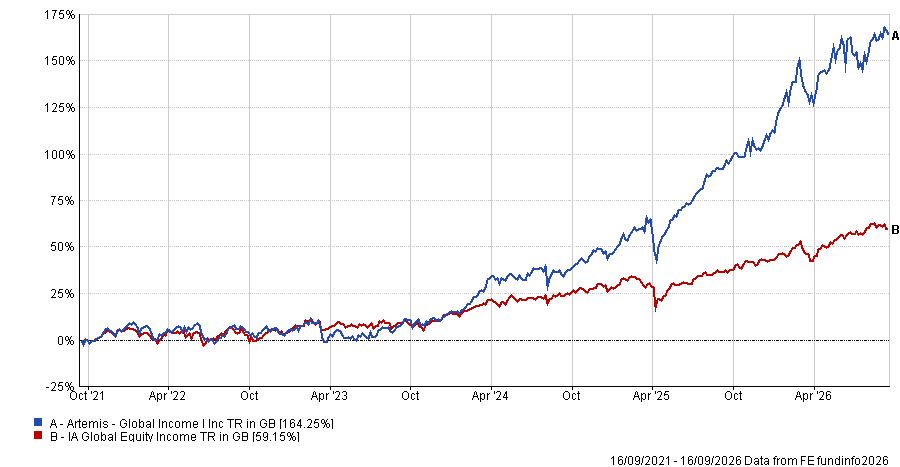
The £6.7bn strategy, which aims to grow both income and capital over a five-year period, returned 163.7% over the five years ending in August.
Performance of the fund vs sector over 5yrs
Source: FE Analytics
Co-managed by FE fundinfo Alpha Manager James Davidson and Jacob de Tusch-Lec, the fund carries an FE fundinfo Crown Rating of five and has a historic yield of 2.33%.
Kate Marshall, acting head of fund research at Hargreaves Lansdown, said the fund “has several characteristics that are likely to appeal to investors", noting that its “differentiated, value-focused approach has helped it stand out against other funds with a greater emphasis on quality or growth”.
Portfolio holdings include established dividend payers, such as BAE Systems and Pfizer, as well as higher-yielding opportunities that may be overlooked by the wider market, including Norwegian oil producer Aker BP and aluminium manufacturer China Hongqiao Group.
“This can provide diversification compared with many other global income funds,” Marshall said.
Artemis Global Income was the most the most bought fund in the IA Global Equity Income sector in the first half of this year, attracting £1.3bn in net new money while performance added a further £931.6m.
However, while widely followed funds like Artemis Global Income can offer comfort and familiarity, they may also crowd out consideration of other strategies that deliver similar outcomes with different approaches.
Trustnet asked fund pickers to highlight other income strategies they view as credible alternatives to Artemis Global Income.
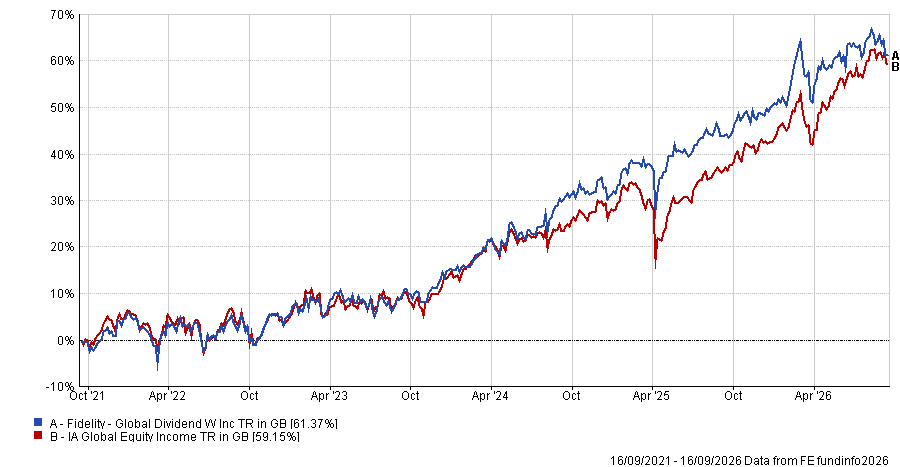
Marshall suggested Fidelity Global Dividend. Launched in 2012 and managed by FE fundinfo Alpha Manager Daniel Roberts, the 50-stock portfolio is tilted toward industrials and financials, with holdings demonstrating resilient cashflows, strong balance sheets and sensible valuations.
Like Artemis Global Income, it aims to provide investors with a growing income from a diversified portfolio of global companies. However, the way it seeks to achieve this outcome is quite different, according to Marshall.
“Whereas Artemis Global Income has a stronger value bias and is willing to invest in more cyclical and economically sensitive businesses when the manager believes they are undervalued, Fidelity Global Dividend has a greater focus on quality, resilience and companies capable of generating sustainable cashflows through a range of market conditions,” she said.
“This different approach can make the fund a useful alternative for investors seeking global equity income exposure, but who would prefer a more conservative approach.”
In comparison, the Artemis strategy’s value bias can lead to periods of strong outperformance, Marshall noted that the trade-off is that returns can be more volatile, with the fund more sensitive to shifts in investor sentiment.
Dzmitry Lipski, head of funds research at interactive investor, also likes Fidelity Global Dividend, highlighting its “more cautious approach with lower US concentration and focus on sustainable dividends”.
“It also offers broader diversification – usually holding 80–120 stocks, reducing single stock risk,” he added.
Performance of the fund vs sector over 5yrs
Source: FE Analytics
As well as Fidelity Global Dividend, Lipski pointed to the £6.5bn Guinness Global Equity Income fund, which is co-managed by Ian Mortimer and Matthew Page.
The high-conviction fund prioritises dividend growth over high yield, focusing on bottom-up fundamentals. It should perform well when markets are focused on valuation but it is not biased to cyclical stocks and should remain competitive in growth markets because of the moderate dividend target and quality focus.
Given its focus on companies with strong balance sheets and sustainable growing dividends – avoiding US mega-cap dominance – Lipski said it ensures “more consistent, smoother returns, and less extreme outperformance compared to Artemis Global Income”.
However, given its lack of exposure to the Magnificent Seven, it may lag when markets are driven by the mega-cap stocks, he warned.
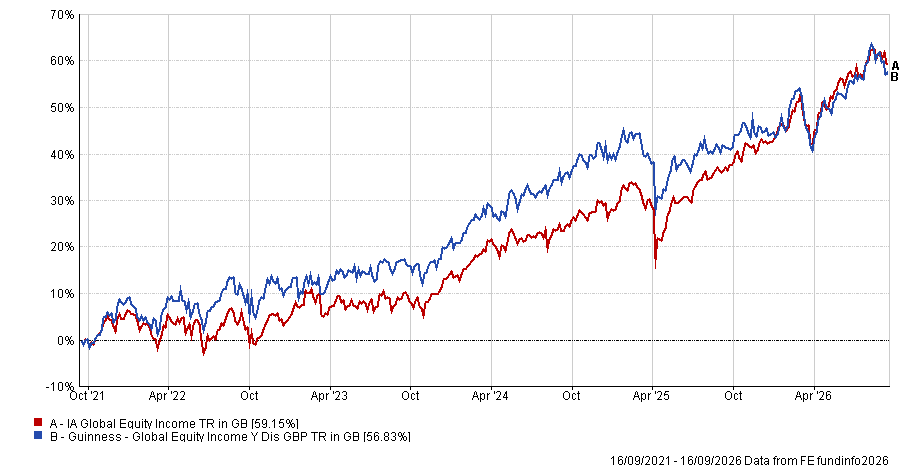
Indeed, the fund has a weaker return medium-term return profile, having gained 57.8% over the five years to the end of August 2026, placing it in the third quartile of the IA Global Equity Income sector.
Performance of the fund vs sector over 5yrs
Source: FE Analytics
Meanwhile, Yearsley suggested two funds that could sit alongside Artemis Global Income or be held as standalone funds in a portfolio: Jupiter Asian Income and BNY Mellon US Equity Income.
“Like the Artemis strategy, their primary objective is income but total return is as important to all three,” Yearsley said.
He noted that the £2.9bn Jupiter Asian Income strategy, which is co-managed by Jason Pidcock and Sam Konrad, is “an idiosyncratic fund, but very good”, investing in five countries across developed Asia, culminating in a high concentration 30-stock portfolio. It targets a yield at least 20% more than its benchmark index.
It currently holds big positions in two of the three big AI plays in Asia, with 9.5% invested in TSMC and 8.8% in Samsung.
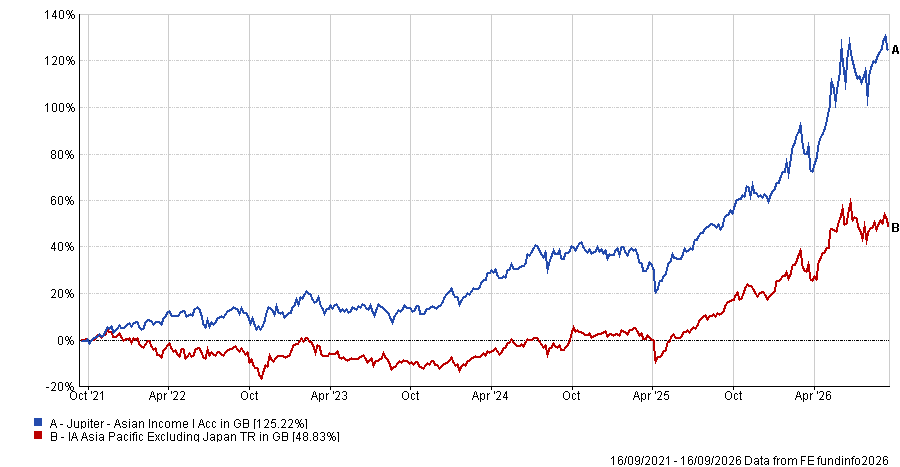
RSMR analysts also like the fund, pointing to its strong record versus other Asian income funds. It has returned 121.8% over the five years to the end of August 2026, placing it in the first quartile of the IA Asia Pacific Excluding Japan sector.
Performance of the fund vs sector over 5yrs
Source: FE Analytics
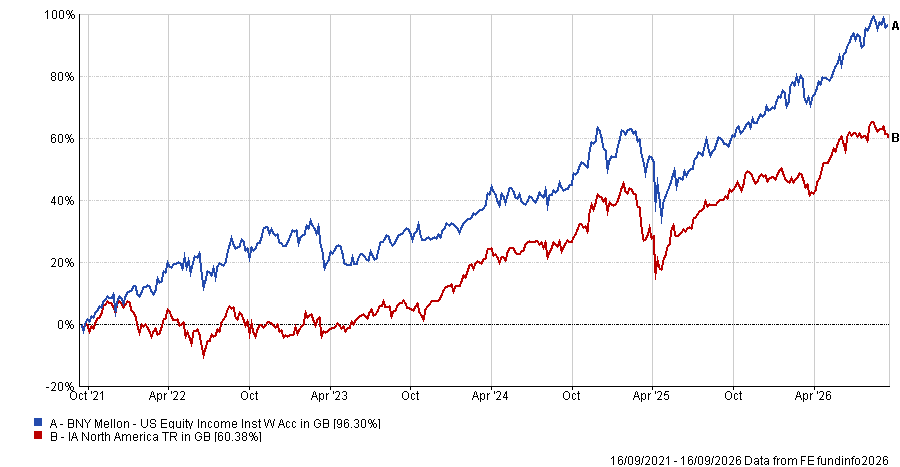
Meanwhile, the £2.1bn BNY strategy is slightly less concentrated with around 50 holdings managed by John Bailer since 2018, with Brian Ferguson and Keith Howell as deputies.
The fund targets a yield of at least 50% in excess of the S&P 500 and is valued-oriented, looking for companies providing a high dividend income paired with solid dividend growth. Such holdings include established US large-caps Microsoft, JPMorgan Chase and UnitedHealth Group.
“Despite the US not being known as an income market, the yield is close to 2% – so not too bad,” Yearsley said.
It is also popular in its own right. The fund attracted £412m in inflows in the first half of this year, with performance adding a further £194m.
Performance of the fund vs sector over 5yrs
Source: FE Analytics