






While the global AI rally has propelled some Asian markets higher, Invesco Asian (UK) co-manager William Lam is looking for opportunities in markets it has left behind.
“Asian markets – Korea and Taiwan in particular – have never been this expensive, driven by AI momentum. Yet China is extremely cheap. That is a massive opportunity,” Lam said.
Indeed, for the 12-month period ending 30 June 2026, the trailing price-to-earnings (P/E) ratio for the MSCI China index was just shy of 13x, whereas MSCI Korea was 17x and MSCI Taiwan was 25x.
“The momentum is all in the AI-exposed regions. Those markets are well above what we would consider fair value,” he said.
Lam does hold significant positions in some of these names – TSMC and Samsung Electronics are Invesco Asian (UK)’s two largest holdings – but he argues that at current valuations the better long-term returns will come from elsewhere.
As such, he is focused on finding stocks wrongly written off as AI losers, particularly in China, where he sees the valuation gap as an opportunity the market is overlooking.
In China, consumer confidence has been badly damaged – first by a multi-year property downturn and then by Covid lockdowns that, unlike in the West, were not cushioned by government hand-outs.
“We think we have seen the worst of it and are at the bottom of the cycle in terms of consumer confidence,” Lam said.
Below, Lam explains the investment philosophy behind his contrarian approach, how he is navigating a bad spell for the fund and why he exposes the fund to value traps.
What is your investment philosophy?
We are contrarian, so we look for new ideas in unloved areas of the market. We believe that share prices can be out of whack with reality and they become that way because human psychology means that people get over-negative when there is bad news and over-positive when there is good news.
The right way for us to invest is to capitalise on those times when people are overly fearful because of current bad news – say, when that bad news is being reflected 50% in the share price when it is only maybe 10% of the true impact.
We will then hold the stock until it reaches that fair value.
The fund has struggled in more recent months. Why is that?
We are performing quite badly this year – it has been the worst period of performance I’ve ever had in my 20-year history.
The reason we are underperforming is because this is an extremely momentum-driven, very narrow bull market.
Given our focus on investing in unloved stocks, we are not looking to play in what we call the ‘greed zone’. We typically underperform when there are a lot of stocks we have already sold that have made the transition from undervalued to fairly valued and now above the fair value threshold.
Underperformance right now is therefore not surprising but it is unusual, as we haven’t really had a sustained momentum bull market in Asia for most of the time I’ve been working. The last was probably around 2006-2007, during the China infrastructure build-out.
Performance of the fund vs sector year-to-date
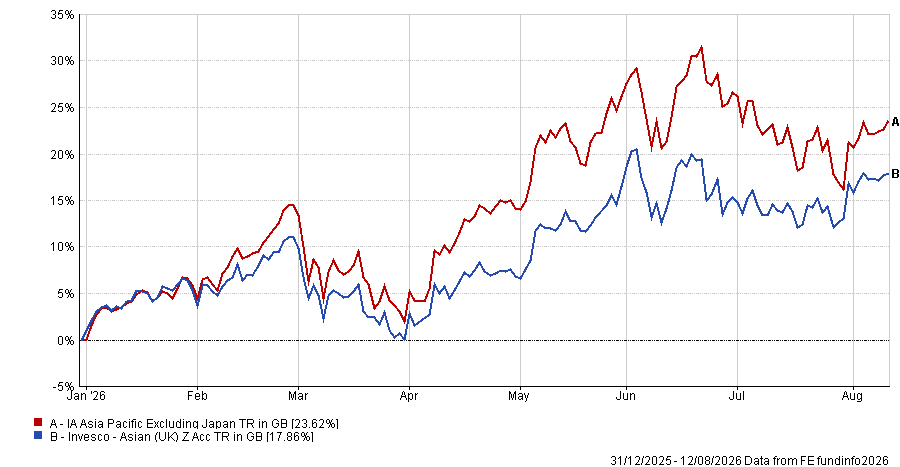
Source: FE Analytics
How do you react to a period of underperformance? Do you make changes to your process?
No, we don’t – underperformance is a normal part of our process. This is what you would expect our process to deliver at this juncture – all things being equal, we will expect share prices to revert back down to fair value.
There is a recent example of this in history, when the unprofitable tech companies peaked in late 2021 and later collapsed. We performed extremely well in 2022 because that section of the market was collapsing and we didn’t own any of it.
Sea Limited [a global consumer internet company] was the archetypal stock in that category. It went up 10x post-Covid and then came back down almost all the way.
This is the sort of situation we might expect over the next couple of years.
How do you deal with value traps?
I will hold my hands up and say that we do expose ourselves to the value trap problem and we do sometimes have to cut our losses.
If we are expecting 8% earnings growth and it turns out to be more like 2%, we adjust our estimates to face reality – we won’t sit there happily. If we think we own a value trap and it is going to get worse not better, we will exit.
Dongfeng Motor is an example of a stock we viewed as a potential value trap and exited. It’s a Chinese car company that ended up struggling to compete in the electric vehicle space, so we exited.
The stock did go up a lot a couple of years after we sold it, driven more by financial engineering than fundamentals – even accounting for that, it was probably still the right thing to do.
What have been your best and worst calls over the past 12 to 18 months?
The worst call is easy: SK Hynix. It’s become one of the most famous stocks in the world, with memory semiconductors in very tight supply and high demand due to the AI build-out.
We have always preferred Samsung Electronics, which is traditionally less volatile with a stronger balance sheet. We were strongly overweight until we were forced to start selling because we hit the 10% position limit. When we did, we didn’t buy SK Hynix but instead bought other things that were not AI-related.
The biggest headache for us right now is that SK Hynix is 7-8% of [MSCI AC Asia Pacific ex Japan] and we own none of it, which is very uncomfortable.
SK Hynix has been an astonishingly good performer over the 12 months to the end of June 2026, as the stock went up 9x in that period – a nearly 9% negative impact on the portfolio.
However, our overweight in Samsung Electronics had an offsetting positive impact of 5% over the same timeframe.
The best call is harder due to the period of fund underperformance but one that is a little contradictory to what I just said about SK Hynix is Yageo, which I actually sold out of early in the year.
It was a very small position, maybe 50 basis points (bps), and I was effectively doing some housekeeping. But I quickly reversed that decision – around March or April – when it became clear that Yageo was becoming an AI beneficiary.
It makes passive components [equipment that stores rather than produces electricity] for all sorts of tech products and wasn’t previously seen as an AI play until this year.
We bought back roughly an 80bps to 1% position and that stock tripled in three months. Yageo contributed a positive 3% to portfolio performance over the 12 months to the end of June 2026.
What do you do outside of fund management?
I love to write songs, I play the piano and sing.