






Temple Bar investment trust had a tough first half of the year, the company revealed in its results this morning, with its net asset value (NAV) total return of 5.4% lagging the 7.2% made by the FTSE All Share.
This only looks at the performance of its underlying holdings, however. When taking into account the trust’s own share price swings, the trust made slightly less at 5.2%.
In their interim statement, managers Ian Lance and Nick Purves said the first half was dominated by the geopolitical shock of war in Iran, which caused the oil price to spike. During this time, the FTSE All-Share index proved “relatively resilient” thanks to its “substantial energy and materials weightings”.
The £1.3bn trust’s underperformance over the period was due to it not owning two large companies, HSBC and Rolls-Royce, which on their own added more than three percentage points to the index return, the managers said.
However, they were not idle during this time, with seven new names entering the portfolio in the six months to the end of June that fit the managers’ philosophy of buying “fundamentally sound businesses that should be capable, by virtue of their market positions and the industries in which they operate, of growing their profits over time, but which continue to be modestly valued in the stock market”.
Performance of trust vs sector and index over 5yrs
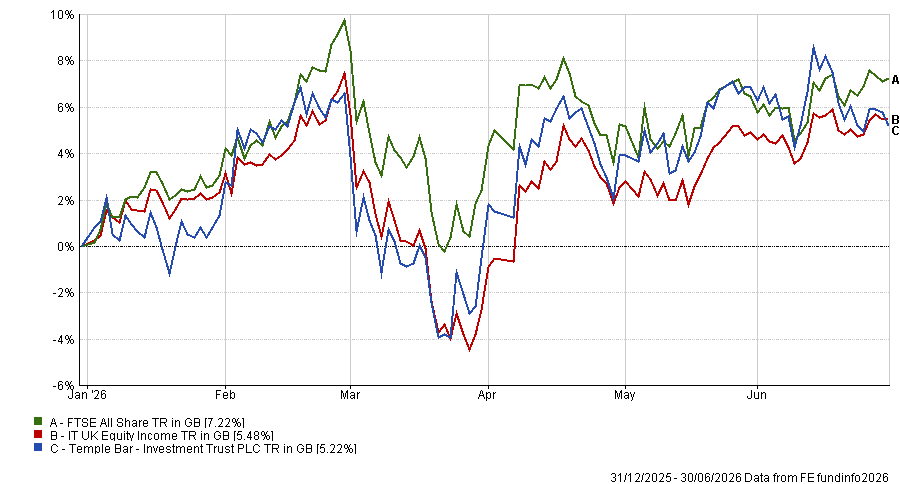
Source: FE Analytics
The UK additions
B&M European Value Retail came into the trust with the managers describing it as a “retail franchise that has been undermined by recent self-inflicted operational errors rather than structural decline”.
In late 2025, the company issued consecutive profit warnings while an accounting failure to recognise £7m in freight costs led to profits being overstated.
“A new CEO has clearly diagnosed the issues, set out credible operational fixes, and demonstrated alignment through share purchases. With retail discipline being restored, we believe the market materially undervalues B&M’s core earnings power, offering significant upside if execution improves,” Purves and Lance said.
Shares are down 58.6% over the past five years but have gained 42.7% so far in 2026, according to Google Finance data. The managers said shares trade at around 7x their valuation of the business.
Alongside B&M, real estate investment trust Land Securities was also brought into the fold. The firm focuses on London real estate, with around half of its net rental income received from offices and buildings in the capital.
“London office valuations were hit hard during the pandemic, driving higher yields, while rents proved more resilient – creating scope for yield normalisation as conditions stabilise,” the managers said.
It pays a “generous” 7% dividend and targets steady earnings and dividend growth of 3% to 4% per year, giving investors the potential to achieve a “relatively low-risk double-digit annual total return”.
The overseas picks
While just two new UK names were added, there was a raft of moves in the trust’s overseas allocation. While Temple Bar sits in the IT UK Equity Income sector and has 70.7% invested in domestically listed companies, the remainder is in overseas holdings.
US food company JM Smucker was one of the new purchases. The firm behind Jif peanut butter and Folgers coffee is listed in America and counts towards the firm’s overseas holdings.
It was bought at a price-to-earnings multiple of approximately 10x and a dividend yield of approximately 4%, the managers said, after shares have dropped around a third in the past three years.
“Sluggish operating performance and the overpriced acquisition of the Hostess brand in 2023” are the main reasons for this, they noted, but operational improvements should lead to a re-rating, they argued.
Staying in the food business, the trust also bought into Kraft Heinz, one of the world’s largest food and beverage companies, at a price-to-earnings multiple of just over 10x and a dividend yield of almost 7%.
“Like JM Smucker, Kraft Heinz has suffered from changing consumer tastes in the North American market, coupled with input price inflation,” they said, with this year’s earnings expected to be 30% down from where they were a few years ago.
However, the shares are down more than 70% from their pre-Covid peak, while new chief executive Steve Cahillane “has set about cutting costs and using the savings to increase marketing spending and invest in R&D,” they said.
US telecoms giant Comcast was also added in the first half of the year, with fears of decline in cable TV and competitive pressures in broadband and wireless “overstated”, the managers said.
In Europe, pharmaceutical group Sanofi entered the portfolio despite facing a significant challenge from the expiry of patents on its most successful drug, Dupixent, in 2031.
“The valuation is such that the stock market is pricing in only a small probability that the company will be able to replace at least a portion of the lost sales over the next few years,” they said.
Lastly, in Asia, Chinese conglomerate Swire Pacific made the list. It has companies in the property, aviation and beverages space.
On the way out
These purchases were paid for primarily through the sale of two positions: miner Anglo American and drinks brand Molson Coors.
On the former, Purves and Lance said Anglo’s share price had performed “exceptionally strongly”, doubling in the space of 12 months. This meant the valuation “no longer offered the margin of safety that it once did”.
Conversely, Molson Coors was sold at a loss, with the managers concerned about the declining beer consumption in the US alongside a switch in consumer preferences towards more craft beers.
“The company is currently seeing mid-single-digit annual volume declines, which if sustained would likely see the company’s earnings potential reduce over time,” they said.