






Nvidia's second-quarter results beat forecasts on both revenue and profit, and its forecast for the current quarter came in above what analysts had pencilled in. The chipmaker's outsized weight in the S&P 500 means the numbers, released after the UK market close on 26 August, are being read as a signal for the wider AI trade.
The company expects revenue to grow by around 70% in its 2028 financial year, against analyst expectations closer to 45%, and said it can currently meet only around 70% of demand. That gap between what customers want and what Nvidia can ship has become the central argument for those still backing the AI infrastructure trade.
“This was another beat-and-raise quarter, but the bigger message was the outlook,” said Charu Chanana, chief investment strategist at Saxo. “Nvidia expects revenue growth of approximately 70% in fiscal 2028 and says demand remains supply-constrained even at its current scale. That is a powerful counter to the view that the AI capex cycle is already peaking.”
Performance of stock over 1 month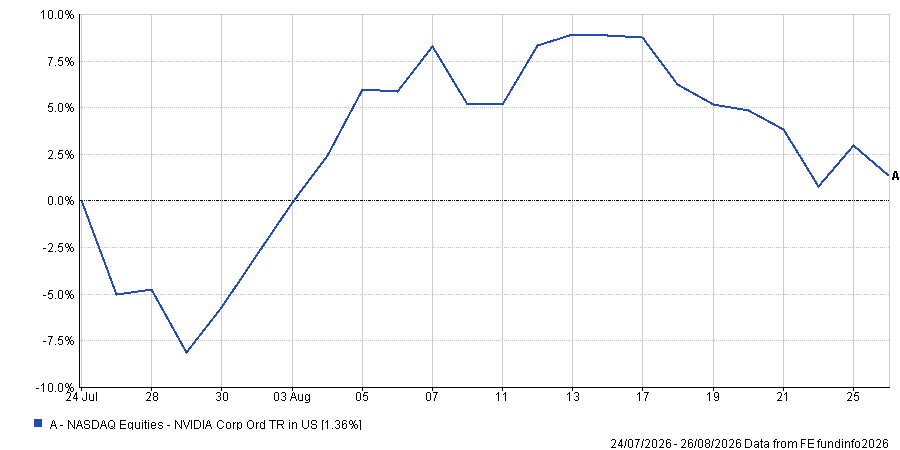
Source: FE Analytics
Commenting on what the numbers mean for the stock's valuation, Matt Britzman, senior equity analyst at Hargreaves Lansdown, said Nvidia remains “an extraordinary business that just delivered triple-digit revenue and profit growth while trading at less than 20 times forward earnings.
“There are legitimate questions around margins, competition, and the returns customers will ultimately earn on their AI spending. But the valuation already reflects a healthy dose of scepticism, and that's the disconnect.”
For Amish Patel, head of equity research at Raymond James, growth is no longer confined to the largest US technology firms buying up chips for their own data centres.
“Growth is not just being driven by the largest hyperscalers, but increasingly by AI labs, neoclouds, enterprises and sovereign customers. Nvidia is effectively saying that the market for AI infrastructure is still expanding faster than the supply chain can keep up with it.”
Analysts were prepared to look past the quarter's weaker spot: Nvidia's gross margin guidance, which points lower over the rest of the year as the cost of memory chips rises.
Patel said the company expects pricing to offset some of that pressure next year, but that investors will want to see margins settle as its newest chip architecture, Vera Rubin, ramps up production.
The margin question is part of the broader debate that has run through this earnings season, namely whether the money being spent on AI infrastructure is starting to generate a return.
Jack Janasiewicz, portfolio manager at Natixis Investment Managers Solutions, argued the conversation is shifting.
“For the past two years, the dominant question surrounding AI has been whether the massive infrastructure buildout could ever generate returns sufficient to justify the investment,” he said.
“That debate is far from settled, but recent data suggests the conversation may be shifting from whether AI can monetise to how much it can monetise.”
Ahead of the results, UK retail investors on trading platform IG had already been positioning for a strong print.
IG chief market analyst Chris Beauchamp said 63% of trades in Nvidia on 25 August were buys, against 37% sells.
“The recent dip in Nvidia from its August highs has been well timed, bringing traders back in ahead of the results,” he said. “As befits a company that has been such a consistent beater of expectations, the majority of trades have been buys.”
Not every corner of the market shared that enthusiasm going into the results. Marcus Weyerer, director of ETF investment strategy at Franklin Templeton, noted that flows into technology-focused exchange-traded funds (ETFs) had reversed sharply in the weeks before the results, with money moving instead into small-cap and growth strategies.
“The message from ETF flows is therefore not that investors are abandoning equities, but that they are becoming more selective about where they take risk,” he said.
Nvidia shares rose by 4-5% in after-hours trading once the results were published, recovering ground lost during that pre-results caution. The question now, as Chanana put it, is less about whether demand for Nvidia's chips is real, and more about whether the company, and the industry buying from it, can convert that demand into durable profit.