






No equity market has showed as much growth in recent history as the US has in the 2020s thus far. While other regions grappled with energy crises, governance reforms and geopolitical realignment, the US equity has market powered ahead on a combination of corporate earnings strength, fiscal staying power and the AI boom – a global megatrend powered by a handful of mega-cap US stocks.
But the ride has not been entirely smooth, either. Donald’s Trump’s return to the White House in 2025 was quickly followed by an aggressive tariff agenda that sent the S&P 500 tumbling.
US markets didn’t stay down for long, adjusting to rising geopolitical tensions and leaning on the continued strength of the Magnificent Seven.
In this ongoing series, Trustnet is identifying funds where taking more risk has been rewarded.
This article focuses on the most volatile funds in the IA North America and IA North American Smaller Companies that delivered first-quartile returns between 2020 and the end of July 2026 and first quartile Sharpe ratios over the same period.
Sharpe ratios indicate whether a fund’s returns justified the level of risk taken, using the same 2.76% risk‑free rate applied consistently across all sectors in this series to reflect the average Bank of England base rate over the period as a uniform baseline for UK investors.
In the IA North America sector, funds were assessed against the S&P 500, which logged a Sharpe ratio of 0.85, while we chose the Russell 2000 index for the IA North American Smaller Companies sector. The Russell 2000 index logged a Sharpe ratio of 0.35.
IA North America
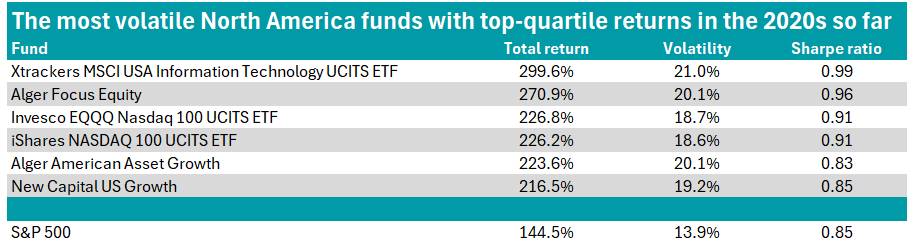
Six funds in the fourth quartile for volatility in the IA North America sector logged a first-quartile Sharpe ratio and returns from the beginning of 2020 to the end of July 2026.
Source: FE Analytics
The highest Sharpe ratio among actively managed funds in the table came from Alger Focus Equity, with a ratio score of 0.96. It returned 270.9% with a volatility of 20.1%.
It is one of the smaller funds in the sector with around $60m in assets and carries an FE fundinfo Crown Rating of five. It is co‑managed by FE fundinfo Alpha Managers Ankur Crawford and Patrick Kelly.
The 50‑stock portfolio invests across market capitalisations, identifying companies with strong growth potential and long‑term appreciation prospects through fundamental research.
Prospective holdings are stress‑tested for a range of outcomes, with the managers focusing on businesses undergoing ‘positive dynamic change’ – those experiencing high unit volume growth alongside favourable lifecycle shifts.
Major AI players dominate the portfolio, including Nvidia (8.9%), Microsoft (8.3%) and Amazon (5.5%), while top active positions include TSMC, Western Digital Corporation and AppLovin.
Alger Focus Equity’s stablemate Alger American Asset Growth also met the criteria.
The $846.8m fund, also managed by Crawford and Kelly alongside Dan Chung, returned 223.6% with a volatility of 20.1%, culminating in a Sharpe ratio of 0.83.
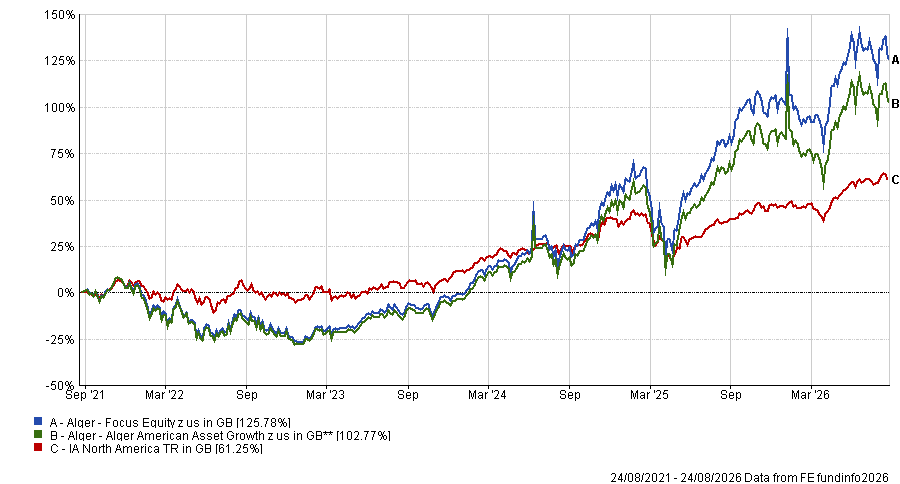
Both Alger strategies have logged first‑quartile returns in the sector over one, three and five years. Alger American Asset Growth, the older of the two, has also delivered a first‑quartile return of 456.2% over the 10 years ending July 2026.
Performance of the funds vs sector over 5yrs
Source: FE Analytics
Another strong performer was New Capital US Growth, which returned 216.5% with a volatility of 19.2% and a Sharpe ratio of 0.85.
The $400.8m strategy is co‑managed by Chelsea Wiater and Mike Clulow and aims to provide capital appreciation by investing in high‑quality US mid‑ and large‑cap stocks that exhibit strong growth trends while trading at low relative valuations.
Like the Alger strategies, its top holdings include major AI‑related names such as Nvidia and Alphabet.
The fund logged first‑quartile calendar‑year returns in six of the years between 2016 and 2025, although it struggled in 2022 – a difficult year for equity markets – losing more than 25%.
Several exchange-traded funds (ETFs) are also included in the table, all of which logged higher Sharpe ratios than the chosen benchmark.
IA North American Smaller Companies
Only three funds in the IA North American Smaller Companies sector met the criteria.

Source: FE Analytics
The strongest performer in the table and the entire sector was delivered by Heptagon Driehaus US Micro Cap Equity. It returned 240.3% and a Sharpe ratio of 0.67. It was also the most volatile strategy in the sector over the assessed period at 26.5%.
Managed by Jeff James since 2016, the $1.4bn Heptagon Driehaus US Micro Cap Equity fund aims to achieve long‑term capital growth by investing primarily in US micro‑cap companies James believes have strong growth potential. He also considers competitive positioning, industry dynamics, growth catalysts and financial strength.
The portfolio holds 125 names, with 34.2% allocated to healthcare, 17.9% to industrials and 13.9% to information technology.
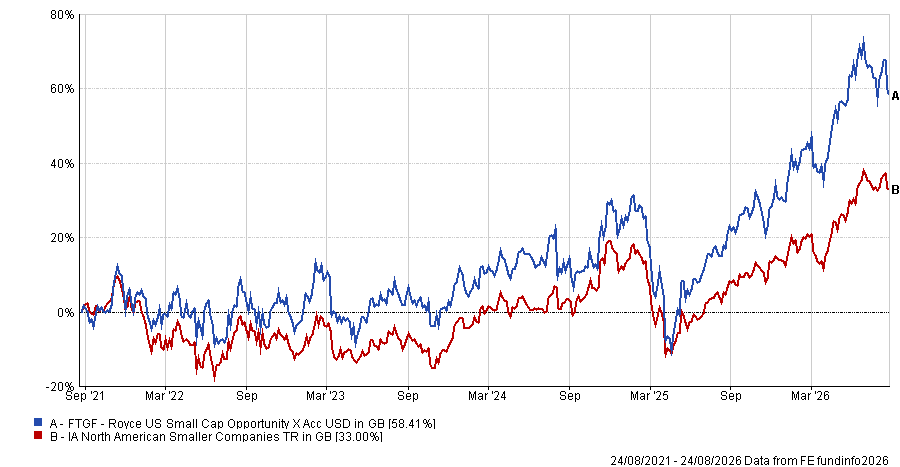
FTGF Royce US Small Cap Opportunity also met the criteria, gaining 141.1% with a volatility of 24.1% and a Sharpe ratio of 0.48.
The fund is managed by Brendan Hartman, Jim Harvey and Jim Stoeffel and invests in 215 small‑ and micro‑cap companies, with its highest‑conviction position representing 0.95% of the portfolio.
It is on the more expensive side, carrying a higher ongoing charges figure (OCF) of 1.23%.
The strategy has experienced varied performance over the years: it was the worst‑performing fund in the sector in 2018, yet delivered particularly strong returns in 2016, 2017 and 2021.
Performance of the funds vs sector over 5yrs
Source: FE Analytics