






Investors looking at China have been staring at a split story this year, with reasons both to add and to stay away from the market. While the MSCI China index is down 8.4% year to date, AI and semiconductor names have been strong as Beijing pushes for technological self-sufficiency.
Exports also grew 24% year-on-year in US dollar terms in July, according to TrinityBridge, whose head of investment specialists, Tony Whincup, described the picture as split down the middle: “China's economy is uneven. Factory production and exports have remained relatively strong but domestic weakness has persisted.”
Investors who cut their exposure to the region after the 2021 regulatory crackdown and the years of property-driven gloom that followed might be tempted to reconsider, especially as the index trades at a discount to both global and emerging market peers.
Another reason China has been back on the radar is Shein. After failed attempts in New York and London, the fast-fashion retailer finally listed in Hong Kong at a valuation of around $27bn, roughly 70% below the $100bn it had in private markets in 2022.
The gap was due to slower growth, tariff changes that undermined its low-cost model, intensifying competition from Temu and mounting regulatory scrutiny in the US and Europe. Dan Coatsworth, head of markets at AJ Bell, said the company has “gone from being untouchable to something many investors wouldn't touch with a barge pole.”
But even so, the bull case shouldn't be dismissed outright.
“Shein has considerable scale and agility, meaning it can bring new designs to market quickly and get a clear idea of what's working and what's not,” he said, pointing to the retailer's ability to restock in-demand products in as few as five days.
“A cut-price valuation might present an opportunity for contrarian investors who believe the potential rewards outweigh the long list of risks.”
But the counterarguments continue. China's economy grew just 4.3% in the year to June, below Beijing's 4.5-5% target, and the property market remains in a multi-year downturn as household confidence has yet to recover.
So which is it, a market on the verge of a recovery or one where the good news is confined to a narrow slice of the economy?
Performance of index and over the year to date and 5yrs
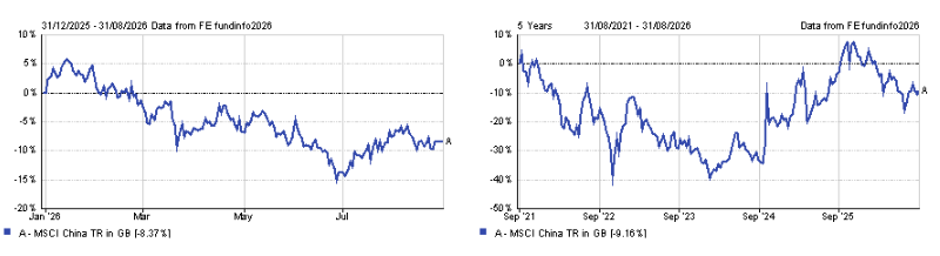
Source: FE Analytics
Fund managers with China exposure are increasingly answering that question the same way: neither broad recovery nor broad avoidance.
One example is John Citron, manager of the JPMorgan Emerging Markets Growth & Income trust (JMGI), who said China's economic momentum “remains soft” and its recovery “uneven”.
“We are taking a selective approach rather than relying on a broad recovery in the Chinese economy. We have added to the portfolio's industrial investments in China as exports have strengthened and continue to see potential opportunities in technology, advanced manufacturing, AI infrastructure, robotics, semiconductors, batteries and advanced equipment,” he said.
“However, the consumer and property-linked parts of the Chinese market may remain under pressure until domestic demand improves more clearly.”
The manager highlighted how the bull case for China today is different to the false dawns of 2023 and 2024 because it does not depend on a swift, economy-wide turnaround.
The China and Hong Kong weighting of JPMorgan Emerging Markets fell from 26.8% at the end of July 2025 to 22.4% a year later in absolute terms, even as the position relative to the benchmark moved from underweight to slightly overweight. The shift was funded by trimming strong performers elsewhere in Asia.
For Citron, property remained the exception to his gradual re-engagement: he holds no direct real estate exposure and described the sector as “an important part of the China picture and a structural headwind,” with a durable pickup in domestic demand likely to require “greater stabilisation” first.
On the enthusiasts’ side of the split, Robin Parbrook, co-manager of Schroder Asian Total Return, has taken his China/Hong Kong position overweight for the first time in 20 years.
“It's about the companies, not the economy. Macro is a poor guide to where the bottom-up opportunities are,” he said.
“Companies have stopped diluting shareholders and started buying back shares and paying dividends. Tencent, for example, has been buying back stock aggressively.”
Combined with cheap valuations and improving returns on invested capital, he argued, “we are finding value bottom-up.”
Rob Secker, portfolio specialist for emerging markets at T. Rowe Price, recently initiated a position in Tencent for the first time, “not because the macro is turning, but because the risk-reward at current levels has shifted”.
Secker saw particular value in internet platforms and depressed consumer names, where “any sign of a pickup in inflation should benefit multiples,” while flagging that China's AI winners remain too small a slice of the benchmark to draw the same attention as Korea or Taiwan.
Yet another approach was that of Linda Lin, manager of the Baillie Gifford China Growth Trust, who was wary that AI capital expenditure was being propped up by debt and took profits from technology holdings earlier in 2026, redeploying the proceeds into hydropower group Yangtze Power, battery maker CATL and Chinese banks, as she told Trustnet last week.