






Investing in emerging markets has always come with a health warning: yes, there is high growth potential but there is also typically higher volatility, greater political and currency risk, and sudden sharp drawdowns. The 2020s have been no exception.
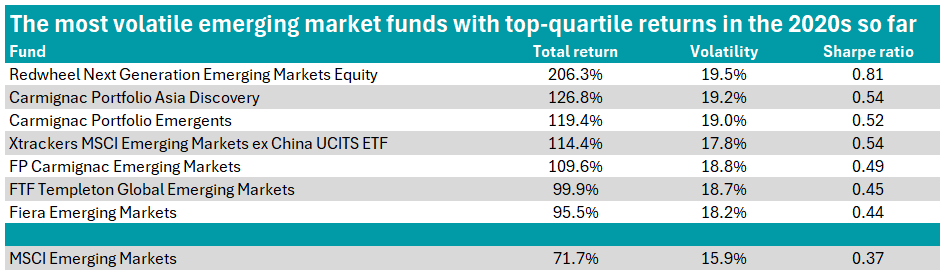
Against this backdrop, Trustnet is continuing its series identifying funds where risk has paid off, with the most volatile funds in their respective sectors posting first-quartile returns between 2020 and the end of July 2026, alongside top-quartile Sharpe ratios.
The Sharpe ratio indicates whether a fund’s returns justified the level of risk taken, using the same 2.76% risk-free rate applied consistently across all sectors in this series – reflecting the Bank of England’s average base rate over the period to represent a uniform baseline for UK investors.
Turning to the IA Global Emerging Markets sector, the most popular benchmark utilised by funds in this universe is MSCI Emerging Markets, which gained 71.7% over the assessed period, with a Sharpe ratio of 0.37.
All funds in the table below met the outlined criteria and also beat the index’s Sharpe ratio.
Source: FE Analytics
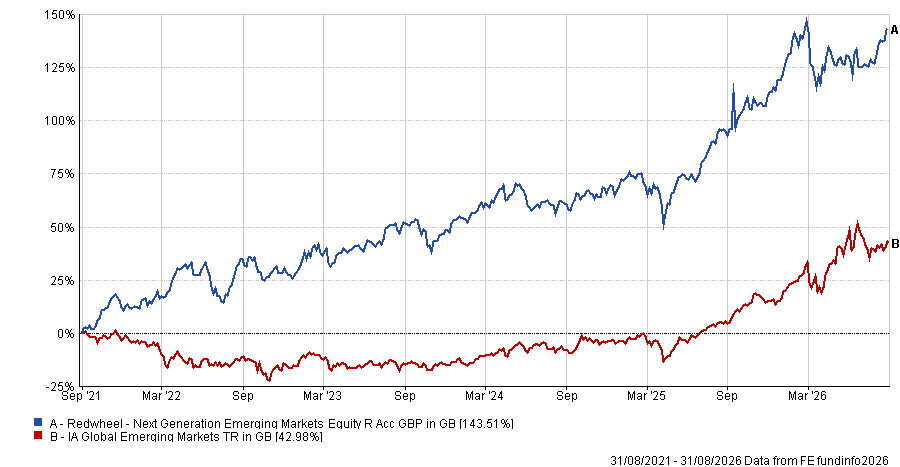
The strongest performer was Redwheel Next Generation Emerging Markets Equity, which topped the table with a return of 206.3%, Sharpe ratio of 0.81 and volatility of 19.5%. The fund also logged the highest return and Sharpe ratio across the whole sector.
The $2.6bn strategy, managed by FE fundinfo Alpha Manager James Johnstone since 2019, aims to provide long-term capital appreciation by investing primarily in smaller emerging markets and frontier equity markets, which Johnstone believes benefit from structural tailwinds such as expanding consumer populations and low labour costs.
Earlier this year, Trustnet research found that the fund was in the top decile for downside capture ratio over five years, as it has historically gained ground when MSCI Emerging Markets has fallen.
Titan Square Mile analysts have given the fund an ‘A’ rating. They said: “We believe the strategy [offers] long-term investors diversification benefits given that the markets the fund invests in are typically under-researched and under-represented by current indices.
“It provides access to a differentiated exposure [compared] to other mainstream emerging market funds, which may appeal to long-term investors looking to add a niche offering to their core large-cap emerging market allocation.”
However, the Redwheel strategy is on the more expensive side, with an ongoing charges figure (OCF) of 1.40%.
Performance of the fund vs sector over 5yrs
Source: FE Analytics
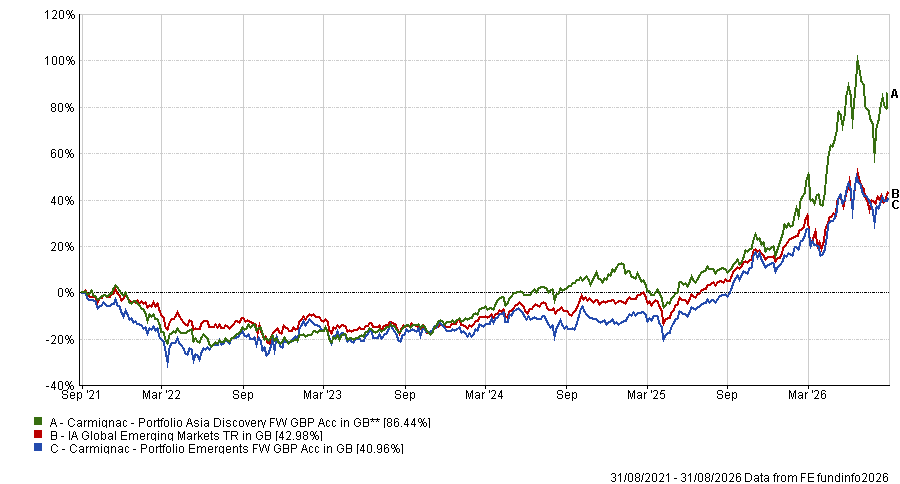
Another strong performer in the table is Carmignac Portfolio Asia Discovery, which has €257.2m in assets and has been managed by Naomi Waistell since late 2025. She took over from predecessor Haiyan Li-Labbé, who left Carmignac to pursue a career outside of portfolio management.
Formerly known as Carmignac Portfolio Emerging Discovery, the fund was renamed after shifting its strategy to focus more specifically on Asia excluding China. It can invest across Asian companies without emphasis on business sector or market capitalisation.
The strategy is in the first quartile of the sector for its one‑year return to the end of August 2026, gaining 70.5%. It is also in the top quartile over three, five and 10 years, rising 181.4% over the decade.
Its larger stablemate, Carmignac Portfolio Emergents, also met the criteria, albeit with a slightly lower Sharpe ratio of 0.52. Waistell is one of the co-managers of the €733.8m fund, alongside Alpha Manager Xavier Hovasse.
The strategy combines a top-down approach with bottom-up analysis, looking for long-term high-growth opportunities. It also considers sustainability factors, allocating at least 80% of net assets to companies aligned with the UN Sustainable Development Goals and lower carbon emissions.
Information technology (35.7%), industrials (16.9%) and consumer discretionary (14.7%) are its largest sector exposures, with top holdings including the popular trio of AI-focused stocks: TSMC, Samsung and SK Hynix.
Performance of the funds vs sector over 5yrs
Source: FE Analytics
Other funds that met the criteria include FTF Templeton Global Emerging Markets, FP Carmignac Emerging Markets and Fiera Emerging Markets.
Turning to funds targeting specific emerging market regions, only one strategy in each of the IA India/Indian Subcontinent and IA China/Greater China sectors met the criteria.
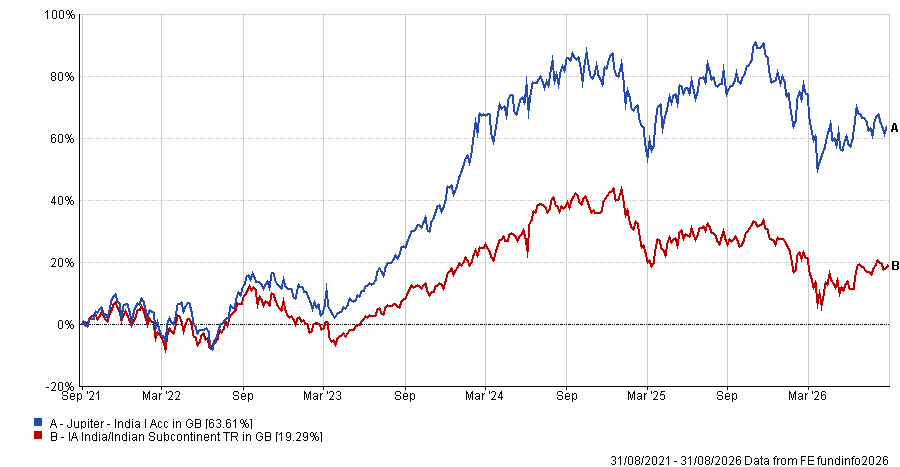
In the IA India/Indian Subcontinent sector, Jupiter India made the list, posting a 112% return in the 2020s thus far, with a volatility of 19.1% and Sharpe ratio of 0.49. In contrast, the most popular benchmark in the sector – MSCI India – returned 67% with a volatility of 18.4% and Sharpe ratio of 0.29.
Jupiter’s £1.2bn strategy carries an FE fundinfo Crown Rating of five and is co-managed by Avinash Vazirani and Colin Croft.
The portfolio is defensively tilted, with the largest allocations to financials, healthcare and industrials. As such, its top holdings include State Bank of India, Fortis Healthcare and Hindustan Petroleum.
Although the fund lost 6.1% over the past year – a common trend across the sector as the region continues to suffer from its lack of AI exposure – it is in the first quartile for returns over three and five years and has gained 93.7% over the decade ending August 2026.
Performance of the fund vs sector over 5yrs
Source: FE Analytics
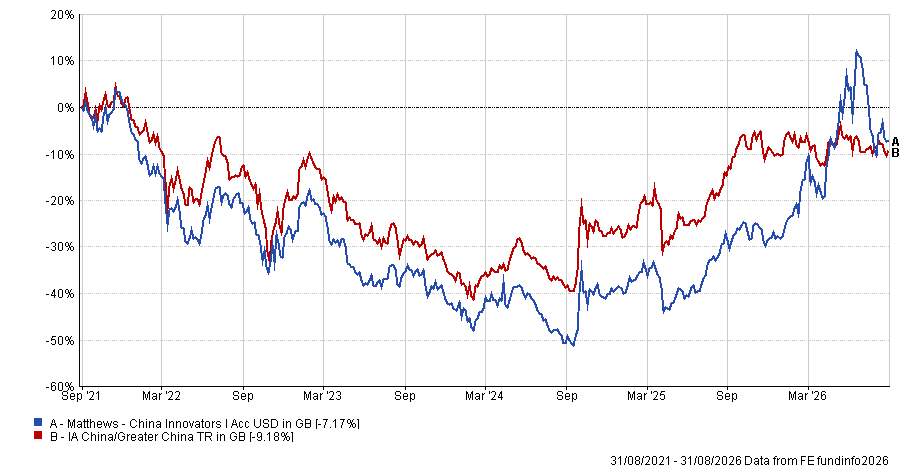
In the IA China/Greater China sector, Matthews China Innovators returned 61.2% with a volatility of 27.3% and a Sharpe ratio of 0.17. Meanwhile, the most popular benchmark in the sector – MSCI China All Shares – returned 11.7% with a volatility of 20.3% and a Sharpe ratio of 0, indicating that investing in the index delivered no risk-adjusted return premium over cash for a UK investor in the 2020s.
The fund is managed by Tiffany Hsiao and targets long-term capital appreciation while promoting environmental and social characteristics according to Article 8 of the EU’s Sustainable Finance Disclosure Regulation (SFDR).
The portfolio is heavily overweight information technology at 30.9% versus 17.7% for the benchmark and industrials (20.1% vs 9.3%).
While the strategy recorded a 7.2% loss over five years to the end of August 2026 – still better than the sector average loss of 9.1% – it has logged top‑quartile returns over one, three and 10 years.
Performance of the fund vs sector over 5yrs
Source: FE Analytics