






Baillie Gifford US Growth Trust has outperformed the S&P 500 over the past 12 months, a critical period as it faces its next battle with US activist investor at the upcoming annual general meeting (AGM).
The trust produced a share price total return of 44.5% in the year to 31 May 2026, while its net asset value (NAV) returned 31%, comfortably ahead of the S&P 500's 29.8% sterling total return, annual results published Thursday showed. The discount to NAV narrowed from 9.4% to 0.1% over the period.
Since its March 2018 launch, the trust's NAV and share price total returns stand at 253.6% and 244.3% respectively, against 250.7% for the S&P 500.
Chair Tom Burnet said the strategy is investing in “exceptional American growth companies” that address large market opportunities, possess durable competitive advantages and distinctive cultures. This, he argued, is delivering results for shareholders but, crucially, remains a fertile hunting ground for future returns. The managers see further “exciting opportunities” for shareholder value creation ahead, he said.
Performance of fund against index and sector over 1yr
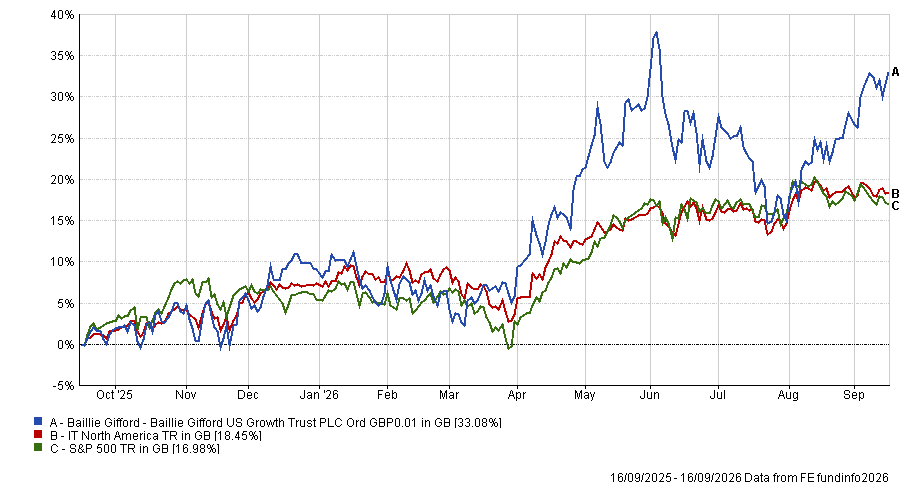
Source: FE Analytics
Betting on AI infrastructure
Four of the trust's five biggest contributors to performance were private holdings – SpaceX, Claude’s parent company Anthropic, payments platform Stripe and data platform Databricks – with NVIDIA the only public name in the top five, up 55.8% over the period. The trust took two new private stakes during the year, in Anthropic and OpenAI (AI lab), and added to its NVIDIA position.
Portfolio managers Gary Robinson and Kirsty Gibson wrote that Anthropic's release of Claude Opus 4.5 in November 2025 “brought together capabilities at a level that surprised almost everyone in the field”.
“Agents were unreliable until recently. The benchmarked performance of Opus 4.5 was good, but the step change in capabilities went beyond what was measurable in benchmarks,” they said.
“Three years ago, leading-edge models could complete, with a 50% success rate, only tasks that took skilled humans around four minutes; today, they can achieve the same success rate on tasks that take humans roughly 12 hours.”
Anthropic's revenue run rate rose from $9bn to more than $47bn between the start of 2026 and May – growth the managers called unprecedented against a SaaS industry that “typically adds around $2bn in net new annual revenue per quarter” combined.
Selling down software
The trust has been more selective about the software names it holds.
“There is a crucial difference between application software, the software that people open and use, and those that provide the infrastructure for other software to run on, the gates and rails,” the managers wrote.
“The former carries more risk, whilst the market opportunity for the latter could actually increase in a world of agents because agents need infrastructure too.”
A position in The Trade Desk (ad-tech firm) was sold over valuation and competition concerns. Airbnb, Sana Biotechnology, Ginkgo Bioworks, software consultancy Globant, Inspire Medical Systems, healthcare platform Doximity and social media Pinterest were also exited, in most cases because the original investment case had broken down. Medical devices company Penumbra was sold after Boston Scientific's takeover bid for the company.
Some AI infrastructure winners were also cut back. Cloudflare, Shopify and DoorDash were all trimmed after triggering an internal rule the managers apply automatically once a public holding has delivered a 2.5x return.
Private exposure fell after SpaceX listing
Private companies made up 45% of the trust's assets at the year end, up from 34.9% a year earlier. SpaceX alone accounted for 16.3%, a position the managers had trimmed earlier in the year to manage risk, before letting it run again once a listing looked likely.
SpaceX floated on the Nasdaq on 12 June 2026, shortly after the year end. With that stake now valued as a listed holding and lock-up releases allowing partial sales, private companies had fallen to 28.9% of total assets by 14 September 2026.
Robinson and Gibson said they increasingly favour more established private businesses that already turn over billions in revenue, a shift from the earlier-stage names the trust leaned toward in its first years.
Board fight over Saba's nominees
Finally, Saba Capital Management, a significant shareholder, has requisitioned three board nominees for the AGM on 23 October, and the board is urging shareholders to vote them down.
Burnet said: “We urge all of our shareholders to make your voices heard: vote against the Saba resolutions to protect the future of your company.”
The board says electing Saba's nominees would end its independence and its current strategy; Saba has said it would push for a full cash exit if they were elected.
Proxy voting closes at 1pm on 21 October, with some platforms setting earlier deadlines.