






The energy crisis triggered by the closure of the Strait of Hormuz could have been significantly more severe, according to Jonathan Waghorn, co-manager of the Guinness Global Energy fund.
Oil prices surged following the outbreak of conflict between the US, Israel and Iran and the latter’s decision to close off the pivotal oil trading route, reducing daily global supply. The war has been running for over 200 days.
The impact of closing the Strait of Hormuz on oil transits
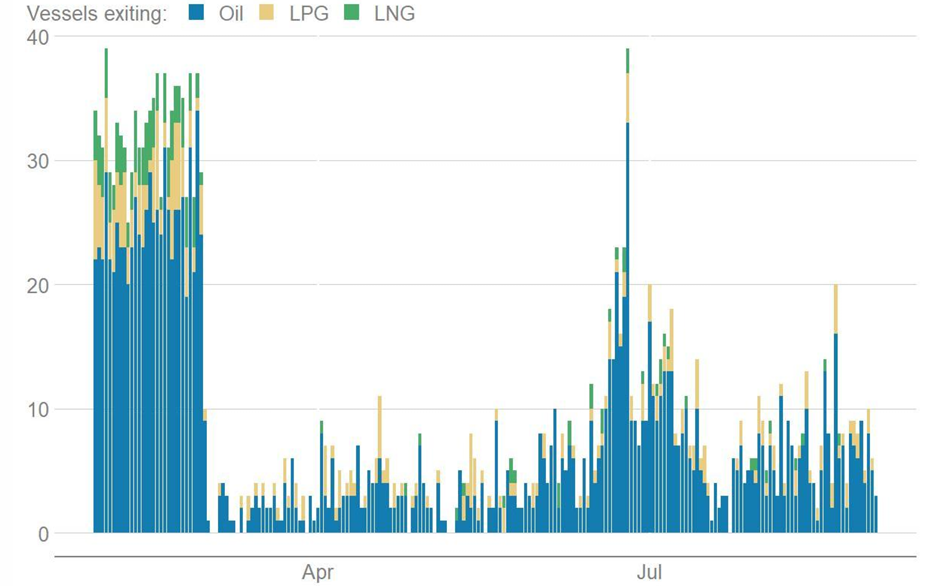
Source: Guinness Global Investors, Morgan Stanley. Data as at September 2026.
Speaking at the Guinness Global Investors’ annual conference last week, Waghorn argued that China’s rapid withdrawal from global oil markets and the heavy use of strategic reserves prevented oil prices moving too high – with some experts having feared a price spike above $150 per barrel.
Despite the huge level of global disruption, as it stands today, the price is hovering around $100.
“We have averaged about $90 per barrel on a year-to-date basis, with the five-year forward sitting at around $70 a barrel – all in all, quite well behaved and quite well managed,” Waghorn said.
The single biggest factor that has averted a spike in oil prices has been the efforts of China, he maintained, noting that China alone typically imports between 11-12 million barrels of crude oil a day but very quickly scaled this down to five million barrels a day, leaning on its strategic supply and sustained efforts to diversify its energy mix.
“That’s a huge volume of oil that China has chosen not to take to allow the rest of the market to balance,” Waghorn said, estimating that oil prices could have been $15 a barrel higher if not for the country’s actions.
Chinese oil imports in 2026 so far
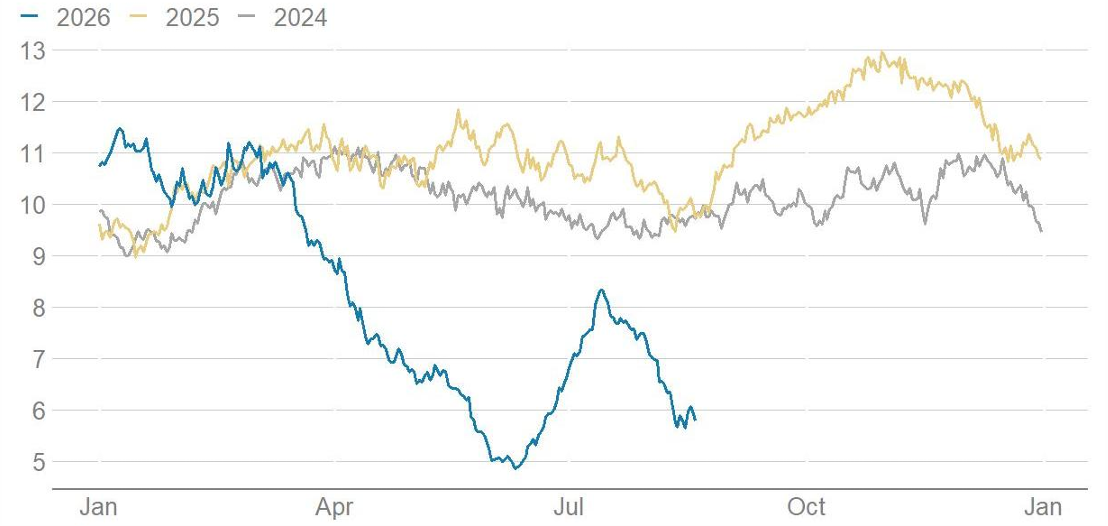
Source: Guinness Global Investors estimates, Morgan Stanley
“It has been really interesting to see the behavioural changes in China,” Waghorn added.
“Late last year, the country was building an oil inventory quite happily at a $65-$75 per barrel oil price. Yet, as the conflict hit, China was able to step away very quickly.”
A July 2026 note published by Natasha Kaneva, head of global commodities strategy at JPMorgan, confirmed that China’s oil demand is falling faster than anticipated, “implying the economy may be adapting to higher energy prices more efficiently than past experience would indicate”.
She additionally pointed to behavioural patterns such as growth in consumer electric vehicle purchases, alongside the country’s broader and ongoing effort to transition to electrification and decarbonisation.
“The oil situation acted as an accelerant,” Kaneva noted, estimating that China’s gasoline demand destruction equates to around 180,000 barrels a day, with 70% of that loss expected to continue after markets normalise.
“In practical terms, this could translate into crude import requirements as much as one million barrels per day below prior expectations, a scenario that would require significantly smaller inventory drawdowns going forward.”
Waghorn nonetheless expects China to re-enter the global oil market when the price reaches between $80-$85 per barrel.
Strategic reserves are drying up
However, China isn’t solely responsible for keeping oil prices contained, as global energy markets have benefitted from countries releasing their strategic supplies.
For example, the 32 member countries of the International Energy Agency were quick to release 400 million barrels of oil from its members’ reserves.
“That is now about 80% out into the market, so 2 million barrels a day have been released from government stockpiles,” Waghorn said.
However, he warned that this is a one-time solution, as government stockpiles are also being depleted.
As proof of this, Waghorn highlighted the US strategic reserve, which once sat at around 700 million barrels and is now edging closer to the country’s legislated minimum of 250 million.
US strategic petroleum reserve (in millions of barrels)
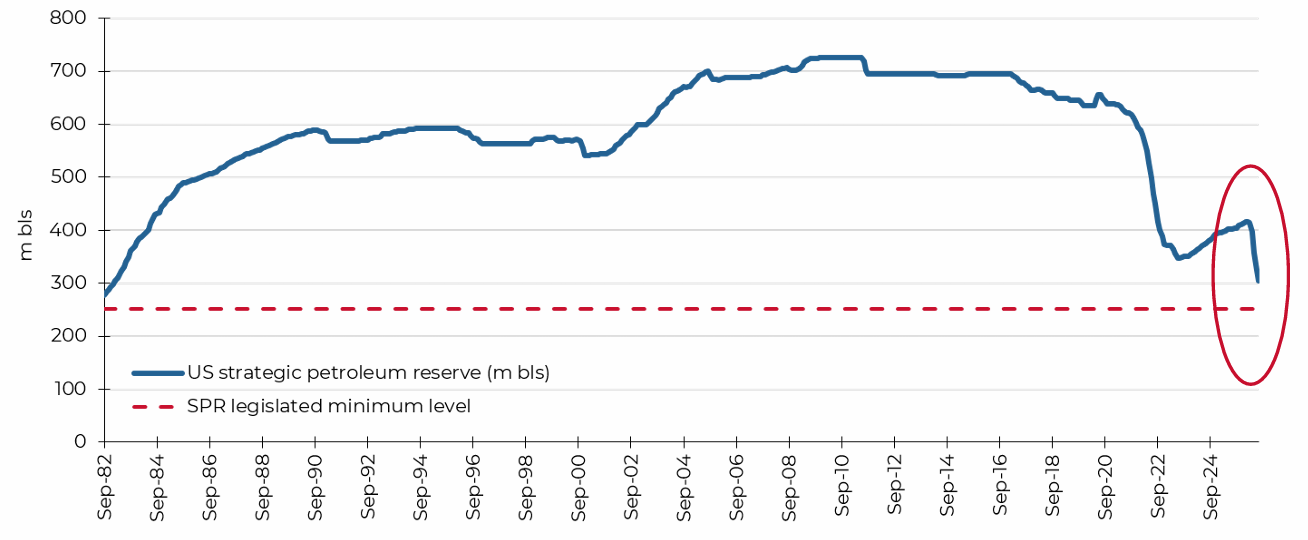
Source: Guinness Global Investors, Bloomberg. Data as at August 2026.
Portfolio positioning
In the near term, Waghorn is positioning to benefit directly from the disruption itself.
Almost a quarter of the Guinness Global Energy fund is invested in oil and gas majors such as Shell and Chevron, and in names tied to rising oil and gas spending, such as Baker Hughes.
But a more distinctive trade, he argued, is in refining – a part of the value chain he sees as particularly exposed within conflict zones and therefore particularly profitable right now.
“Looking at the war between Russia and Ukraine, Ukraine has targeted around 30 of Russia’s 32 refineries, taking 4 million barrels of refining capacity a day offline,” he said.
“Add to this the Middle East disruption and global refining capacity is down around 8 million barrels a day – that is 8% of world refining capacity.”
The result has been a steepening of refining margins alongside a sharp increase in product prices – gasoline, diesel and jet fuel in particular – which is proving highly profitable for the companies positioned in that part of the value chain.
US and European refining margins (US dollars per barrel)
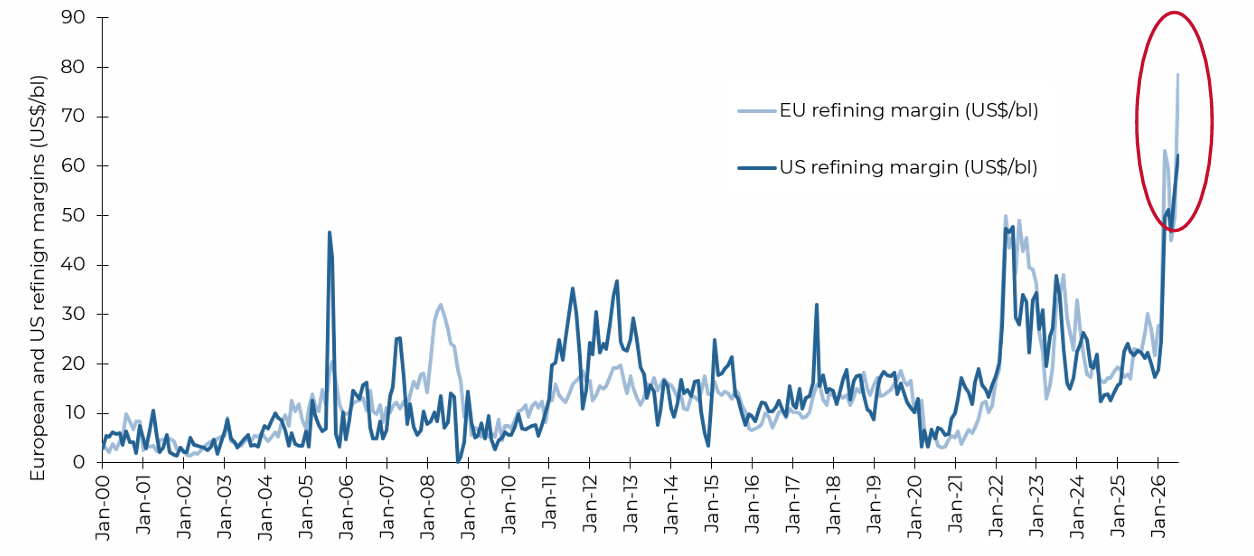
Source: Guinness Global Investors estimates, Bloomberg
Looking further out, though, Waghorn sees merit in the long-term investment opportunities surrounding renewables – especially in countries left exposed by their reliance on imported energy.
He said: “Japan, South Korea, the EU and UK are suffering their second energy crisis in five years – which is prompting a change in behaviour, largely toward renewables and electrification.”
The EU, for instance, has announced it will be accelerating its transition away from fossil fuels, pledging to add 100 gigawatts of renewables to its energy mix every year – quadrupling energy storage and doubling its rate of electrification.
This longer-term shift is reflected in the positioning of Guinness Sustainable Energy, which is heavily focused on electrification – with over a quarter of assets invested in companies such as Eaton and Legrand, alongside grid modernisation names like Itron and Hubbell.
Increasingly, there is also a secondary driver behind the renewables case beyond energy security: artificial intelligence.
“There is a huge demand inflection in electricity, with demand growing by around 4% per annum, and a lot of that comes from AI,” he said.
“AI being enormously power-intensive is putting pressure on trying to find available supply and renewables look like a key part of that supply for two reasons.”
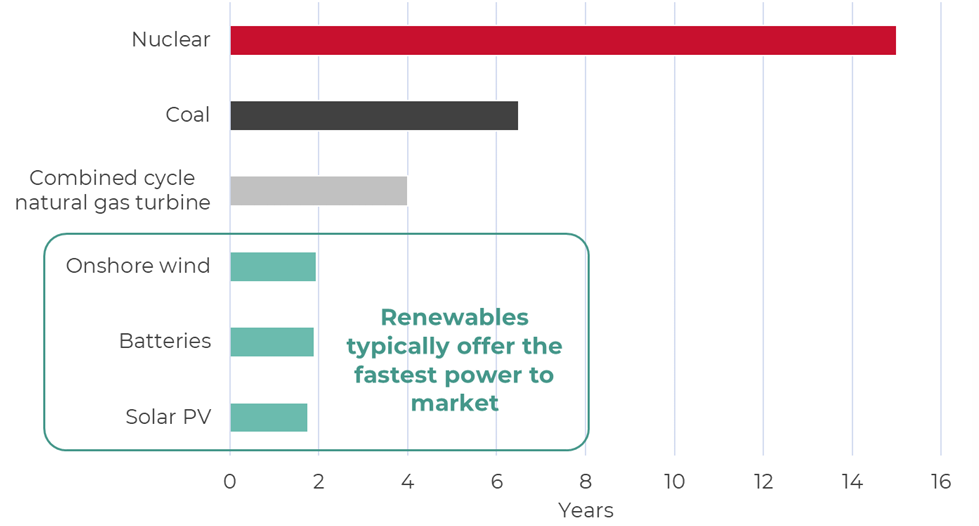
The first is speed to market, as renewable projects typically take around two years to bring online, much faster than fossil fuel developments.
Average US power plant development timeline, from concept to operation
Source: Guinness Global Investors, Lawrence Berkeley National Laboratory, NextEra, Wood Mackenzie, Bernstein
The second driver is cost, with the levelised cost of renewable power generation now typically equivalent to, or lower than, fossil fuel alternatives.
“The economics for the move to renewables is more attractive in the long term,” Waghorn said.
Still, near-term demand for oil remains robust and Waghorn expects attractive opportunities to persist in both fossil fuels and cleaner energy for some time yet.