






Investing in AI is a very polarised subject, with people torn between the growth prospects and the multiple dangers spanning concentration, circular financing, and mounting debt.
But those are all the wrong things to look at according to Max Kettner, chief multi-asset strategist at HSBC Asset Management, who said concerns around AI are "way, way overblown".
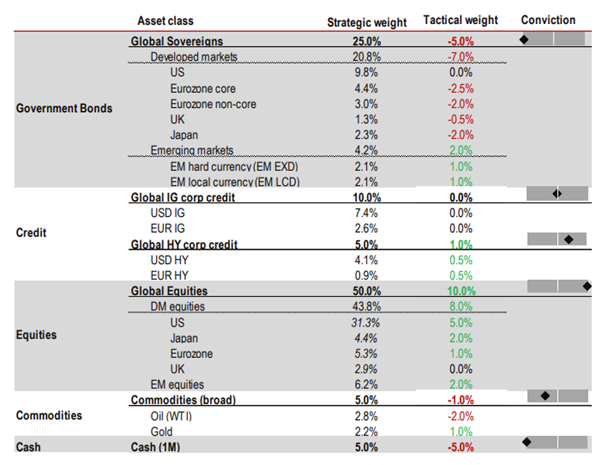
In HSBC's asset allocation, global equities carry a 50% strategic weight, with a further 10 percentage points added tactically – the largest tactical overweight of any asset class in the portfolio and the highest-conviction position on the table below.
Kettner said the multi-asset range has been "maximum overweight on equities" since late March. At the other extreme, cash is at a 5% strategic weight cut to zero tactically, the largest underweight on the table.
HSBC multi-asset portfolio allocation
Source: HSBC
Much of the firm’s enthusiasm for equities comes from AI, but there are concerns. First, he addressed worries that AI has not yet led to a spike in productivity. Here, Kettner said the absence of gains in top-down data is to be expected.
"That will take some time because of the way we measure productivity. You might be able to pick up an improvement in productivity if you're saying, 'I had an old machine, now I have a new machine'. But if you have a revolution, if you have something that's never been there, how do you want to measure that?” he asked.
“So it's quite logical to me that you are not really seeing a productivity pick-up yet in the official, very broad macroeconomic models. The AI strength is underestimated and the concerns around AI are way, way overblown."
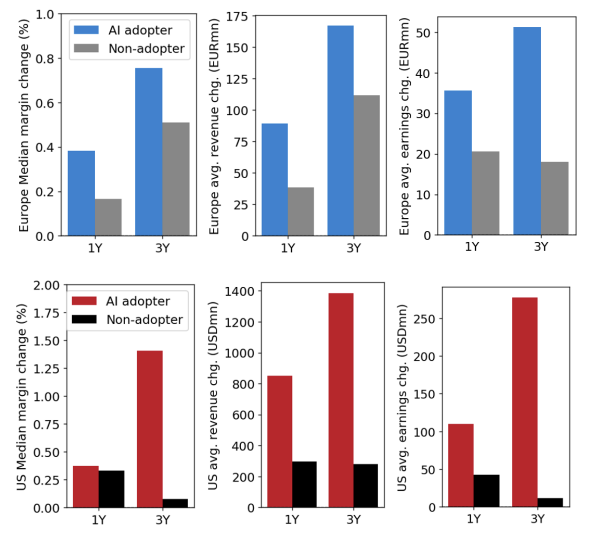
HSBC tested the question by screening European and US companies on what they reported about AI. The screen counted only those that quantified the impact on margins in earnings calls or quarterly reports and excluded those that mentioned using AI in passing. It then compared the median change in margins, revenues and earnings for the companies that met the test.
Kettner said the result was the same on both sides of the Atlantic.
"You're very clearly seeing, whether it's in the US or in Europe, that those companies that are adopting AI are faring much better."
AI adopters’ improving fundamentals in Europe and in the US
Source: HSBC
However, equities are not solely linked to AI and Kettner’s belief in the asset class does not solely depend on the fortunes of the nascent technology.
While Kettner said AI is a large part of the equation, he noted that S&P 500 12-month forward earnings excluding technology were 50% above the pre-Covid trend.
"This is not just [all about] tech and by the way, this is not just the US. You look at the same thing in the UK, in the eurozone, in Japan, in emerging markets, it's everywhere. Earnings have been increasing, particularly in the past three and a half years."
The equity overweight in HSBC multi-asset portfolios formed part of a three-to-six-month tactical view and is backed by a further, final data point that is another structural reason for confidence: equity markets have become quicker to recover from setbacks.
Measuring drawdowns and recoveries by decade, HSBC found that for selloffs of more than 10%, the average recovery time has fallen from 84 days in the 2000s to 64 days in the 2020s to date – faster than at any point since the 1990s.
Smaller pullbacks show the same pattern: drawdowns of between 5% and 10% now take a mean of 26 days to recover from, versus 47 days in the 2000s.
The data is based on a 65-day rolling peak, measuring drawdown severity in three bands (2.5-5%, 5-10%, and over 10%) across five decades.
"With that, if you're not bullish now, I can't help you,” he concluded.