






The physical risks associated with climate change could wipe up to 40% off global stock values, yet markets are failing to price this in.
Physical climate risk refers to the financial consequences of extreme weather events and longer-term shifts in climate patterns, such as floods, wildfires, hurricanes and rising sea levels.
Thomas Lorans, senior research engineer at EDHEC Climate Institute, said: “The price of an asset is supposed to be the expected discounted future cashflow – and here you have the element of expectation of continued growth. However, this does not price in the impacts of physical climate risks.”
Yet such events can damage assets, disrupt supply chains and impair company performance, making physical climate risk an increasingly material consideration for investors managing portfolios.
Lorans highlighted research conducted by EDHEC Climate Institute which examined the impact of climate change-induced transition costs and physical damages on global equity valuation by pricing equity as the sum of discounted claims on consumption across different climate and economic scenarios.
While alignment with the 2015 Paris Agreement’s commitment to limit global warming to ‘well below 2°C’ by 2050 would limit downward equity revaluation to between 5% and 10%, losses in value of global stocks could top 40% if no action is taken, the research warned.
Lorans said: “We find that currently the most probable scenario is at least 3°C of global warming by the end of the century.”
Instead, most investors are focused on accounting for transition-related risks – that is, the positive and negative implications of industries moving (or not moving) to more sustainable business practices. Lorans said this “totally ignores the most obvious risks” surrounding physical damages caused by current and future climate change.
“Markets have a blind spot and the pricing of assets is totally off by missing the big elephant in the room,” he said.
Yet the costs of physical climate risk are already impacting companies globally – and rapidly ramping up.
A 2024 report by the International Chamber of Commerce and Oxera noted that extreme weather events cost the global economy just over $2trn between 2014 and 2023, while more recent research by the Sustainable Markets Initiative suggests listed companies will be exposed to an estimated $1.3trn in losses in the next year alone.
Looking further ahead, S&P Global predicts addressing physical climate impacts will cost large companies $1.2trn every year by the 2050s – even under a scenario assuming strong greenhouse gas emission reductions – as shown in the table below.
Total annual financial impact on S&P Global 1200 companies in the 2050s
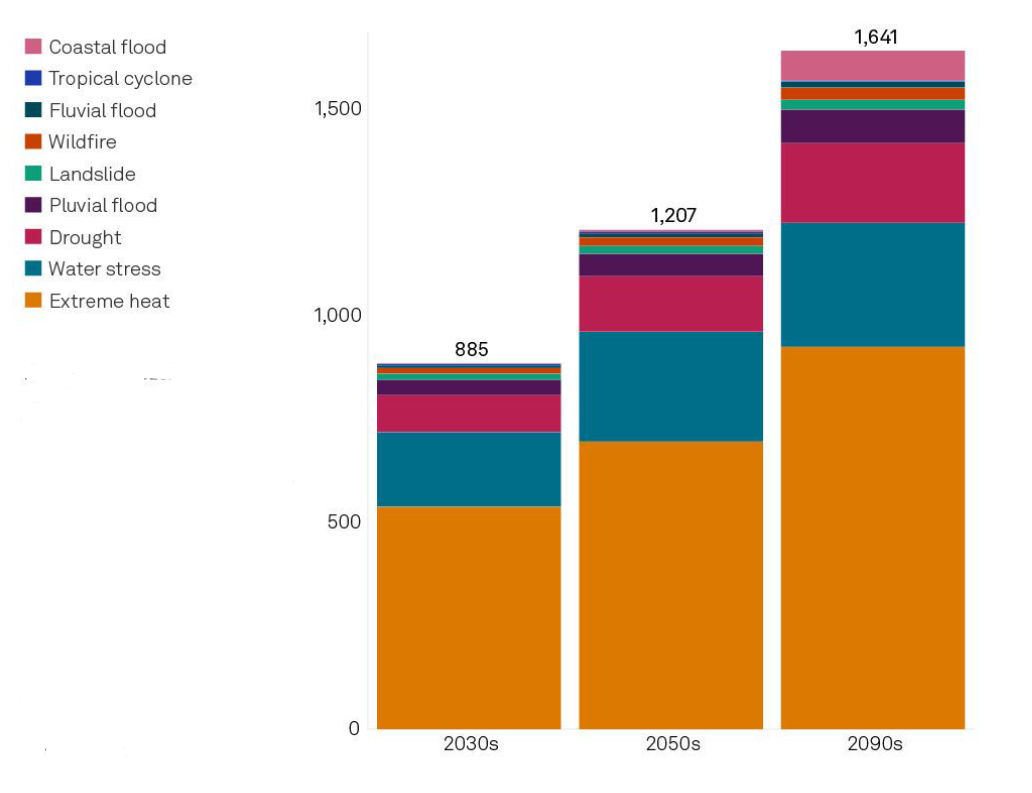
Source: S&P Global Sustainable1. Data as of February 2025.
Katie Self, co-manager of Pictet Global Environmental Opportunities, said: “The physical risks of climate change are no longer hypothetical, forward-looking risks confined to models – they are already visible in company revenues, costs and supply chains today.”
However, figuring out the degree of impact on companies is harder than mapping transition-related risks.
George Crowdy, senior fund manager at Royal London Asset Management, said considerable attention has been paid over the past decade to carbon emissions, net zero commitments, regulation and transition pathways – yet quantifying the financial impacts of future flooding, heat stress, water scarcity or supply chain disruption “remains considerably more difficult”.
He attributed this to data gaps, uncertainty around timelines and the complexity of modelling non-linear climate impacts.
“Physical climate risk is highly location-, sector- and company-specific,” Crowdy said. “While some risks may be underappreciated, markets are continually incorporating new information and the scale and pace of repricing is inherently uncertain.”
Yet, with less visibility of a company’s exposure to physical climate risks and the possible financial impact, it is harder to know how to diversify a portfolio.
“In the transition scenario, diversification is more obvious – you increase the weight of renewables in the portfolio versus fossil fuels,” Lorans said. “It is less obvious to diversify away from physical risk.”
Pricing in physical climate risk
Managers are increasingly accounting for company exposures to physical climate risks – and the measures businesses are taking to mitigate or adapt to them – when making investment decisions.
Charlie Thomas, manager of EdenTree Green Impact Equity, assesses whether a prospective investee company has a climate adaptation strategy, which could include use of climate scenario modelling, flood-risk software, storm tracking, business continuity planning or incident response procedures.
“We also look at whether the company has dedicated capital expenditure that has been ringfenced towards – or whether there are specific programmes implemented to – improving the resilience of assets/infrastructure over time,” Thomas said.
Meanwhile, Ed Mountney, co-manager of Foresight Environmental Infrastructure, said they have enhanced their ability to assess physical risks to the portfolio through the continued development of the Frontierra Climate & Nature Insights Platform, a joint platform development project supported by the UK Space Agency.
“The platform analyses physical climate and nature-related risks and opportunities at both an asset level and fund level,” he said, noting this includes a ‘Value at Risk’ module to help assess the projected value at risk.
In addition, the trust utilises S&P Global Sustainable1’s Climanomics platform, which analyses a range of possible global warming scenarios.
“In FY26, all assets in the portfolio were assessed against nine physical climate hazards,” Mountney added.
“The analysis assesses the potential annual loss in asset value under future climate scenarios and informs both investment decisions and resilience planning.”
Companies at risk and adapting
Fund managers are paying closer attention to how exposed companies are responding to the physical climate risks, investing in those prioritising climate adaptation over those that don’t. This includes widely held names, such as TSMC.
“The majority of its manufacturing facilities are based in Taiwan, a region that faces an increased threat from climate-driven extreme weather, including typhoons and droughts,” Crowdy said.
However, as a result of this risk, he noted that TSMC has “become a global leader in water adaptation including mandating a minimum 85% process water recycling rate across its operations combined with having water-positive goals where it aims to return more clean water to the local ecosystem than it consumes”.
“The company is also diversifying its physical footprint into other regions including Arizona, Japan and Germany,” Crowdy added.
Mountney highlighted assets in his trust’s portfolio that have recently been impacted by physical climate risks: the Crug Mawr and Branden Victoria solar sites.
“Ongoing assessments identified flood-related vulnerabilities,” he said. “So we subsequently implemented drainage improvement works, including the installation of drainage around critical equipment areas to reduce flooding risk, minimise technical disruption and enhance operational resilience.”
The trust’s hydro and wastewater treatment assets are also among those identified as having higher exposure to physical climate risks, particularly around water stress, drought and changing hydrological patterns.
“We actively assess water availability, storage capacity, water recycling opportunities, operational forecasting and climate adaptation measures to reduce vulnerability over time,” he said.
Looking at companies demonstrating increasing resilience to the physical impacts of climate change, Thomas highlighted utility company SSE.
“The company publishes dedicated climate resilience reports that identify material physical climate risks at subsidiary level,” he noted.
“SSE employs climate- and flood-risk modelling tools, tracks the impacts of major weather events across its network and has invested in resilience measures including flood defences, protection of coastal infrastructure and more.”
He noted that these actions can be important indicators of a company’s ability to generate cashflow and of long-term operational resilience versus a peer that cannot demonstrate this level of climate risk management.
A rapidly warming world also presents investors with emerging areas of opportunity.
Self said: “We hold conviction in cooling and HVAC technologies, where 2026 has proven a notable year for the sector, driven by record-breaking heatwaves across Europe and a prolonged US heat dome, which have created one of the strongest near-term demand catalysts the sector has seen in some time.”
She noted that Europe’s air conditioning penetration remains structurally low in many markets and, with Europe warming twice as fast as the global average, “this looks like a multi-year opportunity rather than a one-off spike”.
Lorans, though, was keen to stress that none of this means investors should expect the worst.
“This does not mean you are planning for an apocalyptic world,” he said. “It’s about implementing adaptation measures so your portfolio can handle these risks.”