






Copper is in a “decade-long bull market”, according to Chris Tennant, manager of the Fidelity Emerging Markets fund, while gold has entered a “new paradigm” since the Covid pandemic that should support prices for a long time to come.
In his £1.2bn fund, which he runs alongside Nick Price, Tennant is 14.8% weighted to materials companies, an 8.5 percentage point overweight relative to the MSCI Emerging Markets index.
“Commodities are obviously very important for emerging market equities, not just the mining sector, but it drives the economies of countries like Peru, Mexico, Chile and South Africa,” he said. “The two commodities that we have a particularly strong, positive view on are copper and gold.”
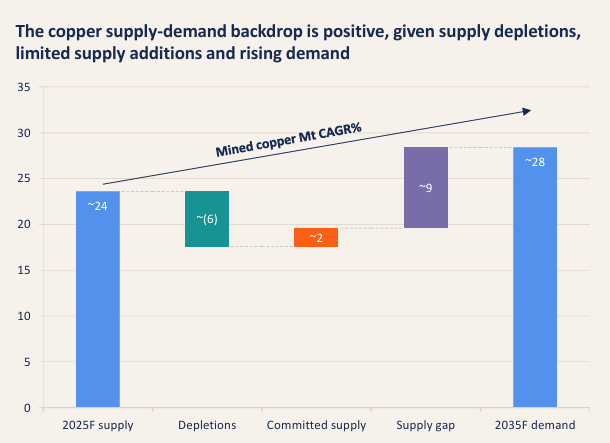
On copper, he said supply constraints should impact the price for years to come. The chart below shows the demand-supply dynamic in the market.
At the end of last year, there were 24 million tons of copper being produced. Over the next 10 years, that should decline by around 6 million tons as projects get wound up.
Conversely, there are only 2 million tons of new projects currently committed, with the manager noting that there haven’t been any major greenfield project discoveries of note in the past decade.
Source: Fidelity, Rio Tinto. Data to 4 December 2025.
“It takes well over 10 years to bring a new project into production, and so you can have very high conviction that the supply gap of 9 million tons is going to need to be filled by demand destruction,” he said, with the price rising to encourage the switch to other metals.
“We think commodity cycles, mined commodities particularly, are very long, and we think we’re in perhaps a decade-long bull market for copper.”
Philip Fielding, manager of the Fidelity Emerging Market Debt fund, said this could benefit countries such as Argentina, where there is a lot of unmined potential.
“The mountain where the copper comes from in Chile goes the other way into Argentina, and the actual Argentine copper production is negligible today. So over the next, let’s say, 10 or so years, it’s not inconceivable that the Argentine copper production starts to accelerate,” he said.
He approached the topic from the fixed income perspective, suggesting that this could help to underpin the bonds of companies involved in new projects, as has been the case with Argentine oil recently.
“Argentina has a very, very strong investment environment for external investment. We see this at the moment in the oil patch in Argentina, in the provinces of Neuquén, Mendoza, where the Argentines have had great success with the exploitation of the Vaca Muerta shale formation and have really accelerated all the oil exports from that area,” he said.
“It’s interesting if you look at the valuations for the companies that have issued bonds in this area; they’re significantly below even the spread of the Argentine sovereigns. So the market perceives these companies as better credit risk than the sovereign itself.”
A country that is already benefiting from tight copper supply is the Democratic Republic of Congo, where he said the acceleration of production in the country has been a “great success story over the past few years”.
“It used to provide about 5% of global copper supply. At the moment, that is at 12 to 13%. So it has really accelerated.”
Turning to gold, Tennant said the precious metal has entered a “new paradigm” since 2020 and, in particular, following the outbreak of war between Russia and Ukraine.
“Firstly, I think a lot of developed markets have taken their fiscal policy past the point of no return, and so for that reason, central banks are looking to diversify into gold as a strategic holding,” he said.
“Also, Russia had its FX [foreign exchange] reserves confiscated after the invasion of Ukraine, and so that has also prompted, I think, a lot of emerging market central banks to look to diversify into gold as well.”
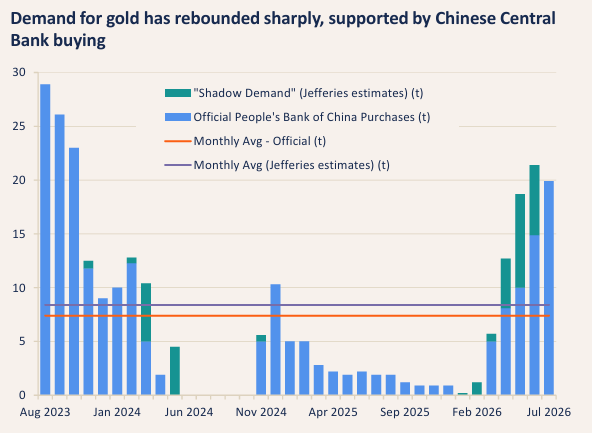
Specifically, he noted China’s central bank has reaccelerated its gold buying in recent months, although at a more modest rate than it was previously.
Source: Fidelity, Rio Tinto. Data to 4 December 2025.
George Cheveley, natural resources portfolio manager at Ninety One, noted last month that China is important to the outlook, accounting for around one-third of annual gold demand as the country looks to bolster the renminbi's role in the global economy.
However, the trend extends beyond China, with gold's average share of central-bank reserves rising from 14% to 25% in two years.
He said: “The significance of the central-bank data is not simply that they are buying gold again, but what it tells us about the level at which they are prepared to buy. Central banks remain committed to accumulating gold, but they are price sensitive.”
It could provide a floor for the gold price at a time when markets are expecting the yellow metal to trend lower.
Tennant said gold is “another commodity where we have a positive view”, noting that it is not only a positive for the miners but also for countries where the economy is heavily linked to the precious metal, highlighting South Africa in particular.