






Investors looking to compare their global value funds to an appropriate benchmark may struggle, as the MSCI World Value index – one of the most widely used style indices – is “completely meaningless”, according to Redwheel’s Ian Lance.
He runs the £628m Redwheel Global Intrinsic Value fund with Nick Purves, which the managers launched in 2023 to sit alongside their UK-centric portfolios.
“The MSCI World Value index has done very well in the last six months,” he said, but noted that the index is invested in stocks that few value managers would own.
He highlighted semiconductor stock Micron as an example. It is the third-largest stock in the index, despite its share price rising around 1,500% over the past five years and more than 400% over the past 12 months.
“I think that index is completely meaningless, the MSCI World Value, just because of the way they [MSCI] put it together and how they define value. No value fund manager in their right mind would describe Micron as a value stock today,” he said.
However, Lance also has issues with the more generic benchmark. His fund uses the MSCI World, where he has a tracking error of 11%.
“It's so high that some investors won't even look at us, because some investors will say, ‘I won't look at someone who's got tracking error higher than 5%,’ or something like that,” said Lance.
“That doesn't tell you anything about us. It tells you about the index. The index itself is just completely ridiculous: 75% in one country, 30% in one sector. It's the index that's become completely ridiculous,” he added.
But the manager admitted that this remains most people’s starting point, as they can buy passive funds tracking global markets very cheaply.
Historically, an equal-weighted index would have beaten a market capitalisation-based one, as money would be reallocated to cheaper stocks. In recent times, the opposite has been true, with larger stocks outperforming.
This makes it a risky time to invest in passives, he said, noting that investors need to decide what the bigger risk is: the potential of losing more money on the downside or missing the index returns on the upside.
Below, Lance explains why he launched Redwheel Global Intrinsic Value three years ago alongside co-manager Purves, how the global and UK value mandates differ, and how his best stock so far has been a “really weird” winner.
What is your process?
It’s to basically find stocks that we believe are trading at a material discount to their intrinsic value, or their worth, to build a diversified portfolio.
We screen the universe, which is MSCI World, using what's sometimes called Graham P/E or a Shiller P/E. It's basically price to 10-year average earnings, and then we focus in on the cheapest fifth of the market using that metric.
We then do analysis on the companies and use price to our own estimate of normalised earnings. We look five years out and ask ourselves where we think the earnings can get back to on a five-year basis as normalised earnings. And then we apply a multiple to that to come up with what we think is the intrinsic value, or the current worth, of the business.
Why did you launch a global fund and how is it different from running a UK value fund?
When we launched this, the reason was that our UK funds had put together some really good returns, yet we were seeing nothing but redemptions. People were basically selling down the UK equity market. So you had all these cheap stocks but nobody was allocating to the market.
We thought it would be nice to actually be running money in an area that people at least could allocate to, and that probably meant going global value.
Performance of fund vs sector and benchmark since launch
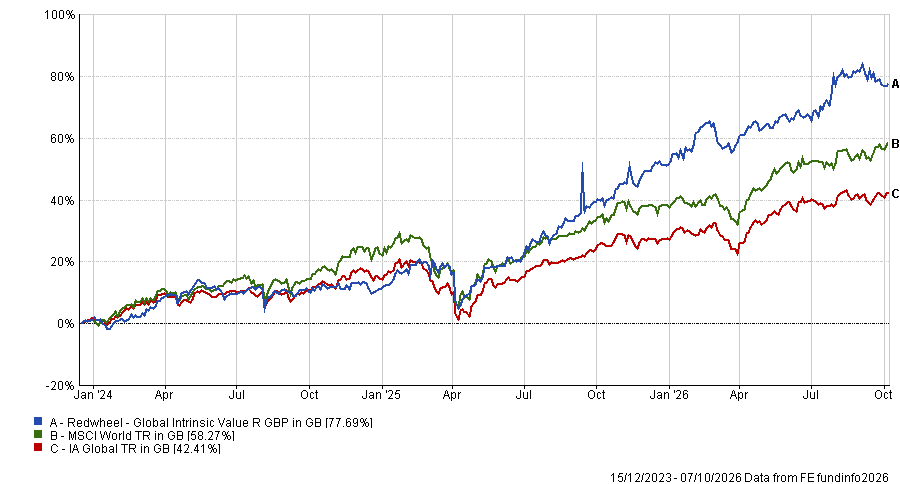
Source: FE Analytics
Have you had to make some changes to how you run money?
We thought it would not be credible for me and Nick to suddenly go: ‘Right, we're now global value fund managers, as well as doing UK’. Therefore, we thought we needed to increase resources. We took three global analysts from an internal strategy that was shutting down and went from being a team of five to a team of eight.
Then we implemented some slightly greater discipline around the way that we deal with things. For instance, we run screens. We allocate stocks to analysts and we do these things called research reviews, where Nick and I go through a stock with the analyst. Those were things that we didn't really need to do on the UK funds. We know the market very well. We don't need to do things like run screens to know what's in favour and out of favour in the UK market.
But we do need to do them on the global funds. Instead of dealing with, say, 200 stocks, our universe is more like 1,600 stocks. And more than that, some of those are companies we don't know particularly well at this point in time.
Why has your US weighting risen?
A year or so ago it would have been maybe 25% and it's now over 40%. That's because most of the recent ideas that we've been finding have been in the US.
To a certain extent, that does surprise us, because we've got plenty of charts showing that the US is more expensive than it's ever been. But of course, what it tells you is the shape of the market.
What makes the index expensive is the fact that there are these massive technology companies, which look very, very expensive, but then there's a great big non-tech set of stocks that are actually very cheap.
There's a big dispersion between the top end and the bottom end of the market. That is heaven for people like us. It's very reminiscent of where we were in 2000, where you had the concentration in, again, technology stocks that were very, very expensive, but then you had a great long tail of cheap stuff. If you're a value investor, that's what gets you up in the morning.
What has been your worst holding since you launched?
The worst is Stellantis, the car company, which is a really sobering experience because we paid 3x earnings for it. You don't normally lose money on a stock when you pay 3x earnings for it.
What's happened is the earnings have gone down. The earnings have gone down for two reasons. One is Chinese competition, something that's common across all European car manufacturers.
And the second one is all these companies were encouraged to plough huge amounts of money into investing in EVs, and then governments moved the goalposts and lots of them ended up writing off huge amounts of money.
Shares have more than halved since we owned it.
And your best?
The best is a really weird one. We bought SanDisk, which is a US semiconductor company. The thesis had nothing to do with AI. It was just classic: this is a cyclical business that's in a trough period and it will recover.
We paid $50 for it. Within four to six weeks, it had gone through $100. We've never seen that before. We've never doubled our money in a matter of weeks. We sold half of the position. Probably, I don't know, eight weeks after that or something, it's through $200.
So having bought it at $50, it's now through $200 and we sold the rest of the position.
A few weeks later it goes through $1,000, and a few months after that it goes through $2,000. That has never happened to us before and will probably never happen to us again.
What do you do outside fund management?
I'm currently learning to play the piano. At the age of 58, instead of buying me a pair of socks for Christmas a couple of years ago, my wife bought me piano lessons. It’s the most nerve-wracking part of my week, going to my piano lesson, knowing that I haven't done my homework.