






Trust manager Imran Sattar has been reshaping the Edinburgh Investment Trust portfolio after a difficult period, including a move into UK housebuilders that he believes offers attractive risk-reward.
Since March 2020 – the point at which Sattar’s former firm Majedie Asset Management (now owned by Liontrust) took over the £1bn trust’s mandate – Edinburgh Investment Trust has delivered a total return of 108%, beating the FTSE All-Share’s 81.6%.
However, the trust has struggled in the nearer-term, logging a just shy of 8% return over the year to the end of September 2026, placing it in the fourth quartile of the IT UK Equity Income sector. As a result, the trust is currently trading at a 7.5% discount to NAV.
Performance of the trust vs benchmark and sector since March 2020
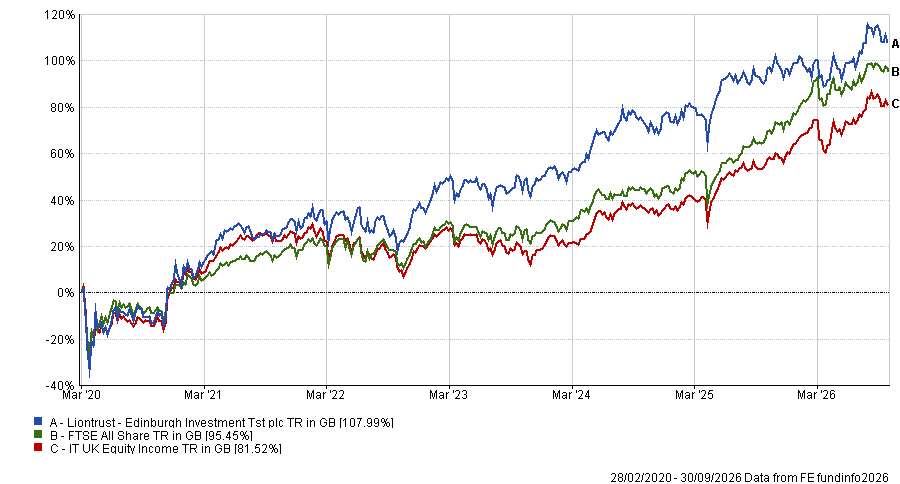
Source: FE Analytics
Speaking at the AIC Investment Showcase, Sattar attributed this recent run of underperformance to three things: “Our data names have been hit by fears of potential AI disruption, a small number of businesses we own did not deliver operationally and, thirdly, we were underweight some of the stronger-performing areas, like banks.”
There are signs of a recovery, however. Over the past six months, the trust’s share price is up by close to double digits and its net asset value (NAV) is ahead of the benchmark.
He noted the management team has “made quite a lot of changes to the portfolio, which is testament to the flexibility we have in our investment process”.
One of the most notable changes has been a move into UK housebuilders.
With housing volumes “very much at a low ebb”, Sattar believes the risk-reward dynamic in the sector is very attractive.
The sector has also rallied following an announcement by the government last month that it would be introducing a new equity loan scheme for first-time buyers of new build homes.
“In aggregate, we have bought about a 5% position of the trust’s assets in this area,” Sattar said, including positions in Bellway and Persimmon, which he argued complement the trust’s existing positions in related businesses such as Marshalls, Ibstock and Howdens.
“We only need a small recovery in volumes for profit to really motor because these businesses are highly operationally geared,” he said.
The Your First Home initiative is expected to be confirmed at the Budget on 28 October. Under its terms, first time buyers would only need a 2.5% deposit for a new-build property, while the government would lend 20% of the price, leaving a mortgage of 77.5%. It is expected that the loan will remain interest-free for a set period.
Over 380,000 new build property purchases were made under the previous Help to Buy scheme between 2013 and 2023, which would suggest the government’s new initiative could increase demand for new build housing – therefore benefiting UK housebuilders.
Sattar has also been adding to companies in adjacent industries, such as construction, investing in European lime and materials group SigmaRoc.
To make room for his bet on the UK housebuilders, Sattar has reduced the portfolio’s position in more consumer-exposed businesses, including fast food chain Greggs and hospitality chain Whitbread.
“We have also banked profits in companies like manufacturer Rotork and value-add solutions group Diploma – two industrial businesses that have produced very strong returns for us,” he added.
In contrast, stocks that have disappointed include pest control business Rentokil, where shares are down by more than 30% year-to-date.
“The business itself is a very attractive one, and the industry is a very attractive one, but the company has not executed very well,” Sattar said, adding that he remains “very excited” about the company.
Navigating a rough patch
Although AI fears may have hurt some of the trust’s data holdings, Sattar has not walked away from the area. Instead, he is being more selective, backing companies he thinks the market has wrongly written off as AI losers. An example of this is UK software company Softcat.
“A year ago, the market thought it was going to be disrupted by AI but we took a different view and bought shares in this excellent business with very high returns,” Sattar said.
“Softcat has got a great growth tailwind behind it and it only has a 4% market share, so we think it has a long runway of growth.”
The company’s half-year results for the 2026 financial year were also strong, Sattar noted, which has had a positive impact on its share price, which is up 36.8% year-to-date.
While Softcat is demonstrating its resilience against the AI loser narrative, Sattar said the trust has reduced its exposures to more vulnerable names, such as Trainline and MoneySuperMarket.
“Our view is that their economic moats are less good than they would have been pre-AI,” he said.
The trust’s underweight position in UK banks proved another drag on returns. According to its annual report for the year ending March 2025, Edinburgh Investment Trust had a 15% weighting to financials. As of the end of September 2026, this has been increased to 21.5% – however, financials currently make up just shy of 30% of the FTSE All Share.
However, one of the trust’s top contributors throughout this period has been NatWest Group. It is the trust’s biggest active weight as of the end of August 2026 at 4.5% and represents 6.3% of the overall portfolio.
Sattar said the bank is “producing excellent capital generation, paying a really nice dividend [of 12p per share] and giving cash back via share buybacks”.