


Where a European bank is based decides whether it is worth owning, according to Benjamin Moore, manager of the BlackRock Greater Europe Investment trust.
“Europe is a Krispy Kreme doughnut, with all of the sugar and icing around the edge and not much going on in the middle,” he said.
In the centre is the north of Europe, France, Germany and the Scandinavian markets, where “it’s much more difficult to eke out even a double-digit return”.
On the other hand, peripheral European banks have consolidated, cleaned up their balance sheets and acquired “very sticky” deposit bases, while regulators are also “much more benign” in these parts of Europe. This means the ‘peripheral’ sector is generating returns “on tangible equity”.
“So for European banks, we’re much more selective in where we will play,” Moore said.
For the best part of 15 years after the 2008 financial crisis, European banks were considered poor investments, weighed down by restructuring, fines and tougher capital rules.
“Anyone who looked at European banks 15 years ago, there was a gag reflex if you actually mentioned the European bank because the industry was in such a terrible state of disrepair,” Moore continued. “There’s been dramatic market repairs since, and so we’ve significantly increased our exposure there to an industry where things are actually really improving.”
At the end of August, the Blackrock Greater Europe portfolio had a 23.1% exposure to financials, with the main banks being UniCredit (3.7%), Allied Irish Banks (2.9%) and Caixabank (3.2%).
Fred Sykes, equities portfolio manager at Fidelity, broadly agreed, although he has held bank shares for several years. To him, the sector’s low valuation was justified in the 15 years after the 2008 financial crisis.
In that time, banks earned a return on equity (ROE, or the profit a company makes for every dollar invested in the business) of around 5%, and investors paid much less for each unit of their profit – a gap measured by the price-to-earnings (P/E) multiple.
“The banks were worse-quality businesses than the market, trading at much lower multiples,” Sykes said, referring to the chart below. “Today, ROEs have recovered, but the valuations haven’t”.
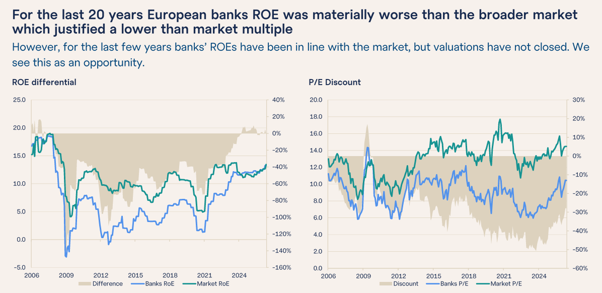
Source: Fidelity
He continued: “We’ve owned bank shares for a number of years and we still think that closing of the quality, the fact that the banks are better quality businesses than they have been historically, is not recognised by the market.”
Niklas Kammer, senior equity analyst at Morningstar, didn’t see it that way.
In its latest European Banks Industry Pulse study, the firm found that valuations look modestly expensive, as it expects eurozone and UK mortgage demand to soften, and sees corporate loan books as more vulnerable than household lending.
“Structural hedges and wider deposit margins should continue to support earnings in the near term, yet much of that benefit now appears reflected in valuations,” said Kammer.
“Looking ahead, the balance of risks is becoming less favourable. If elevated energy prices keep inflation higher for longer, further rate increases could put additional pressure on economic growth, slowing loan demand and increasing the risk of credit losses.”
But while valuation opportunities may be limited, Morningstar pointed to NatWest and BNP Paribas as its favourite picks.
The former offers “the best risk/reward trade-off among UK banks”, with a “strengthening franchise and improving structural profitability”.
Morningstar analysts anticipate “deposit franchise wins and a greater contribution of non-interest income after the acquisition of Evelyn Partners, which should improve earnings quality”.
“NatWest has brought its capital levels in line with peers after a significant overhang following the government involvement after the global financial crisis during 2007-09. That said, improving profitability and a robust balance sheet support NatWest’s progressive dividend and share buybacks,” they said.
Conversely, BNP Paribas provides a “compelling mix of income, stability and strategic growth at a discounted valuation”, with the stock trading at a 40% discount to the European banking sector’s average price/tangible book ratio while delivering a 6% dividend yield.
Banks are not the only place where European managers are being careful. Wars in Ukraine and the Middle East, US trade policy and AI all add to the risks, with Moore saying that “the number of things you need to be prepared for and worry about in Europe is just manifold”.
“For us, the emphasis on being very focused and, frankly, very paranoid is higher than it’s been as long as I can remember,” he said.
For example, AI is lowering costs for most businesses, which leaves the question of how many pass the savings on to customers and how many keep them. On top of that, some companies gain a new source of revenue while others are left structurally challenged: the technology has upended industries once seen as defensive, such as telecoms and insurance.
His response has been to hold sectors that are completely outside that narrative, for example, jet engine makers.