


Taiwan and Korea have been the big emerging-market stories in recent years, but the biggest shock for Leon Eidelman, co-manager of JPM Emerging Markets fund, has been the fall of the region's once dominant market: China.
“If you went back 10 years and said ‘What is the world going to be?’ you wouldn’t think that the world’s second-largest economy would be of equal size to [Taiwan]. Basically, it doesn’t make any sense,” he said.
Taiwan now represents some 28.9% of the MSCI Emerging Markets index, while Korea is worth 21.4%. China has slipped to third place (19.8%) while India – the other formerly dominant country before the AI boom – stands at 10.7%.
“The valuations that currently apply to the Chinese equity market are incredibly low, and I think that investors apply a very high cost of risk to China. That’s as a result of some of the political interference in markets and equities that have obviously scarred foreign investors,” he said.
“Domestically, they’re going through some financial pain as they reconfigure the economy from fixed asset investment and real-estate-driven growth to other things.”
The Chinese economy is “very bifurcated”, Eidelman noted, with the only area of the market “ticking along” being the semiconductor stocks, which are receiving a significant amount of government investment. Consumer stocks have “suffered quite a lot”, as exporters experienced a significant amount of pressure due to changes in the tax regime, tariffs from the US and an appreciating renminbi.
With China faltering, Taiwan and Korea have overtaken it in the index thanks to their best-in-class tech giants: TSMC in Taiwan and Samsung Electronics and SK Hynix in Korea. To get there, it has taken them years and decades of spending on research and development, dedication to supply chain resilience and building partnerships with the developed world, said Eidelman.
TSMC, the largest stock in the index, is his £2.8bn JPM Emerging Markets fund’s biggest holding at just shy of 10%, with Korean juggernauts Samsung Electronics and SK Hynix in second and third place respectively.
Eidelman runs the fund alongside John Citron and veteran stock picker Austin Forey. Over the past 10 years, it has been a top-quartile performer in the IA Global Emerging Markets sector, up 119%.
Performance of fund vs sector and benchmark over 10yrs
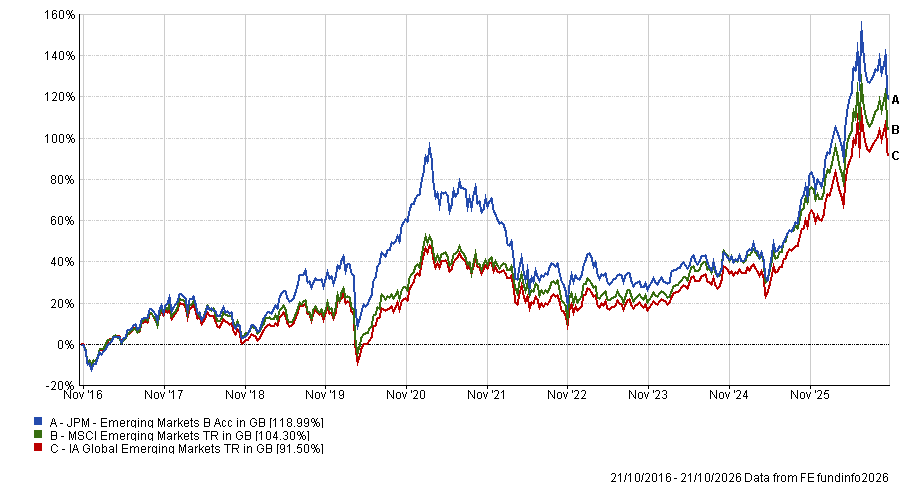
Source: FE Analytics
Below, Eidelman explains why emerging markets lend themselves to growth companies, why India has struggled and which of the ‘big three’ has been the fund’s best performer.
What is your process?
We believe that the single most important attribute an equity can have is growth. In emerging markets, a lot of stocks should have that attribute because of the emergence of two strengths.
The first one is [the consumer]. If you look at the countries in the benchmark today versus 25 years ago, it’s the same. But per capita incomes have grown significantly, and spending patterns have changed alongside them. The opportunity in the asset class is to identify businesses that can grow alongside the consumer.
The second is that the asset class has gone from being a labour-cost arbitrage outsource winner to a dominant manufacturing hub for the world.
The margins that some of these export champions are delivering today reflect the fact that they carry significant amounts of intellectual property and value add.
What has been your best performer this year?
The single best contributor to portfolio performance over the course of the last year has definitely been SK Hynix.
We took a very large position in Hynix about two years ago with the view that (a) the memory cycle was really starting, and (b) it was incredibly well positioned for it. It was the first to really drive high-bandwidth memory, which is obviously what’s going into GPUs today.
Year to date, the stock is up about 140% and has contributed about 130 basis points of return.
And your worst?
The stocks that have been hit by fears around AI have been among the worst contributors, for example travel-related names Trip.com and MakeMyTrip.
There is quite significant fear that those stocks are going to be disintermediated by AI, and that you will be able to book your travel just using [LLMs].
And so, there’s been a pretty significant derating there for those stocks over the course of the year. MakeMyTrip is down 46% and has been a significant detractor to total returns.
India has been choppy recently. What’s your view on the country?
India doesn’t have [tech] hardware or AI, so today it is a much smaller percentage of most emerging market equity portfolios. Not because it’s dramatically underperformed, and not because equities have fallen a lot, it just hasn’t kept up with the earnings growth that you’ve seen in places like Korea and Taiwan.
That will change. Over time, the Indian consumer will continue improving. That should drive returns. India got very expensive, and then it underperformed right as Taiwan and Korea did very well. But it’s now not as expensive as it was.
So now you’re back to [a situation where] India’s performance should be closer to its underlying equity growth, which is pretty good. And so India should start perking up.
Are Korea and Taiwan all about just three stocks?
The Taiwanese domestic market isn’t super relevant. The Korean domestic market has historically had a lot of chaebols [large, family-owned industrial conglomerates] and a lot of issues there. Credit where credit is due, even before the tech stuff started happening, it had been pushing this ‘Value Up’ framework copied from what Japan had been doing, and that has been having some effect.
I went and saw a few financial companies just last week, where historically they would have been nowhere [near good enough quality] on capital allocation and dividends et cetera. They are actually making progress.
So it is improving as a market, and I think it would be a mistake to underestimate how important that has been.
What do you do outside of fund management?
Family obviously is important. I’ve got two small kids, so I spend a lot of time with them. Despite the travel at work, which is a lot, I enjoy travel and seeing the world.
On the more fun side of things, I scuba dive a lot. I’ve done over 2,500 dives globally. It’s my happy place.