






Long-term investment objectives can be achieved through a simple mix of equities, bonds and cash, according to BNY Mellon Multi-Asset Balanced fund manager Simon Nicholls, who said the proliferation of alternative investment products in the market is one of the biggest changes in the multi-asset space since his fund was launched 40 years ago.
Speaking to Trustnet to mark the fund’s anniversary, the co-manager of the £4.2bn fund said much has changed in his 25 years on the portfolio and over the course of the entire four decades it has existed, but one thing has not: simplicity is key.
He argued that one of the biggest changes of the past 40 years has been the increase in availability of more complex investments, “not just asset classes but [also] the various wrappers”.
Nicholls said that there are many competitors in the IA Mixed Investment 40-85% Shares sector that now use complex investments, offering the potential of greater diversification, yet this is not something his fund has needed.
“We haven’t [invested in derivatives]. We can, but the bar is pretty high for us to introduce those more complex investments into the portfolio. And I think there has to be a very good reason as to why we would do it,” he said, noting that the team also has “no immediate thoughts of doing so”.
By investing in only equities, bonds and cash, it is this “simplicity” that has led to the fund’s long-term success, Nicholls argued, as the triumvirate offers plenty of liquidity and transparency in a portfolio without making concessions elsewhere. It crucially also offers the managers greater control over what they are investing in.
“We have found through time that understanding what we own is really valuable. When we ask ourselves questions about which investments need to go into the portfolio, we think about what we own, why we own it, how that investment is going to generate a return and what risks we are exposed to,” he said.
“By keeping it very simple, we’re able to answer those questions reasonably quickly when risks hit in the market.”
This has worked in the long run, with the fund up 109.5% over the past decade, a top-quartile return in the sector and around 33 percentage points ahead of the average peer.
Performance of fund vs sector over 10 yrs
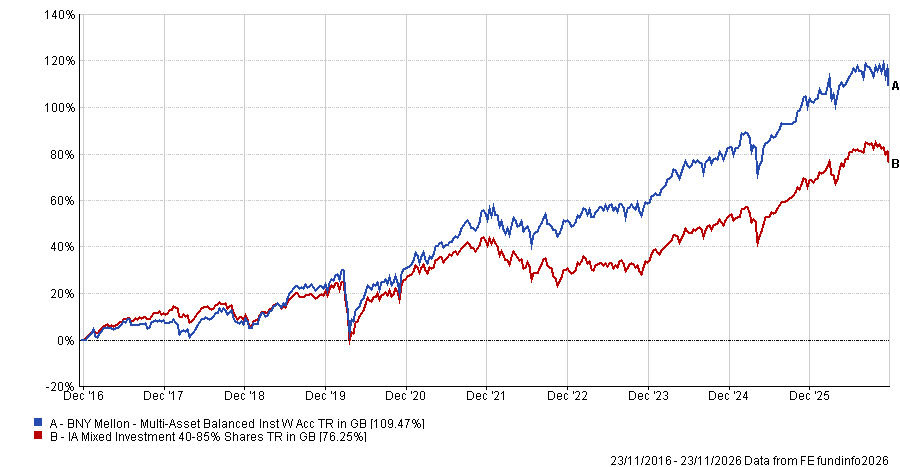
Source: FE Analytics
Gold is another asset that the manager has no use for in the BNY Mellon Multi-Asset Balanced portfolio at present.
“We don’t know how to value it. There are no cashflows from gold,” he said.
The precious metal has made an appearance in the portfolio over the years, particularly during the low interest-rate environment of the 2010s when the opportunity cost of owning gold was very low.
However, he said yields are now around 5% nominal and 2-3% real (after inflation), which means the opportunity cost of holding gold is much higher.
Despite eschewing these areas, the managed conceded that there are times when the correlation between bonds and equities do break down, such as when inflation is causing market wobbles and concerns around stagflation.
But this is where the equity portion of the portfolio needs to change, he argued, suggesting that the right equities that have an element of pricing power and “a little bit less economic cyclicality” should provide stagflation protection.
While the equity portion is fluid, with bonds, the portfolio sticks predominantly to government debt and ignores corporate fixed income. This is because the bulk of the portfolio is invested in equities, so the bond allocation needs to work as often as possible when equities don’t.
At present, he favours gilts as the UK government debt is a high-yielding market compared with others such as US treasuries.
In particular, he noted that there “appears to be some kind of framework” to bring the government debt levels under control over the course of this parliament, which provides a level of security to investing domestically.
An added benefit is the lack of currency conversion required also, as the fund is managed in sterling and therefore does not need to take foreign exchange into account when buying UK bonds.
“We do have about 3% in US treasuries, a mixture of nominal and TIPS [treasury inflation-protected securities], and we don’t hedge those; we leave those unhedged, on the basis that in a real risk-off environment, the history has been that the dollar tends to be reasonably strong, and so they’re there in the portfolio to play the role we want them to play,” he noted.