






Artificial intelligence (AI) has already crept into people’s lives and not just through the use of large language models like ChatGPT. In some parts of the market, it is shaping what consumers buy, how companies operate and where capital is flowing.
That is most visible in places where AI has moved from a supporting role to the centre of the business model. China is one such place. One of the most digitised consumer economies in the world, many of its most successful companies use data and algorithms not simply to optimise pricing or marketing, but to shape behaviour at scale.
Sophie Earnshaw, manager of the Baillie Gifford China Growth trust, said AI is already “driving revenue, margins and returns” at companies such as Tencent and Alibaba. But her favourite example of an AI adopter is coffee chain Luckin Coffee.
Performance of fund against index and sector over 1yr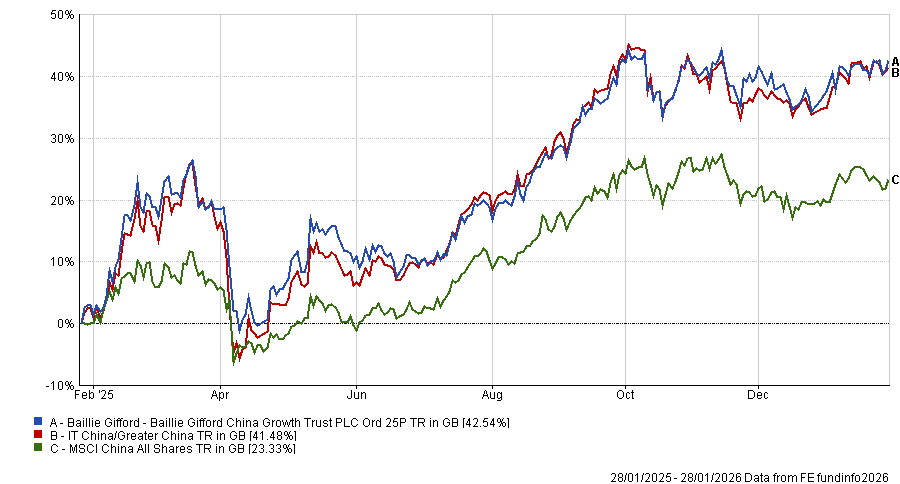
Source: FE Analytics
Rather than competing on branding alone, this company has built its business around an app. “Luckin Coffee operates more like an internet platform than a coffee brand, with its app as the operating system,” she said. “Data drives product development and habit formation.”
Ordering, payment, pricing and product design are all mediated by software, allowing the company to analyse and exploit demand patterns with minimal human intervention, allowing customers to order ‘the usual’ without the need for a barista to remember their face (and their order).
AI systems are being trusted to manage decisions in consumer markets, but a similar approach is taking place in services, especially in sectors that rely on pattern recognition and standardised judgement, such as healthcare.
Healthcare faces mounting pressure from ageing populations, workforce shortages and rising costs. Trevor Polischuk, co-manager of the Worldwide Healthcare trust, argued that these conditions make it particularly exposed to automation. “Every part of the healthcare ecosystem is being influenced and accelerated by artificial intelligence,” he said.
In practice, AI’s role in healthcare is already extending beyond efficiency. Advances in diagnostics, personalised medicine and data analysis are changing how diseases are identified and treated. Polischuk said the result was likely to be a fundamental shift in how care is delivered.
“At the patient level, healthcare is increasingly coming home. Telemedicine is just the beginning,” he said. “We believe primary care and diagnosis will increasingly be supported or replaced by AI interfaces.”
Performance of fund against index and sector over 1yr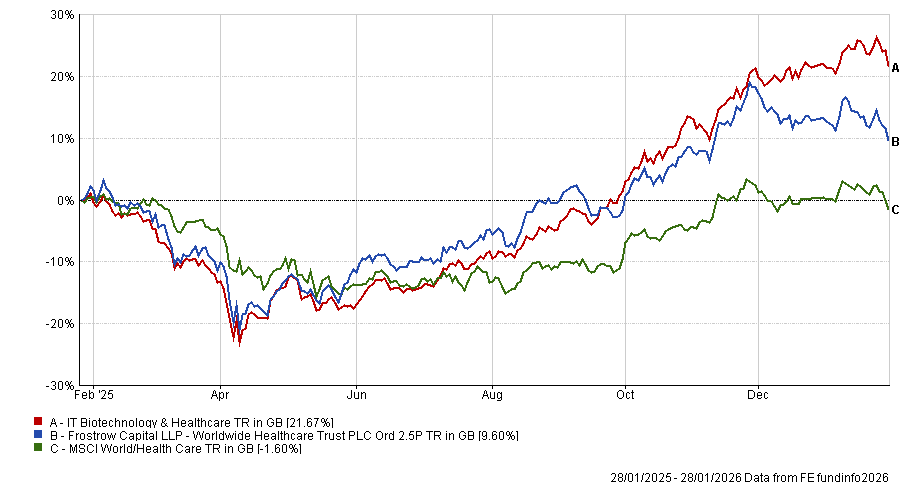
Source: FE Analytics
Many of the tasks performed in primary care – triage, pattern recognition, monitoring and routine diagnoses – are well suited to systems trained on vast datasets. The attraction for healthcare providers is not only cost reduction but also consistency and scale, particularly in overstretched systems.
AI is also accelerating progress further upstream, in drug discovery and treatment design. Polischuk said innovation in medicines is now moving faster than at any point in his career, driven in part by advances in diagnostics and data processing.
“We expect innovation in medicines and cures at a pace never seen before, in part due to the revolution in diagnostics and personalised medicine,” he said. That speed has implications for patient outcomes as well as for how capital is allocated across the sector.
The same dynamic is evident in medical technology, where robotic surgery systems already incorporate machine learning and data feedback, allowing procedures to be refined continuously. While human surgeons remain central, the balance of responsibility may shift over time.
“Systems today have vastly greater computing power and embedded AI learning, with some autonomous functions already built in,” Polischuk said, suggesting that the active role of clinicians could diminish as technology matures.
AI does not need to outperform humans in every dimension to be disruptive; it simply needs to be good enough, cheap enough and scalable enough to alter behaviour, he said. That is the same logic that allowed data-driven platforms to dominate consumer markets long before most users recognised the trade-offs involved.
While some sectors are still struggling to find use cases for AI, its effects may emerge in unglamorous areas where efficiency, volume and repetition matter more than visibility. In healthcare, Polischuk sees this as an unusually compelling moment.
“The confluence of this environment – the innovation, whether it be politics, lowering interest rates, M&A, valuation… – I've never seen it all align like this, and after four years of healthcare underperformance, I think the setup is phenomenal.”
He concluded: “This is the most bullish I’ve ever been on healthcare in my career”.