






Technology has become one of the strongest engines of growth across markets, with AI providing the latest and most powerful reminder of what successful innovation can deliver for investors.
As they seek exposure to the theme and the big returns associated with it, investors are increasingly looking for specialist tech funds. A recent favourite has been Polar Capital Global Technology, which was one of the most-researched funds on Trustnet over the 12 months ending August 2026.
The popularity of the $22.1bn strategy comes from a combination of the well-known management team, strong long-term returns and a balanced, disciplined approach to invest in the sector, as Rob Morgan, chief investment analyst at Charles Stanley, noted.
“It suits many investors who wish to gain access to a number of core technology themes and favour an approach that embraces the AI complex through mega-cap US stocks but also backs smaller emerging beneficiaries of technological change,” Morgan said.
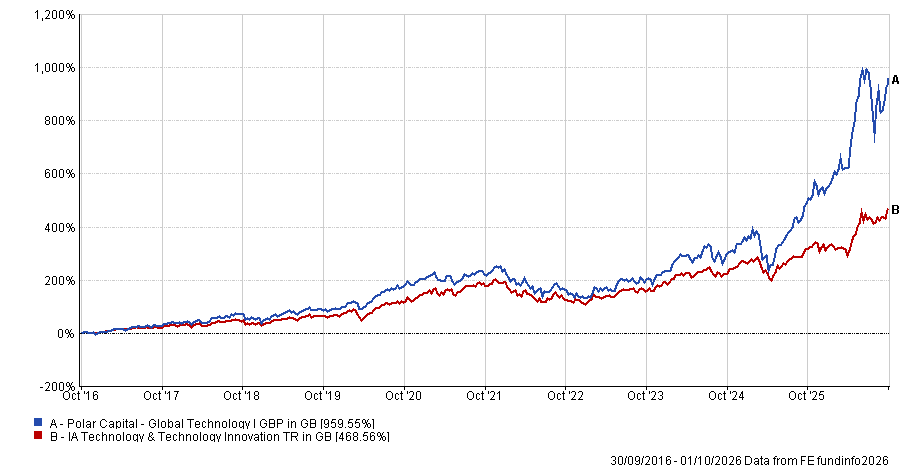
It has a very strong track record, having posted first quartile returns in the IA Technology and Technology Innovation sector over one, three, five and 10 years to the end of September 2026 – gaining 938.9% over the decade.
Performance of the fund vs sector over 10yrs
Source: FE Analytics
Earlier this year, Polar Capital Global Technology was awarded an Elite Rating by FundCalibre and it is already highlighted by AJ Bell and Barclays in their best-buy lists.
But there are other options to capture the long-term technology growth story and Trustnet asked fund selectors to suggest some alternatives.
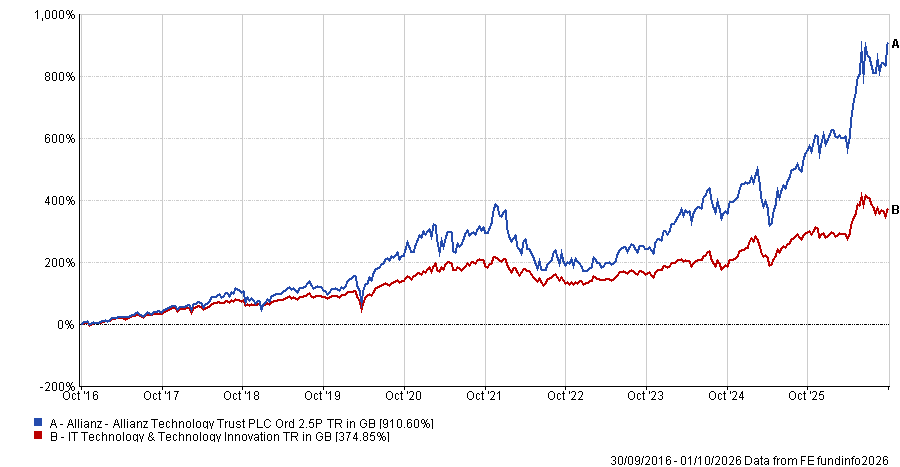
For investors interested in investment trusts, Morgan highlighted Allianz Technology, another long-established vehicle specifically targeting tech innovators and drivers.
“It is a more adventurous choice for those wishing to magnify exposure to significant beneficiaries of themes such as AI, semiconductors, cloud computing and digital infrastructure,” Morgan said.
In the trust’s full year results, published in March, lead manager Mike Seidenberg doubled down on AI-driven secular growth and continued post-Covid technology demand as continued sources of strong returns for the trust.
The most significant distinction to the Polar Capital strategy is its closed-ended structure, which Morgan noted can create several advantages.
“The trust is not subject to concentration limits for its holdings and it has been significantly weighted in the tech mega-caps, which has been a clear advantage over its open-ended peers,” he said.
“The permanent capital structure is also better placed to reach further down the market-cap spectrum and invest more meaningfully in smaller, less liquid names.”
Historically, Allianz Technology Trust has been “more willing” to own more mid-caps and emerging businesses, Morgan noted.
The trust is currently trading at a 7.4% discount to net asset value (NAV).
Performance of the trust vs sector over 10yrs
Source: FE Analytics
Threadneedle CT (Lux) Global Technology can also provide investors with specialist exposure to the structural growth available from technological change, according to Paul Angell, head of investment research at AJ Bell.
“The fund is managed by [Paul Wick and Vimal Patel at] Seligman Investments, with teams based in Silicon Valley and New York. It invests across the technology ecosystem, including smaller and mid-sized businesses that may be at an earlier stage of benefiting from a technological shift,” he said, adding that valuation also forms an explicit part of the process.
Like other tech funds, the managers are looking at areas that enable AI adoption, including semiconductors, data centres, networking and power, but Angell said they are doing this “while retaining a valuation discipline rather than simply chasing momentum”.
“Investors therefore still get dedicated exposure to technology and many of the same long-term structural drivers that make Polar Capital Global Technology attractive, but through a portfolio that can look further down the market-cap spectrum for the next generation of winners,” he said.
Over the 10 years to the end of September, the fund has returned 885% – just over 50 percentage points less than Polar Capital Global Technology.
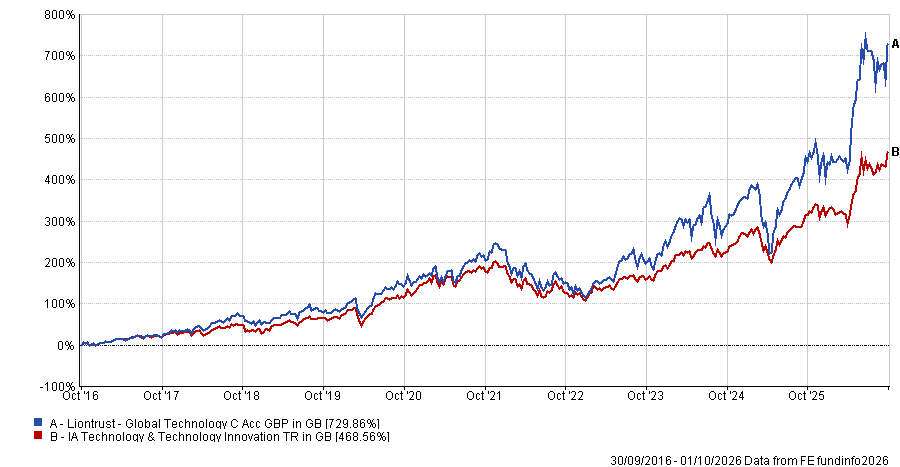
Angell’s next alternative suggestion is Liontrust Global Technology, co-managed by Storm Uru and Clare Pleydell-Bouverie, who were flagged as rising star managers by AJ Bell in August.
“Both the Liontrust and Polar Capital strategies give investors a concentrated way of tapping into the long-term growth generated by technological change,” Angell noted.
“However, Liontrust approaches that opportunity through a very explicit innovation lens. Every company must demonstrate four characteristics: innovation that creates value for customers, strong barriers to entry, good management with a record of execution and strong returns on invested capital.”
He said this this approached has allowed the managers to move beyond more obvious technology winners, although the fund has more recently benefited from backing widely-held AI players, such as SK Hynix.
Performance has subsequently been strong, with the fund returning 64.6% over the past six months to September 2026 alone.
“For somebody who likes the specialist nature and growth potential of Polar Capital Global Technology but wants something a little further off the beaten track, Liontrust Global Technology could offer a compelling alternative,” Angell said.
Performance of the fund vs sector over 10yrs
Source: FE Analytics
A less obvious alternative is WS Blue Whale Growth, which was suggested by Richard Evans, investment writer at Fidelity International.
Managed by FE fundinfo Alpha Manager Stephen Yiu, the £2.5bn fund has less than 30 high-quality and high-growth stocks in the portfolio.
“It might not immediately strike investors as an alternative as it is not even classified as a technology fund; it belongs in the IA Global sector,” Evans acknowledged.
“Nonetheless, if we adopt the ‘if it looks like a duck’ principle, it strongly resembles an AI-heavy tech fund: holdings include Nvidia, Broadcom, SK Hynix, BE Semiconductor, Sandisk and Alphabet.”
Indeed, technology stocks account for over half of the fund; however, the fund also offers more defensive balance, including exposures to industrials and mining companies.
“It has the flexibility to reduce exposure to technology of the manager thinks changing circumstances warrant it,” Evans noted.
Since the fund was launched in September 2017, it has gained 341.8% (to the end of September 2026), beating the sector average return of 125.7%.