






Bonds and equities rarely move in opposite directions over the long term, but investors who started investing after the tech boom have become too accustomed to the phenomenon of negative correlation, according to Ed Senior, chief executive of Fortem Capital.
For the whole of the 20th century, on average, equities and bonds were more likely to move in the same direction, as the chart below shows, with short periods where they were negatively correlated.
However, since 2000, investors have had negative correlation. “So that diversification benefit of having equities and bonds in your portfolio arguably worked,” said Senior.
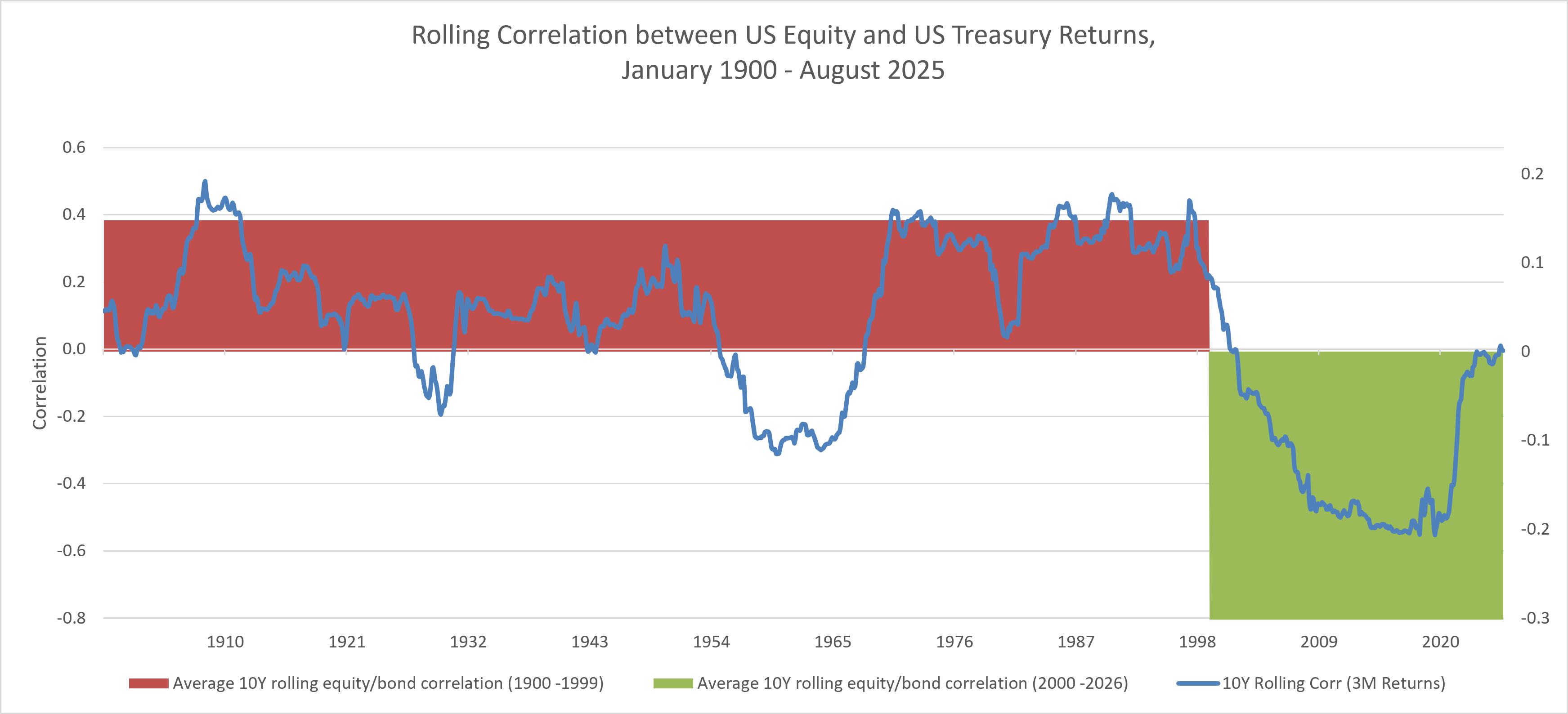
Source: Fortem Capital
“I've been around long enough to know that the period that a lot of people that have worked in finance have experience of – equities and bonds behaving negatively towards one another – hasn't always held true,” he said.
Senior said people assume negative correlation is the norm, when over the long term “that isn’t the case”.
This can be seen more recently. Since 2022, this has reversed again, with equities and bonds moving in the same direction once more. This can be partly linked to inflation, but there are other factors such as geopolitics and monetary policy that also make a difference.
As a result, it is too simplistic to say that inflation (and therefore interest rate) expectations are the determining factor of whether a 60/40 portfolio will provide diversification.
This environment should lend itself to absolute return and alternative strategies, yet an issue that Fortem Capital and other liquid alternative fund houses face is investor apathy towards the asset class, particularly as investors have managed to survive for so long with bonds and equities providing diversification.
The sector also hasn’t helped itself, he noted, with 2020 and the Covid pandemic as an example where markets dropped 35% and volatility doubled almost overnight, yet some absolute return strategies – which should have protected investors – failed to provide the diversification investors expected.
“The whole point about having a diversified portfolio is that things perform in different ways. I think a lot of the disappointment historically with absolute return is that the assumptions around how those products will perform in certain regimes have not actually been the case,” he said.
In addition, investors are having to pay over-the-odds fees for these products. Traditionally, hedge funds used to charge two and 20 – a 2% annual fee and 20% performance fee. This can be down to “one and 10”, said Senior, although he noted that his funds are cheaper still.
This has made these products unviable for most investors and therefore only available to institutional investors, while high fees have been a detriment to the products that are available to everyday investors.
“If you can access those types of strategies more efficiently, then you're going a long way to perhaps addressing some of the disappointment in terms of the high level of costs associated with absolute return,” he said.
Fortem's products typically have an ongoing charges figure (OCF) of around 65 basis points.
Another problem is clarity. One “myth” he pointed to is the belief that hedge fund managers use “sorcery” or a “black box” to make their returns.
“I think it's a myth. I think part of the complexity and all of that is to substantiate, justify and explain performance, or to come up with as many excuses as you can when performance isn't in line with what you said,” Senior suggested.
“The more confusing it is, the more excuses in your toolbox, and the more able you are to justify your ridiculous level of fees. And we're actually being bold enough to say: ‘That's all bollocks’… excuse my language.”
His Fortem Capital Absolute Return fund has produced a 30% return over the past three years, but its solution can be explained simply. It uses a low-cost multi-factor index (which will have higher weightings to areas such as value and quality) and shorts the MSCI World index, which is predominantly driven by growth.
The remaining money is typically held in dollars, which he described as “the defensive currency”.
“I've tried to be relatively simplistic in terms of the factors and the long leg we're trying to isolate. I've been fairly simplistic about the short leg. I've been pretty consistent around the weight on the long and the weight on the short, and therefore what your net is.
“For an investor, they know through time this thing will exhibit, on average, about a 15% to 20% equity market beta, but over the long term it will also harvest these factors, and also harvest the cash, because with a long/short, you can harvest that.
“We really can convey to investors precisely what the different return streams from that investment are and break it down transparently.”