


A balanced portfolio of 60% equities and 40% bonds should make investors 7% per year, according to JP Morgan Asset Management’s Long Term Capital Market Assumptions report.
The study found three main themes shaping the world today that are expected to persist into the future: economic nationalism, technology adoption and capital rewiring. Each impacts different asset classes in unique ways.
Economic nationalism is the understanding that governments need to influence economic activity in the current political climate, in which the international landscape has changed significantly.
The report noted that the “reliability of traditional allies and the prospect of supply chains being weaponised” have caused governments to re-evaluate which strategic activities need to be brought back in-house, such as defence spending and energy.
Turning to the second theme – technology adoption – the report found that the emphasis has shifted from the creation of AI to its integration into broader corporate life.
“Since 2023, we have incorporated incremental upgrades to our total factor productivity (TFP) and capital growth assumptions because of AI’s potential impacts. This year, we have rebuilt our AI methodology to reflect growing evidence of the technology’s impact and faster-than-expected adoption,” the report read.
Lastly, capital rewiring will result from both economic nationalism and technology adoption as both governments and corporates increase spending. Put simply, it means money will move around between sectors and geographies, meaning a broadening out of returns.
“Some of the rewiring will be forced or encouraged. Governments may want to play a role in redirecting capital more actively through a combination of carrots (tax incentives) and sticks (home-bias mandates). ‘Make at home’ and ‘invest at home’ government policies are proliferating,” the report said.
Below, Trustnet looks at how JP Morgan Asset Management experts expect these themes to impact different asset classes.
Government bonds
Economic nationalism should increase the neutral real rate as it is likely to be inflationary in the near-term, before eventually proving disinflationary later down the line.
“Investment in national imperatives – such as energy security, defence and grid and infrastructure upgrades – increases debt loads and tends to push real rates higher,” the report noted, while populist policies, from higher minimum wages to restricted immigration, constrain the labour force and raise costs.
“The result is a steeper curve, with more issuance and a higher inflation risk premium embedded at the long end,” the report said.
Capital rewiring lifts yields through competition for people’s cash. Meanwhile, the normalisation of yields outside the US, driven higher by domestic spending, should erode the real yield advantage of US treasuries versus other countries’ debt.
“We raise our forecast for long-end US yields relative to other developed markets partly because US investment is being repatriated into domestic markets and partly because of higher inflation risk premia,” the report read.
“Still, starting yields and inflation forecasts – as well as forecasts for dollar depreciation – mean a narrow spread of real returns across developed market bond markets and the potential for capital to diversify further across sovereign markets.”
Lastly, technology adoption raises potential growth and the neutral real rate, lifting cash rates as a result. Over the long term, the effects of technology adoption on inflation likely should be flat, but in the short term there are inflationary risks as capital expenditure and power demand squeeze supply chains.
“Later in our horizon, the productivity boost we expect presents a disinflationary risk,” the JPMAM analysts said.
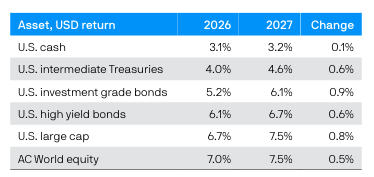
Overall, using US treasuries as a barometer for developed market bonds, the firm expects a long-run average return of 4.6% over the next 10-15 years from government bonds.
Public market return assumption changes vs prior edition of report
Source: JP Morgan Asset Management
Credit
Staying with the US, investment grade bonds are expected to make 6.1% over 10-15 years, while high-yield debt is slightly higher at 6.7%.
“In credit, the building blocks for our forecasts are the underlying sovereign yields, credit spreads and the expected impact of defaults and recoveries,” the report read.
However, the three main themes of the next decade increase dispersion. Economic nationalism and capital rewiring, for example, should generate a structural and growing demand for yield as investors seek income in a higher rate world.
“This hits credit subsectors unevenly,” JPMAM analysts said. They raised both the default and the average spread assumptions for loans where issuance tied to software and AI has surged over the past five years.
High yield is a “more constructive story”, as index quality has improved, with less AI- and software-related issuance and persistently low defaults. In particular, the BB share of the index has risen, lowering spread assumptions and leading to the upgrade of US high yield returns.
Meanwhile, investment grade return expectations are also higher as issuance by hyperscalers should improve the quality and cash flow profile of the index, they said.
Equities
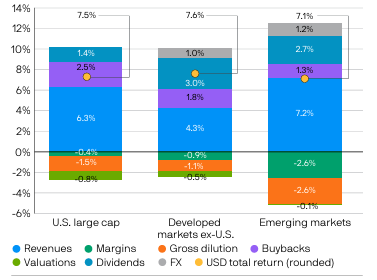
Among stocks, US large-caps are expected to make 7.5%, developed market ex US 7.6% and emerging markets 7.1%, as the chart below shows.
Equity return expectations by region
Source: JP Morgan Asset Management
Technology adoption is the main reason for optimism, with the ongoing capex surge, long-term productivity gains and better margins helping to drive a big re-rating in forecast US equity returns. The shift towards other developed markets should continue, however, as investors seek diversification.
“For US large-cap equity, we lift our long-term revenue growth assumption for the second year running to reflect growing optimism about AI’s revenue-generating potential. We also believe edge-case technologies, like quantum computing, could become feasible within our time frame due to AI advances,” the analysts said.
“We also upgrade our long-term return outlook for developed market equities ex US. The uplift to revenues and margins from tech adoption should be broader and less concentrated than in the US, but still meaningful.”
However, one area that may underwhelm is emerging markets, which represent a drag on performance to the overall equity expectations. In particular, the report highlighted Korea as a stock market that is heavily concentrated in one area within the AI economy: chipmakers.
“These firms win during the AI capex surge, but as capacity is built to meet demand, their profits fade,” the report noted, which means today’s “supernormal profits” will “likely normalise”.