






Being underweight technology is not something you'd expect from a Baillie Gifford fund. But that is exactly where the Baillie Gifford China Growth Trust sits today, even as Chinese AI and semiconductor names have driven much of the market's gains this year.
Fund manager Linda Lin and co-manager Sophie Earnshaw took profits from their tech holdings earlier in the year, redeploying capital into hydropower group Yangtze Power, battery maker CATL and Chinese banks instead. The reason is valuation, with Lin wary of an AI bubble forming, inflated by debt-fuelled spending.
“We're not quite sure when this AI bubble will burst, but we're not comfortable that capex is being supported by leverage and debt. We feel nervous about the AI valuation bubble globally and China is no different,” she said.
Below, Lin explains why investors should have dedicated China exposure, when she would warn of notagainst investing in the region and explains reflects its on performance since Baillie Gifford took over the trust in 2020.
What is your process?
The only thing we care about is whether we can search for the most exciting Chinese growth companies, whether they can grow revenue and whether they can compound earnings. Our growth hurdle is that we want them to double their revenue in the next five years, which is a relatively high hurdle.
We focus on companies in both private and public markets with large market potential, durable competitive advantage and a very strong management team, and we aim to build a relatively concentrated portfolio with our highest conviction ideas, drawing on research from both our China office in Shanghai and the global teams.
Our private company investment experience has led us to start following those companies at an early stage. We can choose to invest in a company at the private stage, wait for the public initial public offering (IPO) or even on the secondary market.
Why should investors buy a China fund?
If you look at the growth company definition, China still offers more than 30% of the growth companies globally. So if you want to hunt for growth, China is the place to go.
But also from a valuation perspective, the entry point to the Chinese market is really important. If you look at the MSCI China index, it's only trading at about 12x [price-to-earnings], compared to 20x globally. It is even much lower than the emerging market index.
So rather than just putting the money into the whole EM basket with some other more expensive countries where the valuation is already priced in, I think China is an interesting starting point to look at as a strong standalone asset class.
Would you warn investors off China if the valuation increased?
Yes, we've been very honest with our clients. If you look at the history, most clients tried to invest in China around 2020 to- 2021, when the valuation shot up a lot, and they've been burned quite badly during that period, to be honest.
If China was trading at a premium compared to other markets, and we thought the growth valuation was quite rich and that we could probably find other areas for better growth ideas at cheaper valuations, we would encourage our clients to cut China and allocate the money somewhere else. But that's not the situation now.
Entry point and valuation are very important when buying Chinese assets. If you look at those investors who allocated assets to China around 2020-2021 the valuation swings during thatose periods were dramatic.
But if you widen the time horizon, I think China as a standalone asset class offers real diversification for global managers, because if you look at China's performance, it actually runs a negative correlation with global markets.
So from an asset-allocator's perspective, China assets can be a diversifier. It's never going to be your major asset but we think the next two to three years is going to be a very exciting period for investors to look at China.
Why should investors choose your trust?
In the trust space there are only three players: Fidelity, JP Morgan and us. If you look at the style [of each], we are the most growth-focused manager in that category.
So if clients really want to look for growth, then come to Baillie Gifford China Growth Trust. If you look for deep value companies, I don't think you need to go to China – you can go somewhere else.
And also, our portfolio can invest in both private and public markets, which has given us some exciting opportunities. Recently we also bought a company called RedNote, which is a consumer super-app in China, it's like Instagram.
How has performance been since you took over the trust in 2020?
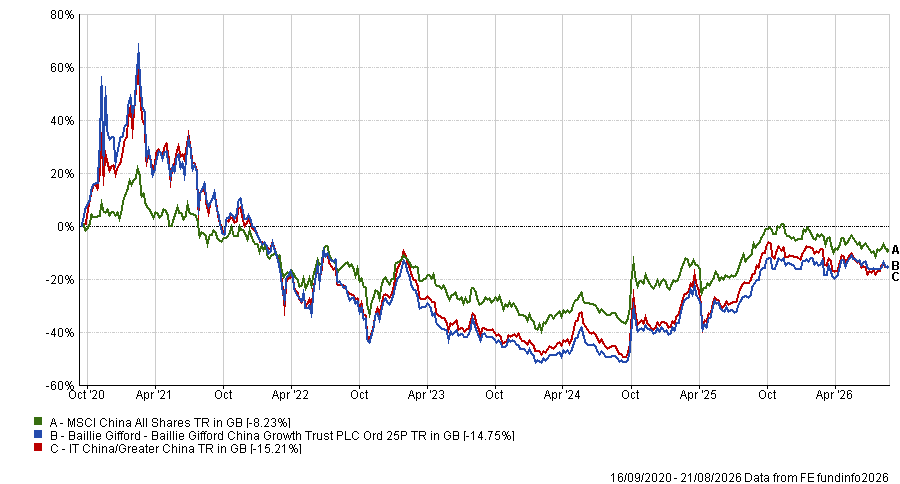
If you look at past performance – three years, one year – we are actually the best-performing trust among the three. Over five years we are the second best [of three, down 23% over the past half a decade].
During the Covid period, and during 2023-2024, everyone told me China was not investable, because growth was broken. The Chinese government was really aggressive towards private companies, there was a regulatory crackdown on the internet sector, and together with the lockdowns and Covid, growth in China was broken. So you can imagine our style was not outperforming during that period.
Performance of fund vs sector and benchmark under Baillie Gifford managers
Source: FE Analytics
Then the inflection point was September 2024 when the government came out and said the regulatory crackdown was over and that private companies would drive the next wave of growth.
What really marked the inflection pointhis was the launch of DeepSeek in January 2025. During that very dark period, people thought China was over [in terms of] AI and, that it would never catch up with the US as it wasn't entitled to receive advanced GPUs, or EUV [lithography machines].
But DeepSeek actually proved that China can use a cost-advantage model to build large language models and that China can achieve technological self-sufficiency in semiconductors. That whole thing drove China's growth engine back. Once the growth style came back, we outperformed our peers.
What have been your best and worst performers so far in 2026?
The best performer [to the end of July] is our private company holding, ByteDance, which has been the largest positive contributor, adding about 1.7 percentage points to relative performance as its valuation increased by 27% over the half year.
Another strong performer from our private holdings, as I mentioned, is the Chinese ‘Instagram’ RedNote. Its numbers performed quite strongly, with the valuation up about 37%.
For listed holdings, China is quite similar to what's happening in Australia, Korea and Taiwan. All the AI-related names have been doing really well. There are two separate tracks: one is the Nvidia supply chain, where there are lots of Chinese players, like optical component companies, supplying the Nvidia supply chain.
And on the China AI/semiconductor supply chain side, we've invested a lot in local champions. China can't get EUV [lithography machines] from ASML, so instead, the local DUV [lithography machines] players have been doing really well. So that's the relative positive contribution to performance.
On the detractor side, I'd say the link to the economy is a K-shaped one, because technology has been really strong everywhere but it's not linked to the consumption market, which was relatively weak in the first half of this year.
So the detractors were, first, Pop Mart, the Labubu story, and second, Zijin Gold, one of the major global gold miners from China. The gold price dropped dramatically in the first half.
What do you do outside fund management?
I like travelling and cooking. I grew up in China, but I moved to New Zealand when I was young, and then I moved to the UK, so I've travelled a lot around the world, and I also studied Eastern culture at university. So culture and food.